For sure, but people have lots of incentives to do farming and stuff even without the profit motive, otherwise human civilization wouldn’t have made it out of the paleolithic era. Humans are actually the most co-operative species on the planet, it’s biologically hard wired into us to work together to improve our living conditions for our communities and to share what we have with others.
This altruistic instinct rapidly tapers beyond one’s immediate community. Sure, we have the instinct to try helping others, even those who are very distant. But without reinforcement of our good behaviors, any given behavior will peter out.
Like, suppose you are making enough money to live comfortably. You then hear about a charity that builds wells to provide clean drinking water to people in impoverished parts of the world, and decide you can spare $5 per month to help them. So you donate $5. However, this charity focuses entirely on doing the actual charitable work, so you have to remember to donate and manually type in your credit card information each month. And they don’t do any PR. No monthly emails with personal stories about the people they helped or anything like that. Instead, they simply have a publicly accessible spreadsheet that has data on wells built and people served. Almost everyone would stop donating to this charity after a month or two, simply because they would forget or procrastinate until they forget, because our brains don’t assign relevance to things which don’t create an emotional impression on us. Compare this with, say, helping your child and their new partner build a home with your own hands. This kind of project provides lots of positive reinforcement - exercise, time outside, time spent with others, seeing progress being made day by day, the appreciation of others, the knowledge that you have helped someone who is important to you.
Hence why most people find most jobs to be unpleasant in one way or another. Not many people want to spend their days pumping a stranger’s septic system. The unpleasant work (aka, “work”) is what is left over after everyone does the pleasant work for free.
Also, some anthropologists theorize that the beginning of labor intensive agriculture and large permanent settlements was only possible via forced labor, coerced by violent, authoritarian leaders. Evidence shows that early agrarian life was significantly worse in just about every way than nomadic hunter-gatherer life, which explains why hunter-gatherer tribes almost universally fought against or fled from agrarian settlements.
Do you not believe that we can structure society in such a way that our best instincts are leveraged for the benefit of as many people as possible, rather than leveraging our worst instincts for the benefit of a select few?
If you say so! I think the claims implied by my statement are pretty self-evident, but if there’s something specific you take issue with, I’d welcome a discussion on it. I am always more than willing and able to defend my positions.


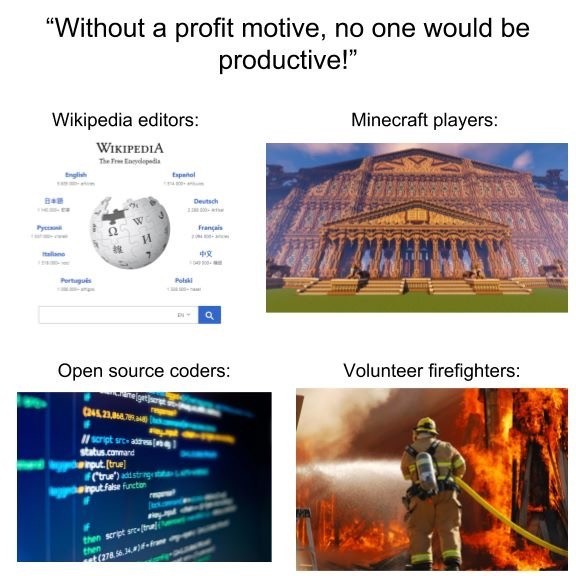
For sure, but people have lots of incentives to do farming and stuff even without the profit motive, otherwise human civilization wouldn’t have made it out of the paleolithic era. Humans are actually the most co-operative species on the planet, it’s biologically hard wired into us to work together to improve our living conditions for our communities and to share what we have with others.
This altruistic instinct rapidly tapers beyond one’s immediate community. Sure, we have the instinct to try helping others, even those who are very distant. But without reinforcement of our good behaviors, any given behavior will peter out.
Like, suppose you are making enough money to live comfortably. You then hear about a charity that builds wells to provide clean drinking water to people in impoverished parts of the world, and decide you can spare $5 per month to help them. So you donate $5. However, this charity focuses entirely on doing the actual charitable work, so you have to remember to donate and manually type in your credit card information each month. And they don’t do any PR. No monthly emails with personal stories about the people they helped or anything like that. Instead, they simply have a publicly accessible spreadsheet that has data on wells built and people served. Almost everyone would stop donating to this charity after a month or two, simply because they would forget or procrastinate until they forget, because our brains don’t assign relevance to things which don’t create an emotional impression on us. Compare this with, say, helping your child and their new partner build a home with your own hands. This kind of project provides lots of positive reinforcement - exercise, time outside, time spent with others, seeing progress being made day by day, the appreciation of others, the knowledge that you have helped someone who is important to you.
Hence why most people find most jobs to be unpleasant in one way or another. Not many people want to spend their days pumping a stranger’s septic system. The unpleasant work (aka, “work”) is what is left over after everyone does the pleasant work for free.
Also, some anthropologists theorize that the beginning of labor intensive agriculture and large permanent settlements was only possible via forced labor, coerced by violent, authoritarian leaders. Evidence shows that early agrarian life was significantly worse in just about every way than nomadic hunter-gatherer life, which explains why hunter-gatherer tribes almost universally fought against or fled from agrarian settlements.
Do you not believe that we can structure society in such a way that our best instincts are leveraged for the benefit of as many people as possible, rather than leveraging our worst instincts for the benefit of a select few?
You managed to cram an impressive amount of false dichotomies and unfounded assumptions into a single sentence.
If you say so! I think the claims implied by my statement are pretty self-evident, but if there’s something specific you take issue with, I’d welcome a discussion on it. I am always more than willing and able to defend my positions.