
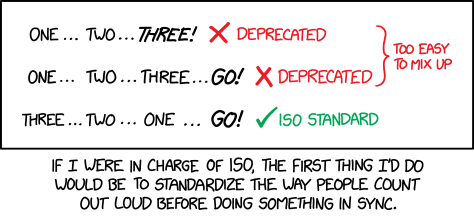
xkcd #3232: Countdown Standard
Title text:
Anyone who is caught counting ‘three … two … one … zero … GO!’ will be punished with a lifetime of eating only ISO standard food samples.
Transcript:
Transcript will show once it’s been added to explainxkcd.com
Source: https://xkcd.com/3232/
I’ve been through this conversation so many times it haunts me. What I’ve found is that people don’t use that verbiage outside of casual conversation, so when they misunderstand each other nothing comes of it, so they never find out. Someone triples his salary and tells you “I’m making two times more now!” and you think “Cool, he doubled his salary” and never find out that you misunderstood each other.
Once I walked around with my best friend after having this exact disagreement and polled people at work for their thoughts. The vast majority went by my understanding, as do any grammar authors you can find online. It just never comes up unless someone like me makes a whole thing about it.
You are correct in that enough people share the misunderstanding that it becomes technically correct use of language, like using “literally” to mean “not literally”.
It’s clear use of language though, more than means a number is more than another.
Pete has —— more apples than John.
P = J + (described amount)
(3) more > P = J + (3)
(2 times or 200%) more > P = J + (200% J) = 300% J
If you want to say they are interchangeable, you are saying “50% more” and “50% as much” mean the same thing.
Certainly agree that I’ve never asked or been asked about this before!
My original thing, though, was that it couldn’t be used interchangeably for fractions or percentages, but could for whole numbers. So your example with 50% clearly doesn’t work, but 3 times more and 3 times as much could more easily mean the same thing.