I’m sorry but this is just ridiculous. I’ll address the size later, because it requires history.
How do you measure authoritarianism? Number of people managed by the criminal justice system? The amount of population managed by US criminal justice is 300% bigger than anyone else. Russia and China don’t even come close to that. The US is also the only country charging its prisoners hundreds of dollars a day to be in prison and then dominating them to pay back that debt after they get out.
The US policing system is the 3rd or 4th largest military budget in the world. That doesn’t include the budget for the prison system.
The US has engaged in wars of choice and acts of aggression against 14 countries since 1992. Russia has engaged with 3, all of them border disputes stemming from the fall of the USSR. China hasn’t dropped a bomb or fired on a ship since 1989.
By most reasonable measures, the imperial core is far more authoritarian than either China or Russia. The difference in application of authority is primarily the difference between being in the imperial core where you aren’t ever going to be attacked and being outside the empire where the empire has you surrounded with 600 military bases, nuclear missiles, and 60+ years of covert operations hell bent on toppling your country.
As for size…
Russia is predominantly uninhabited land. 80% of Russia’s population lives in the European part of Russia. The rest of Russia is and always has been very very sparsely populated. By way of comparison, historians estimate that there were 10M people living North of Mexico before European genocide, whereas in Russia it was less than 1M people before the Eastern Slavs of Europe migrated and established agriculture in what is modern day Russia. Russian imperialism was predominantly applied to territory and people that today you know and understand to be literally fully recognized independent nation-states: Latvia, Estonia, Poland, Belarus, Georgia, Azerbaijan. The fact that these nation-states exist now instead of being part of Russia is exactly what it means for the empire to be dismantled and sovereignty returned to the people. The Bolshevik revolution of 1917 was anti-imperialist in this exact way. Nearly every single one of these countries were part of the Tsarist empire prior to the communists coming to power. With the communists in power, they established independent national republics for each of these, building them governments for self-administration and generally setting up everything they would need to become independent states when the USSR eventually dissolved. The Tsarists also engaged in heavy Russification, crushing ethnicities, while the Bolsheviks literally funded the creation of national alphabets and dictionaries for the formerly subjugated nations, required all schooling to be in local languages instead of Russian, etc.
In short, Russia’s size has nothing to do with imperialism.
As for China, the story is different but similar. There are 5 autonomous regions on China. If you remove them, China becomes significantly smaller than Europe. The difference here is philosophical driven by geography. Compare European geography to Chinese geography and you see that Europe is replete with physical division that fundamentally limits the scope of European warlords to smaller territories. Chinese geography is basically a big open plain surrounded by barriers, which meant that a single warload could build momentum and roll the entire joint. Both of these things happened in their respective locations multiple times. As such, ancient political philosophies diverged along these lines, with ancient European political philosophy favoring many small independent states mapped to ethnicities (and thus war is violation of sovereignty) and ancient Chinese political philosophy favoring pluralistic society with many ethnicities living in unity (and thus war is bad for the collective).
When we add back in the 5 autonomous regions, China’s size becomes very large. The regions are 45% of China’s total landmass. However, they only make up 10% of the population, because like the vastness of Russia, most of the autonomous regions are uninhabited or very very sparsely inhabited. And this is actually quite important for understanding why they are autonomous regions and not fully independent nation-states. Like Greenland, the autonomous regions are not populous enough to field military capable of defending against outside aggression, and that means, like Greenland, their stability relies on being a protectorate. Tibet became a protectorate under the Chinese dynastic umbrella of protection when the Mongols invaded in the 1700s. Prior to that, Tibet and China were independent and happy to be so. But the invasion by the Mongols was too much for Tibet and they requested the Qing Dynasty to protect them. The Qing came in, saved Tibet, and established a protectorate because Tibet clearly could not defend itself from invading forces as the gunpowder revolution and industrialization were underway. It was either let Tibet get taken over and over again or establish a standing protectorate and let Tibet be autonomous within that structure. That’s the current state.
Inner Mongolia and Xinjiang are much closer to imperial holdings, with Xinjiang being a highly pluralistic crossroads of warring states and Inner Mongolia being a clear borderland integration as the imperialist Mongols fell apart. The fact that they are autonomous regions is a testament to this. Inner Mongolia is essentially defined by the Gobi. While it was historically occupied and controlled by the Mongols broadly speaking, it’s geography is much more integrated with the inner bowl of China. That it was Mongol is more of political warring thing that an indigeneity thing. Xinjiang similarly does not have a national character, being far more pluralistic as a borderlands between many nations. Both of these are autonomous regions for the express region that they aren’t fundamentally occupied foreign nations but rather territory that historically had distinct pluralistic cultures with distinct governance models. Establishing them as autonomous regions is the exact opposite of imperialism.
The other 2 autonomous regions are further evidence against imperialism. Both of them are separate governing structures for different ethnic minorities, elevating their cultural histories and investing in cultural institutions and local economies. Basically anti-imperialist behavior.


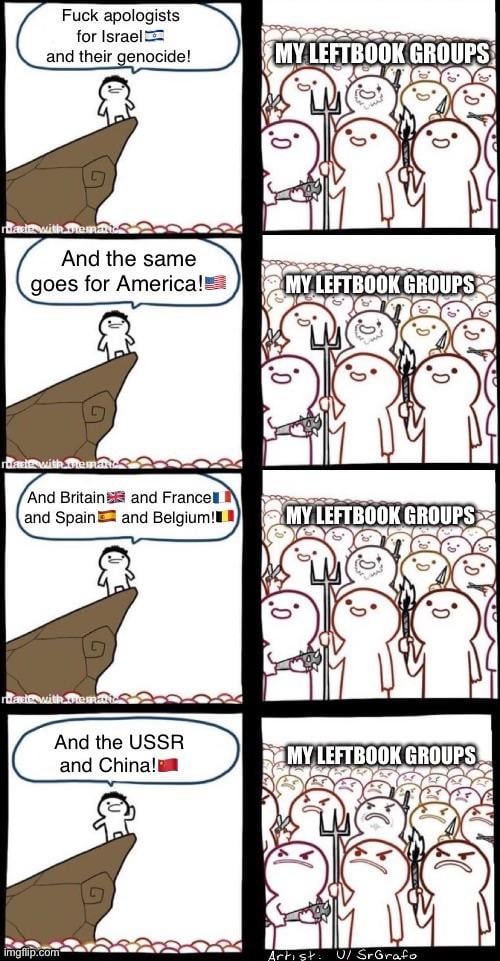
Right, they have their own imperialists projects.
How tf do you think they got so huge and authoritarian?
I’m sorry but this is just ridiculous. I’ll address the size later, because it requires history.
How do you measure authoritarianism? Number of people managed by the criminal justice system? The amount of population managed by US criminal justice is 300% bigger than anyone else. Russia and China don’t even come close to that. The US is also the only country charging its prisoners hundreds of dollars a day to be in prison and then dominating them to pay back that debt after they get out.
The US policing system is the 3rd or 4th largest military budget in the world. That doesn’t include the budget for the prison system.
The US has engaged in wars of choice and acts of aggression against 14 countries since 1992. Russia has engaged with 3, all of them border disputes stemming from the fall of the USSR. China hasn’t dropped a bomb or fired on a ship since 1989.
By most reasonable measures, the imperial core is far more authoritarian than either China or Russia. The difference in application of authority is primarily the difference between being in the imperial core where you aren’t ever going to be attacked and being outside the empire where the empire has you surrounded with 600 military bases, nuclear missiles, and 60+ years of covert operations hell bent on toppling your country.
As for size…
Russia is predominantly uninhabited land. 80% of Russia’s population lives in the European part of Russia. The rest of Russia is and always has been very very sparsely populated. By way of comparison, historians estimate that there were 10M people living North of Mexico before European genocide, whereas in Russia it was less than 1M people before the Eastern Slavs of Europe migrated and established agriculture in what is modern day Russia. Russian imperialism was predominantly applied to territory and people that today you know and understand to be literally fully recognized independent nation-states: Latvia, Estonia, Poland, Belarus, Georgia, Azerbaijan. The fact that these nation-states exist now instead of being part of Russia is exactly what it means for the empire to be dismantled and sovereignty returned to the people. The Bolshevik revolution of 1917 was anti-imperialist in this exact way. Nearly every single one of these countries were part of the Tsarist empire prior to the communists coming to power. With the communists in power, they established independent national republics for each of these, building them governments for self-administration and generally setting up everything they would need to become independent states when the USSR eventually dissolved. The Tsarists also engaged in heavy Russification, crushing ethnicities, while the Bolsheviks literally funded the creation of national alphabets and dictionaries for the formerly subjugated nations, required all schooling to be in local languages instead of Russian, etc.
In short, Russia’s size has nothing to do with imperialism.
As for China, the story is different but similar. There are 5 autonomous regions on China. If you remove them, China becomes significantly smaller than Europe. The difference here is philosophical driven by geography. Compare European geography to Chinese geography and you see that Europe is replete with physical division that fundamentally limits the scope of European warlords to smaller territories. Chinese geography is basically a big open plain surrounded by barriers, which meant that a single warload could build momentum and roll the entire joint. Both of these things happened in their respective locations multiple times. As such, ancient political philosophies diverged along these lines, with ancient European political philosophy favoring many small independent states mapped to ethnicities (and thus war is violation of sovereignty) and ancient Chinese political philosophy favoring pluralistic society with many ethnicities living in unity (and thus war is bad for the collective).
When we add back in the 5 autonomous regions, China’s size becomes very large. The regions are 45% of China’s total landmass. However, they only make up 10% of the population, because like the vastness of Russia, most of the autonomous regions are uninhabited or very very sparsely inhabited. And this is actually quite important for understanding why they are autonomous regions and not fully independent nation-states. Like Greenland, the autonomous regions are not populous enough to field military capable of defending against outside aggression, and that means, like Greenland, their stability relies on being a protectorate. Tibet became a protectorate under the Chinese dynastic umbrella of protection when the Mongols invaded in the 1700s. Prior to that, Tibet and China were independent and happy to be so. But the invasion by the Mongols was too much for Tibet and they requested the Qing Dynasty to protect them. The Qing came in, saved Tibet, and established a protectorate because Tibet clearly could not defend itself from invading forces as the gunpowder revolution and industrialization were underway. It was either let Tibet get taken over and over again or establish a standing protectorate and let Tibet be autonomous within that structure. That’s the current state.
Inner Mongolia and Xinjiang are much closer to imperial holdings, with Xinjiang being a highly pluralistic crossroads of warring states and Inner Mongolia being a clear borderland integration as the imperialist Mongols fell apart. The fact that they are autonomous regions is a testament to this. Inner Mongolia is essentially defined by the Gobi. While it was historically occupied and controlled by the Mongols broadly speaking, it’s geography is much more integrated with the inner bowl of China. That it was Mongol is more of political warring thing that an indigeneity thing. Xinjiang similarly does not have a national character, being far more pluralistic as a borderlands between many nations. Both of these are autonomous regions for the express region that they aren’t fundamentally occupied foreign nations but rather territory that historically had distinct pluralistic cultures with distinct governance models. Establishing them as autonomous regions is the exact opposite of imperialism.
The other 2 autonomous regions are further evidence against imperialism. Both of them are separate governing structures for different ethnic minorities, elevating their cultural histories and investing in cultural institutions and local economies. Basically anti-imperialist behavior.