I learnt to “type” when I was at school, programming a Commodore Vic-20. I thought I was quite fast, but what I had really learnt was just the key combos for common words. It’s what most people who have never learnt properly before do, and it’s called “point and poke”. You don’t realise the extra effort you’re putting in, and the mistakes you’re making (overuse of the backspace key) and so on.
When I went to college at 16 (UK) to study computer science, we had the option of learning touch typing. We all thought we were pretty good at typing, but afterwards, we’d all doubled our typing speed (or more) and increased our accuracy by 10x. We learnt on proper electric golfball typewriters, and as we got better, we all noticed that code entry got a lot faster. The thing that is affected most, though, is typing up from notes or printed copy - because you don’t have to keep looking away from the source, back to the keyboard and screen, you can be much quicker. Also, typing your thoughts is much faster as you are not having to split your attention between the thoughts and the keyboard - what you think just appears on the screen without having to spend mental effort on typing.
I feel like we’re talking about two different things. Touch typing, regardless of the technique used, only implies looking away from the keyboard. If you’ve got the muscle memory, and instinctively know where keys are, whether that’s through technique or reinforced familarity, you can look wherever you want.
Yeah, you and all the people you’re responding to are talking about different things.
They’re talking about touch typing, a noun with a specific definition and meaning referring to a technique, instructional method and practice and you’re talking about what you think words should mean.


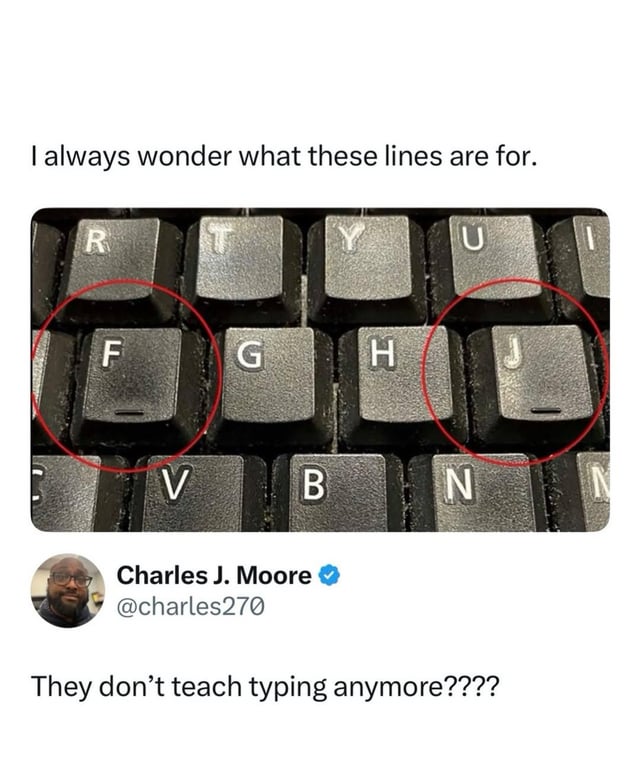
I learnt to “type” when I was at school, programming a Commodore Vic-20. I thought I was quite fast, but what I had really learnt was just the key combos for common words. It’s what most people who have never learnt properly before do, and it’s called “point and poke”. You don’t realise the extra effort you’re putting in, and the mistakes you’re making (overuse of the backspace key) and so on.
When I went to college at 16 (UK) to study computer science, we had the option of learning touch typing. We all thought we were pretty good at typing, but afterwards, we’d all doubled our typing speed (or more) and increased our accuracy by 10x. We learnt on proper electric golfball typewriters, and as we got better, we all noticed that code entry got a lot faster. The thing that is affected most, though, is typing up from notes or printed copy - because you don’t have to keep looking away from the source, back to the keyboard and screen, you can be much quicker. Also, typing your thoughts is much faster as you are not having to split your attention between the thoughts and the keyboard - what you think just appears on the screen without having to spend mental effort on typing.
I feel like we’re talking about two different things. Touch typing, regardless of the technique used, only implies looking away from the keyboard. If you’ve got the muscle memory, and instinctively know where keys are, whether that’s through technique or reinforced familarity, you can look wherever you want.
Yeah, you and all the people you’re responding to are talking about different things.
They’re talking about touch typing, a noun with a specific definition and meaning referring to a technique, instructional method and practice and you’re talking about what you think words should mean.