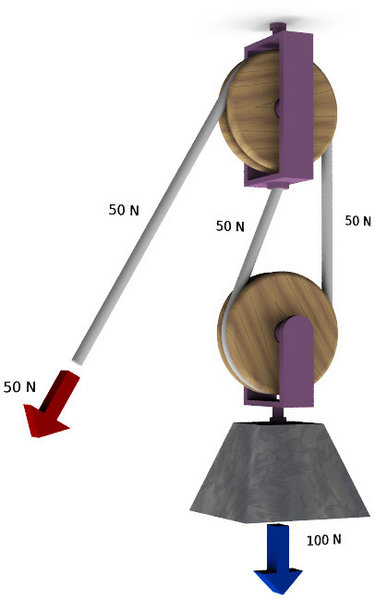
A gun tackle has a single pulley in both the fixed and moving blocks with 2 rope parts dividing the load of 100N. The mechanical advantage is 2, requiring a force of only 50N to lift the load.
Author: César Rincón
What’s the force in this point?
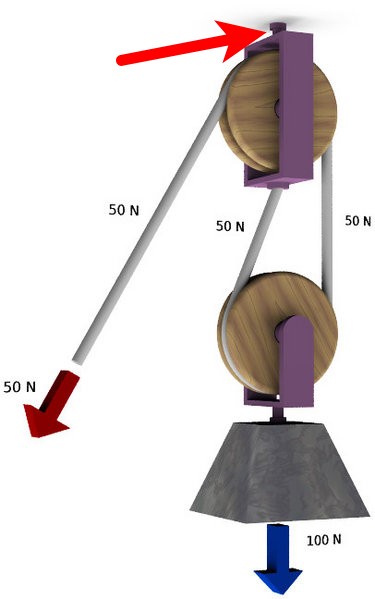
Somewhere between 100-150 N of downward force, depends on the angle that the rope on the left is being pulled at
I don’t think it can get as low as 100N, for that you would have to pull completely upwards. The shadow in the image implies a ceiling, so ~112N if we take 90° as the max angle. The 150N would be the only case with a completely downward force, if you pull at another angle the resulting force vector will be angled as well.
Yea that’s why I said max down force, didn’t want to do the math to find the resultant for a 90 degree to the left pull
Wouldn’t it depend on how fast that rope is pulled too, adding in the acceleration of the mass (or are you considering that with your range of 100-150)?
Nope. Right now the system is balanced, the rope is not being pulled just hold. To pull the weight up you need more than 50N, plus a bit more if we take into consideration the friction in the pulleys and in the rope itself.
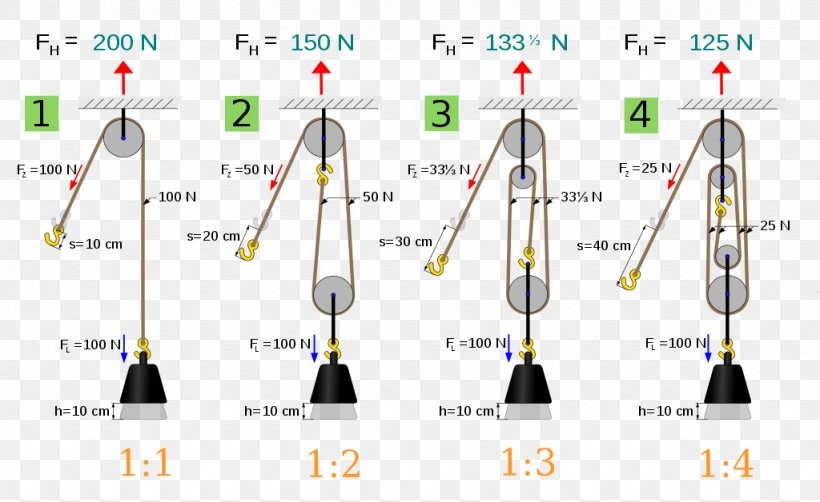
Okay, I’ve found a nice picture for it. Whoever sad 150 N (with the 180° angle, less with other angles) was right, and the rest of us were wrong :)
It should be 50 N assuming ideal system (0 pulley traction), right? What about non-ideal systems?
Wouldn’t it be 100, same as the mass being lifted (well more really, depending on the acceleration of that mass)?
No, the other commenters are right — it’s between 100 and 150 depending on the angle. And it’s like this because we have 50 N + 50 N on both sides of the top pulley (classic pulley thing) + 50 N more attached to it at the bottom. Kinda confusing at first, not gonna lie :)