As much as economists like to pretend, capitalism is not a political system. The goal is exploitation because we choose so. As a society we could just as easily choose to make our goal the maximal fulfillment of the needs of the public. All that takes is preventing those without a personal concept of “enough” from controlling capital.
Capitalism is an exploitation system. It will exploitation what it needs to, to ensure it continues. If that is policies then it will do so. Preventing those without the concept of enough from controlling capital is an an uphill battle. Easier said than done
Theft and rape get muddy but we still prosecute those. Society needs to draw a line somewhere.
For example say 100% tax after $50 million net worth. Or 1 year in jail for executive officers of a company if the net income (stock counts as income valued at the price when acquired) of the highest paid person in a company makes more than 30x the lowest paid person. Or we just drone strike Forbes richest person every year. We just need to draw a line.
That’s just not possible when you factor in both accumulation of wealth (it’s exponential like compound interest) and the competition between capitalists for profit. The competition does not come from their moral beliefs but from the incentives created by the system itself.
All that takes is preventing those without a personal concept of “enough” from controlling capital.
This would require to remove capital from the hands of individuals and either throw it in the hands of the state, or change its (corporate) ownership to co-op model (one worker - one vote). Both have been shown to work but that would no longer be capitalism but instead a form of socialism, as private capital would no longer dictate what’s produced in the economy and how it’s distributed. Instead it would be dictated by the state which is controlled by the people through some form of democracy, or democratically by the workers within each corporation, or both. In both cases what’s produced is dictated by the needs of the majority of the workers in that state. And that’s textbook socialism.
Das Kapital was published in 1867. Modern psychology is considered to have begun in 1879. The first DSM was not published til 1952. Marx understood economics but he has an archaic understanding of human psychology which cripples his work.
Modern economic theory incorporates behavioral economics. In reality people don’t always act rationally or optimally. Time restraints, cognitive limitations, emotional attachment, and trauma all affect decision making.
We are living in an example of how the working class will vote against their own material interests and how deprivation of resources doesn’t inevitably lead to a proletariat uprising.
Nowhere within Capital does Marx actually say proletarian uprising is inevitable; he arguably alludes to this in the Afterword to the Second German Ed. but it’s actually a difficult question whether proletarian revolution is inevitable in Marxism in the first place.
It was obviously known in Marx’s time that people don’t always act rationally or optimally. This isn’t the basis for Marx’s theory.
None of that goes against Marx, though. Marxist economics does not depend on people acting rationally 100% of the time. The working classes do not control bourgeois elections, the fact that you think this is a point against Marx points to unfamiliarity with Marxism more than anything.
You keep ignoring large parts of my argument. Think about how wrong the understanding of biology that doctors had in the 1860-70s compared to what we do now. Marx had the equivalent lack of knowledge about human psychology. His theories do not accurately describe human behavior on a fundamental level.
Marx did not understand the psychological and sociological needs that religion fulfills (I.e. fear of death). He confuses properties of Judeo-Christian religions as being universal to religion itself. Did most pre Columbian Native American faiths struggle with the exploitation of the proletariat? No. If anything several were closer to the Marxist ideal of a classless society than any attempts at communism.
The working classes do not control bourgeois elections,
I have asked you several times to explain how Marx’s theories do not accurately describe human behavior on a fundamental level, not to simply restate your thesis over and over. There’s nothing to work with here. As for how religion works, Marx was analyzing the context of contemporary (to him) religion, not historical religion, with respect to the proletariat. Plus, Marx analyzed what he called “primitive communism,” the very early communalist societies you’re referencing here. These are not the same as communism, the future fully collectivized global system, but they do “rhyme” with it. Further, pointing out that the working classes do not actually control anything in capitalism isn’t an excuse, it’s a core denial of your central idea.
I am not ignoring your argument, it’s abundantly clear that you don’t actually have the familiarity with Marx to be able to make blanket claims about the viability of his theories.
Accumulated wealth is a choice. We can tax inheritance at 100% beyond a certain point (say 100,000x the federal minimum wage).
The competition does not come from their moral beliefs but from the incentives created by the system itself.
Disagree. It is a choice to not say to yourself “I have enough. I am stopping work and donating all this wealth I don’t need to charity.” It is a choice not to make your fortune, retire, and then give ownership of the company to the employees who made you successful. Society once chose to treat homosexuality as a mental illness. No reason we couldn’t do the same for greed.
We say people can’t use slave labor. We say kids can’t work. There is no reason we couldn’t say people above a certain wealth threshold can’t work. That’s just regulation, not socialism.
You cannot separate economics from politics, they are infinitely intertwined. The only way to actually control political economy by humans, rather than the capitalist control system, is through socialism. Collectivizing production and distribution and running it on a common plan, rather than profit, is the path to overcoming the way the profit motive shapes society and the state.
The fundamental problem is scarcity. If someone has to choose between themselves experiencing scarcity or someone else, people will almost always choose someone else. In that sense profit will always exist.
Personally I see capitalism and socialism as tools which can each be used when appropriate. Capitalism is great for getting 30 flavors of breakfast cereal (innovation with failure being acceptable). Socialism is great for things like healthcare or firefighting (failure is not acceptable, innovation not essential).
With the fire department , the government owns the means of production (fire houses, trucks, etc) and sets the prices instead of the free market (paid for by taxes). That is socialism. Public healthcare may or may not be depending on what system it is.
Because this isn’t what socialism is. State ownership/price regulation by itself isn’t necessarily socialist or capitalist. It can be used to expand/reinforce market freedom or to undermine it.
That isn’t capitalism or socialism. Both are modes of production dependent on which aspect of the economy is principal, ie rising and dominant, and which class controls the state. You’re horribly mixing up welfare for socialism.
Both are modes of production dependent on which aspect of the economy is principal,
which class controls the state
This is an interesting element. The USSR under Stalin was controlled by a few elites. That doesn’t make it capitalist. The US is a democracy, so it is controlled by the people . That doesn’t make it socialist. An economic system is not a political system and vice versa.
Welfare can be a part of a capitalist or socialist system, but is not those systems itself. You are trying to slice up parts of a cohesive system and treat those constituent parts as though they form an independent system themselves, but this is incorrect. The consequences of this error result in confused understandings of bodies like the US military as “socialism,” despite being a tool of monopoly finance capital. This is why the identity of an overall system is in its principal aspect, as this principal aspect determines how the rest of the system functions.
As for the USSR, it was run by the working classes. Classes are relations to ownership of production and distribution, not simply income levels or levels of administrative authority. You are referring to workers in the central committee and CPSU as “elites,” yet they were paid wages and did not own any capital. Just like a principal is the same class as a teacher, so too are administrators in socialist economies the same class as factory workers. The USSR had a form of democracy that began at the local level, and laddered upwards through councils called Soviets.
The US Empire is not democratic. The only viable political parties are those run and owned by capitalists, so candidates are representatives of that class. The media is owned by the capitalist class as well. The majority does not run society, they pick between outcomes already decided as okay by the capitalist class.
In trying to slice up systems and pretend there is no meaningful interaction between these, and that instead these systems are functionally independent, you are making metaphysical errors in analysis.
You are trying to slice up parts of a cohesive system and treat those constituent parts as though they form an independent system themselves, but this is incorrect.
Ah, I see the issue here. I am not arguing that the system is entirely capitalist or socialist. I am arguing that a system can contain sectors that operate under one system while other sectors operate under the other. The “principal aspect” certainly applies as a general description of the whole, but that doesn’t change the nature of individual elements.
Classes are relations to ownership of production and distribution, not simply income levels or levels of administrative authority
I would argue classes are determined by power. In the USSR, the power was held by the government and organized crime, not workers.
The US is a democratic republic. No matter how much capital you have, you can’t gain power without convincing people to vote for you. Granted money makes this easier, but it is not sure thing. Look at Elon Musk. He tried to use his money to force his way into government with that DOGE thing, but it failed miserably and he was pushed back.
The majority does not run society, they pick between outcomes already decided as okay by the capitalist class.
Was it any different in the USSR with the party making all the choices? Power always sets up the game board we all play on.
The principal aspect of the economy is the driving force of the economy, and determines the direction in which it develops. It does not change whether private property is private or not, but it does determine what that private property is submitted to, either it’s dominant over the economy or it’s submissive to it. To see this in practice, you can look at the FDA, and how it’s in bed with big pharma to secure drug patents and help profits over the people. This is not socialism and capitalism working together, but public property helping the dominant private property in the context of a capitalist system.
Classes are not something as vague as “power.” The reason classes are directly related to ownership of the means of production is because classes have shared class interests. The USSR was governed by the working classes, with the most energetic among them elected to become members of the Communist Party, upon which they were subjected to criticism if they did not perform well. The party regularly purged those the working classes did not support, and replenished its ranks from the rest of the working classes.
The US is a dictatorship of capital, and is far less democratic than the USSR was. Even your example of Elon Musk is horribly flawed, he was not kicked out by workers, but by rival capitalists. The class dictatorship of the US always supports that class, not necessarily any and all individuals belonging to that class. This is why class analysis is important.
And to answer your question, yes, it was very different in the USSR. Factory councils, village committees, and more were run democratically. Administration was highly veted and came from the best among the working classes, and the members of the party were subject to open criticism. Corruption often came, as it does in any society, but the CPSU made a deliberate effort to kick out lazy and corrupt officials, and replenish their ranks from the working classes. This is why the Soviet Union was run by engineers, professors, miners, factory workers, and more, not capitalists like the US.
This is not socialism and capitalism working together, but public property helping the dominant private property in the context of a capitalist system.
Corruption is a problem with any system. Capitalism or communism is irrelevant. Marx would probably argue that greed is a social construct, but I think psychology has conclusively shown that while elements of greed are social, it is fundamentally an evolutionary adaptation (as is altruism).
The reason classes are directly related to ownership of the means of production is because classes have shared class interests.
Ownership of the means of production is just a type of power. It is the power to grant or deprive others of resources. Shared interests by class is another falsehood bred from lack of psychological understanding by Marx. A black woman who works at a grocery store in a city and a white male farmer from a rural area are the same class to Marx. However their interests are vastly different because of intersectionality (which Marx had no way to know about).
The US is a dictatorship of capital, and is far less democratic than the USSR was.
The USSR was on no way democratic. It was an authoritarian state with one party who regularly presented voters with one single party-approved candidate to vote for. The public was not allows fundamental democratic principles like freedom of speech or independent political opposition. Stalin literally won 100% of the vote because of uncontested elections.
The US political system is heavily impacted by capital, but capital isn’t a single entity. It is a wide range of groups with a wide range of conflicting interests. Beyond limiting government regulation of capital and taxation, they rarely agree. Capital spends heavily influencing voters opinions, BUT the voters do still vote and those votes are counted honestly. We absolutely need to get money out of politics and we need to get rid of first past the post style voting. That being said, we are a democracy. And imperfect democracy, but a democracy.
Exploitation is fundamental to the existence of capitalism, it cannot exist without it, at least in my opinion, and the opinion of many other economists.
In neoclassical economics (or at least to plenty of neoclassical economists - neoclassical being the prevalent theory in modern western society), the term “exploitation” refers to the exploitation of labour, which is when wages are lower than the marginal productivity of labour.
To put it simply, surplus value is the difference between the value added by the labourer (for example, the assembly of car parts into a car, or turning raw materials into a product), and the wages they are paid.
Surplus value also has another name: profit.
The whole basis of capitalist economics is to prioritize, reward and encourage the maximization of profit. Based on my statements above, there is only one way to do that: exploiting labour. Thus, exploitation is not only prevalent in capitalism, but encouraged, rewarded, and required, otherwise the business will fail because it cannot keep up.
The definition of capitalism has nothing to do with how the profits are distributed. As long as individuals or businesses own the means of production and prices are determined by the free market rather than the government, that is capitalism.


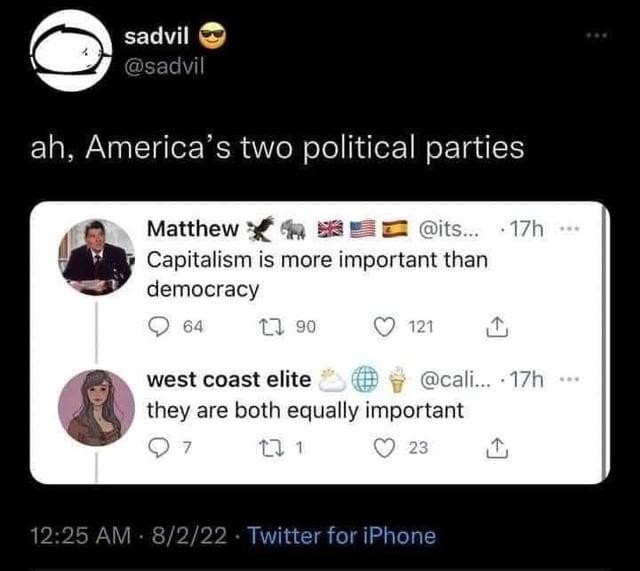
As much as economists like to pretend, capitalism is not a political system. The goal is exploitation because we choose so. As a society we could just as easily choose to make our goal the maximal fulfillment of the needs of the public. All that takes is preventing those without a personal concept of “enough” from controlling capital.
Capitalism is an exploitation system. It will exploitation what it needs to, to ensure it continues. If that is policies then it will do so. Preventing those without the concept of enough from controlling capital is an an uphill battle. Easier said than done
Not if you make greed a capital offense (pun intended).
Sure but who will enforce that what is defined as greed? It gets very muddy
Theft and rape get muddy but we still prosecute those. Society needs to draw a line somewhere.
For example say 100% tax after $50 million net worth. Or 1 year in jail for executive officers of a company if the net income (stock counts as income valued at the price when acquired) of the highest paid person in a company makes more than 30x the lowest paid person. Or we just drone strike Forbes richest person every year. We just need to draw a line.
Love that idea!
That’s just not possible when you factor in both accumulation of wealth (it’s exponential like compound interest) and the competition between capitalists for profit. The competition does not come from their moral beliefs but from the incentives created by the system itself.
This would require to remove capital from the hands of individuals and either throw it in the hands of the state, or change its (corporate) ownership to co-op model (one worker - one vote). Both have been shown to work but that would no longer be capitalism but instead a form of socialism, as private capital would no longer dictate what’s produced in the economy and how it’s distributed. Instead it would be dictated by the state which is controlled by the people through some form of democracy, or democratically by the workers within each corporation, or both. In both cases what’s produced is dictated by the needs of the majority of the workers in that state. And that’s textbook socialism.
How to make a cluekess dude read Marx? It’s baffling that we have to answer the same questions again and again.
Das Kapital was published in 1867. Modern psychology is considered to have begun in 1879. The first DSM was not published til 1952. Marx understood economics but he has an archaic understanding of human psychology which cripples his work.
Can you elaborate? How does Marx’s understanding of human psychology hold back his work?
Modern economic theory incorporates behavioral economics. In reality people don’t always act rationally or optimally. Time restraints, cognitive limitations, emotional attachment, and trauma all affect decision making.
We are living in an example of how the working class will vote against their own material interests and how deprivation of resources doesn’t inevitably lead to a proletariat uprising.
Nowhere within Capital does Marx actually say proletarian uprising is inevitable; he arguably alludes to this in the Afterword to the Second German Ed. but it’s actually a difficult question whether proletarian revolution is inevitable in Marxism in the first place.
It was obviously known in Marx’s time that people don’t always act rationally or optimally. This isn’t the basis for Marx’s theory.
None of that goes against Marx, though. Marxist economics does not depend on people acting rationally 100% of the time. The working classes do not control bourgeois elections, the fact that you think this is a point against Marx points to unfamiliarity with Marxism more than anything.
You keep ignoring large parts of my argument. Think about how wrong the understanding of biology that doctors had in the 1860-70s compared to what we do now. Marx had the equivalent lack of knowledge about human psychology. His theories do not accurately describe human behavior on a fundamental level.
Marx did not understand the psychological and sociological needs that religion fulfills (I.e. fear of death). He confuses properties of Judeo-Christian religions as being universal to religion itself. Did most pre Columbian Native American faiths struggle with the exploitation of the proletariat? No. If anything several were closer to the Marxist ideal of a classless society than any attempts at communism.
Excuses excuses.
I have asked you several times to explain how Marx’s theories do not accurately describe human behavior on a fundamental level, not to simply restate your thesis over and over. There’s nothing to work with here. As for how religion works, Marx was analyzing the context of contemporary (to him) religion, not historical religion, with respect to the proletariat. Plus, Marx analyzed what he called “primitive communism,” the very early communalist societies you’re referencing here. These are not the same as communism, the future fully collectivized global system, but they do “rhyme” with it. Further, pointing out that the working classes do not actually control anything in capitalism isn’t an excuse, it’s a core denial of your central idea.
I am not ignoring your argument, it’s abundantly clear that you don’t actually have the familiarity with Marx to be able to make blanket claims about the viability of his theories.
Yes, let’s hear it from the liberal.
New questions for you to answer: https://archive.org/details/19thcenturyphil
Sheesh. 🤷♂️
Accumulated wealth is a choice. We can tax inheritance at 100% beyond a certain point (say 100,000x the federal minimum wage).
Disagree. It is a choice to not say to yourself “I have enough. I am stopping work and donating all this wealth I don’t need to charity.” It is a choice not to make your fortune, retire, and then give ownership of the company to the employees who made you successful. Society once chose to treat homosexuality as a mental illness. No reason we couldn’t do the same for greed.
We say people can’t use slave labor. We say kids can’t work. There is no reason we couldn’t say people above a certain wealth threshold can’t work. That’s just regulation, not socialism.
You cannot separate economics from politics, they are infinitely intertwined. The only way to actually control political economy by humans, rather than the capitalist control system, is through socialism. Collectivizing production and distribution and running it on a common plan, rather than profit, is the path to overcoming the way the profit motive shapes society and the state.
The fundamental problem is scarcity. If someone has to choose between themselves experiencing scarcity or someone else, people will almost always choose someone else. In that sense profit will always exist.
Personally I see capitalism and socialism as tools which can each be used when appropriate. Capitalism is great for getting 30 flavors of breakfast cereal (innovation with failure being acceptable). Socialism is great for things like healthcare or firefighting (failure is not acceptable, innovation not essential).
Socialism is not when the state owns or regulates some things. There is nothing inherently socialist about public healthcare or firefighters.
With the fire department , the government owns the means of production (fire houses, trucks, etc) and sets the prices instead of the free market (paid for by taxes). That is socialism. Public healthcare may or may not be depending on what system it is.
No, it isn’t.
Why?
Because this isn’t what socialism is. State ownership/price regulation by itself isn’t necessarily socialist or capitalist. It can be used to expand/reinforce market freedom or to undermine it.
The definition of socialism is literally state ownership of means of production and state administration of the market.
Are you saying this is capitalist state ownership and market administration?
That isn’t capitalism or socialism. Both are modes of production dependent on which aspect of the economy is principal, ie rising and dominant, and which class controls the state. You’re horribly mixing up welfare for socialism.
Welfare can be and often is socialism.
This is an interesting element. The USSR under Stalin was controlled by a few elites. That doesn’t make it capitalist. The US is a democracy, so it is controlled by the people . That doesn’t make it socialist. An economic system is not a political system and vice versa.
Welfare can be a part of a capitalist or socialist system, but is not those systems itself. You are trying to slice up parts of a cohesive system and treat those constituent parts as though they form an independent system themselves, but this is incorrect. The consequences of this error result in confused understandings of bodies like the US military as “socialism,” despite being a tool of monopoly finance capital. This is why the identity of an overall system is in its principal aspect, as this principal aspect determines how the rest of the system functions.
As for the USSR, it was run by the working classes. Classes are relations to ownership of production and distribution, not simply income levels or levels of administrative authority. You are referring to workers in the central committee and CPSU as “elites,” yet they were paid wages and did not own any capital. Just like a principal is the same class as a teacher, so too are administrators in socialist economies the same class as factory workers. The USSR had a form of democracy that began at the local level, and laddered upwards through councils called Soviets.
The US Empire is not democratic. The only viable political parties are those run and owned by capitalists, so candidates are representatives of that class. The media is owned by the capitalist class as well. The majority does not run society, they pick between outcomes already decided as okay by the capitalist class.
In trying to slice up systems and pretend there is no meaningful interaction between these, and that instead these systems are functionally independent, you are making metaphysical errors in analysis.
Ah, I see the issue here. I am not arguing that the system is entirely capitalist or socialist. I am arguing that a system can contain sectors that operate under one system while other sectors operate under the other. The “principal aspect” certainly applies as a general description of the whole, but that doesn’t change the nature of individual elements.
I would argue classes are determined by power. In the USSR, the power was held by the government and organized crime, not workers.
The US is a democratic republic. No matter how much capital you have, you can’t gain power without convincing people to vote for you. Granted money makes this easier, but it is not sure thing. Look at Elon Musk. He tried to use his money to force his way into government with that DOGE thing, but it failed miserably and he was pushed back.
Was it any different in the USSR with the party making all the choices? Power always sets up the game board we all play on.
The principal aspect of the economy is the driving force of the economy, and determines the direction in which it develops. It does not change whether private property is private or not, but it does determine what that private property is submitted to, either it’s dominant over the economy or it’s submissive to it. To see this in practice, you can look at the FDA, and how it’s in bed with big pharma to secure drug patents and help profits over the people. This is not socialism and capitalism working together, but public property helping the dominant private property in the context of a capitalist system.
Classes are not something as vague as “power.” The reason classes are directly related to ownership of the means of production is because classes have shared class interests. The USSR was governed by the working classes, with the most energetic among them elected to become members of the Communist Party, upon which they were subjected to criticism if they did not perform well. The party regularly purged those the working classes did not support, and replenished its ranks from the rest of the working classes.
The US is a dictatorship of capital, and is far less democratic than the USSR was. Even your example of Elon Musk is horribly flawed, he was not kicked out by workers, but by rival capitalists. The class dictatorship of the US always supports that class, not necessarily any and all individuals belonging to that class. This is why class analysis is important.
And to answer your question, yes, it was very different in the USSR. Factory councils, village committees, and more were run democratically. Administration was highly veted and came from the best among the working classes, and the members of the party were subject to open criticism. Corruption often came, as it does in any society, but the CPSU made a deliberate effort to kick out lazy and corrupt officials, and replenish their ranks from the working classes. This is why the Soviet Union was run by engineers, professors, miners, factory workers, and more, not capitalists like the US.
Corruption is a problem with any system. Capitalism or communism is irrelevant. Marx would probably argue that greed is a social construct, but I think psychology has conclusively shown that while elements of greed are social, it is fundamentally an evolutionary adaptation (as is altruism).
Ownership of the means of production is just a type of power. It is the power to grant or deprive others of resources. Shared interests by class is another falsehood bred from lack of psychological understanding by Marx. A black woman who works at a grocery store in a city and a white male farmer from a rural area are the same class to Marx. However their interests are vastly different because of intersectionality (which Marx had no way to know about).
The USSR was on no way democratic. It was an authoritarian state with one party who regularly presented voters with one single party-approved candidate to vote for. The public was not allows fundamental democratic principles like freedom of speech or independent political opposition. Stalin literally won 100% of the vote because of uncontested elections.
https://www.nytimes.com/1937/12/14/archives/stalin-wins-poll-by-a-vote-of-100-no-opposition-is-shown-in-count.html
The US political system is heavily impacted by capital, but capital isn’t a single entity. It is a wide range of groups with a wide range of conflicting interests. Beyond limiting government regulation of capital and taxation, they rarely agree. Capital spends heavily influencing voters opinions, BUT the voters do still vote and those votes are counted honestly. We absolutely need to get money out of politics and we need to get rid of first past the post style voting. That being said, we are a democracy. And imperfect democracy, but a democracy.
Screwing your fellow person isn’t what profit is.
Exploitation is fundamental to the existence of capitalism, it cannot exist without it, at least in my opinion, and the opinion of many other economists.
In neoclassical economics (or at least to plenty of neoclassical economists - neoclassical being the prevalent theory in modern western society), the term “exploitation” refers to the exploitation of labour, which is when wages are lower than the marginal productivity of labour.
To put it simply, surplus value is the difference between the value added by the labourer (for example, the assembly of car parts into a car, or turning raw materials into a product), and the wages they are paid.
Surplus value also has another name: profit.
The whole basis of capitalist economics is to prioritize, reward and encourage the maximization of profit. Based on my statements above, there is only one way to do that: exploiting labour. Thus, exploitation is not only prevalent in capitalism, but encouraged, rewarded, and required, otherwise the business will fail because it cannot keep up.
What would differ is where the profit goes. It doesn’t have to go to one individual.
It ought to go to the people who created the value, but that wouldn’t be capitalism unless they are self-employed.
The definition of capitalism has nothing to do with how the profits are distributed. As long as individuals or businesses own the means of production and prices are determined by the free market rather than the government, that is capitalism.