I feel it’s less about their factories and more about using them as a proving ground, as they will have to make that investment make some kind of revenue.
But you can make a soft transition, replace this or that without redesigning everything and take on huge risks. As long as it saves money it works.
So far humans can do FAR more complex work than robots can. The goal has to be to design a robot that you can program by telling and showing it what to do with human language. If you can do that and save money, then you have a robot that can truly scale. Instead of designing thousands of new factories, you have one robot that can be put into every factory on earth. And those robots will benefit from economies of scale.
Yes, it varies a lot. But by and large cases where robots wildly outperform humans were automated decades ago, because the obvious benefits justified the cost and complexity of either building a bespoke robot or programming one to do the job well (all those robot arms you imagine swinging doors into place at the car factory)
The cases left over (and discussed here) are either requiring a level of flexibility that older designs of robot couldn’t handle, or where humans were pretty efficient at anyway, so the complex process of prepping a robot wasn’t justified.
But a robot that can be taught without programming (by any worker or their supervisor), and slots straight into an existing human-shaped hole? That could massively reduce the upfront cost, especially if economies of scale make the robot itself cheaper. possibly to the point that the robot could be worse at the job than a human and still be cheaper in the long run.
Or from the other angle, when there are better forms for working in a factory. We don’t make cars giant mechanical humans you sit atop of, why do the same for robots?
It took several hundred years to make factories even reasonably safe for humans to work in, and yet still, workplace injuries are extremely common because the human form is simply bad at doing this kind of work. It’s trash.
He said humans are not designed for factories, not the other way around. That’s not the same thing. Factories have been designed to take into account our physical shortcomings, but it’s obviously not perfect and industrial accidents are still a thing.


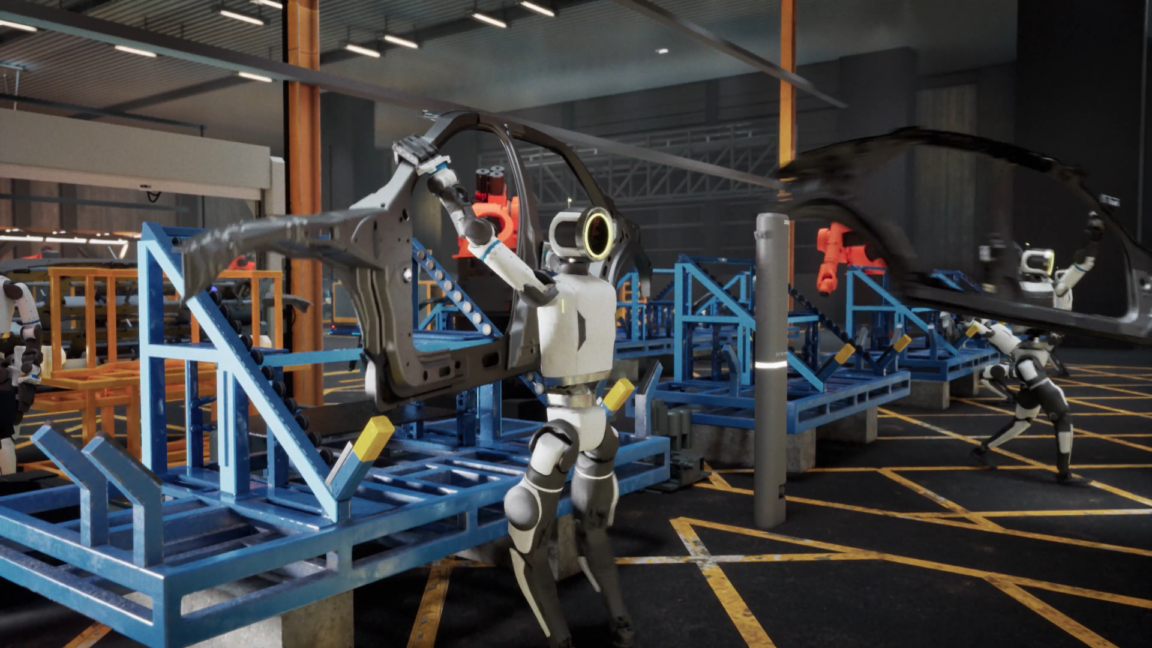
The human form isn’t designed to work in a factory, why would you make your robots have humanoid bodies??
This is 100% management being scammed.
Hyundai bought Boston Dynamic.
I feel it’s less about their factories and more about using them as a proving ground, as they will have to make that investment make some kind of revenue.
They’re not being scammed exactly. It’s more of a fantasy they’re playing out.
https://www.youtube.com/watch?v=rwsowgBE_P8
But you can make a soft transition, replace this or that without redesigning everything and take on huge risks. As long as it saves money it works.
So far humans can do FAR more complex work than robots can. The goal has to be to design a robot that you can program by telling and showing it what to do with human language. If you can do that and save money, then you have a robot that can truly scale. Instead of designing thousands of new factories, you have one robot that can be put into every factory on earth. And those robots will benefit from economies of scale.
Surely that’s very situational? Some cases have robots doing work that a human couldn’t possibly do whatsoever.
Yes, it varies a lot. But by and large cases where robots wildly outperform humans were automated decades ago, because the obvious benefits justified the cost and complexity of either building a bespoke robot or programming one to do the job well (all those robot arms you imagine swinging doors into place at the car factory)
The cases left over (and discussed here) are either requiring a level of flexibility that older designs of robot couldn’t handle, or where humans were pretty efficient at anyway, so the complex process of prepping a robot wasn’t justified.
But a robot that can be taught without programming (by any worker or their supervisor), and slots straight into an existing human-shaped hole? That could massively reduce the upfront cost, especially if economies of scale make the robot itself cheaper. possibly to the point that the robot could be worse at the job than a human and still be cheaper in the long run.
Or from the other angle, when there are better forms for working in a factory. We don’t make cars giant mechanical humans you sit atop of, why do the same for robots?
Huh? Factories are literally designed around human workers unless they are already fully automated…
It took several hundred years to make factories even reasonably safe for humans to work in, and yet still, workplace injuries are extremely common because the human form is simply bad at doing this kind of work. It’s trash.
All factories with human workers are optimised for human movement as much as possible (5s etc). It benefits the factory.
It should be pretty obvious why a humanoid robot that can do anything a human can do, could be easy to implement in these factories.
Although I would think it easier to just redesign the factory to operate without humans, than to design a humanoid robot to replace the humans.
That’s the point the other guy was making
Nope he said factories were not designed around humans which is factually incorrect.
He said humans are not designed for factories, not the other way around. That’s not the same thing. Factories have been designed to take into account our physical shortcomings, but it’s obviously not perfect and industrial accidents are still a thing.