Technically, I think that C° is used to express differences or ranges of temperatures. For instance the difference between 15 °C and 20 °C is 5 C°. Or you could say something like, “5 C° more is all it takes for me to start wearing shorts”.
I feel like that would have come up at some point during my two years of thermodynamics classes where we were constantly using ∆T. just did a search for “C°” in quotes, and for delta T; first one returned nothing, second showed a bunch of sources where the units of ∆T were °C. any idea where you might have heard this?
I’m old. Google tells me that “Celcius degrees” used to be used for differences or ranges, but modern standards just use “degrees celcius” for everything. My experience would come from thermodynamics classes in the 1980’s.
I’ve always seen Kelvin used to describe differences in temperature, since Kelvin has a real zero point and the steps are the same as Celsius. Or people just use °C because they don’t know or care that it’s technically wrong.


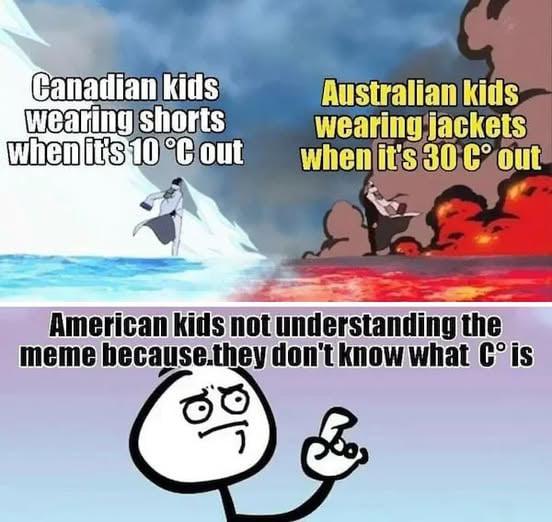
Technically, I think that C° is used to express differences or ranges of temperatures. For instance the difference between 15 °C and 20 °C is 5 C°. Or you could say something like, “5 C° more is all it takes for me to start wearing shorts”.
I feel like that would have come up at some point during my two years of thermodynamics classes where we were constantly using ∆T. just did a search for “C°” in quotes, and for delta T; first one returned nothing, second showed a bunch of sources where the units of ∆T were °C. any idea where you might have heard this?
I’m old. Google tells me that “Celcius degrees” used to be used for differences or ranges, but modern standards just use “degrees celcius” for everything. My experience would come from thermodynamics classes in the 1980’s.
I reject your reality and substitute my own.
I’m pretty sure you’ve made this up. °C is the unit regardless
How would you “say” this, “Five Celcius degrees more…”?
I’ve always seen Kelvin used to describe differences in temperature, since Kelvin has a real zero point and the steps are the same as Celsius. Or people just use °C because they don’t know or care that it’s technically wrong.