

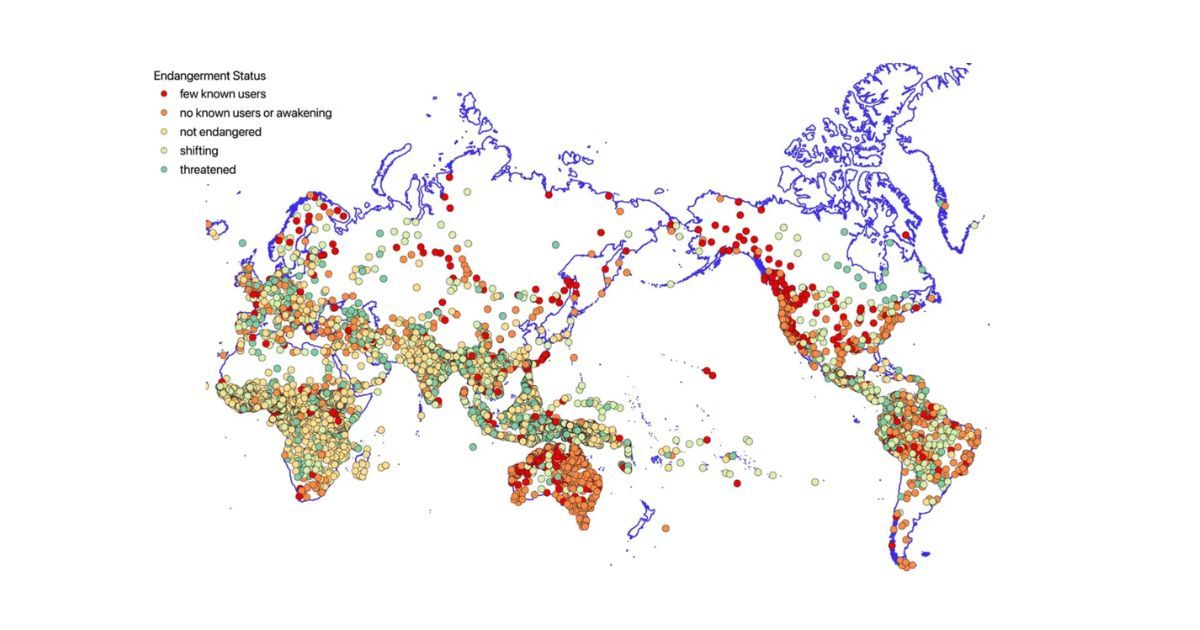
Most people have no idea how many languages and dialects were exterminated as imperialism and nationalism emerged in the last few hundred years. The very concept of a national language that is the same across a broad national territory is novel. And it was created through violence.
Call me ignorant if you wish, but unifying communication is very much not one of the ills brought about by imperialism. Not to mention, basic economics and technological advancement did A LOT of the work, too. Much like how we now have unified time zones around the world. That wasn’t imperialism. That was technical advancement enabling a much broader view for economics (as much as global economics can be unentangled from the imperialism that accelerated it, anyways).
While culture should never be erased, hard lines between now-connected people will dissipate over time.
A golden age … where people couldn’t communicate across vast regions without scholarly levels of knowledge…
We really need to reconsider what we’re calling a, “golden age”…
While I agree that many more languages existed in the past, I have a hard time believing that it was an order of magnitude more. New languages evolve from population drift, they’re not just invented because someone is bored (with some exceptions).
But it very much depends on what you count as a language. German used to be a dialect continuum. People could understand their neighbors and a village or two over, but became mutually unintelligible pretty quickly. Transportation was slow, so populations just didn’t mix as much and language was more local. Latin used to mostly be the language of a single city.
Their modeling suggests
Psh, it’s only a model.
We know proto families and such exist going back through to PIE and others. We know that languages split off of those and, if I’m remembering correctly, proto-Germanic itself would hit in their 0 +/- 1000 range easily.
After we domesticated plants and animals, however, the planet’s population ballooned—and so did the number of languages.
This feels counterintuitive to me. We had small groups of hunter-gatherers that interacted with other groups far less often (at least presumably) before agriculture. If people generally don’t speak like their grandparents today, why wouldn’t that be the case then? I guess one could argue that fewer people meant less drift, but i don’t know about that.
After agriculture (and arguably even before it in some places), we had more permanent societies with structure, population, governance, etc. Why would this be the place that language drift/division starts happening rather than the opposite?
I’m not a trained anthropologist or anything; it just feels weird to me.
Meow meow golden age meow
Hah. Back up to 1900, each village here had their own dialect. Nothing of value was lost with the hobasele (ant).
