

Title text:
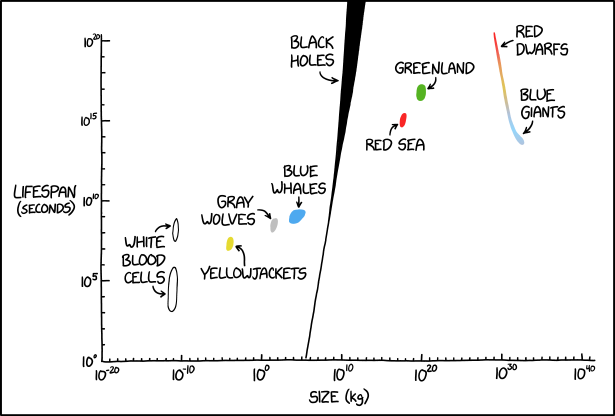
With their 13 years recording and performing together and two humans worth of mass, the White Stripes are sandwiched neatly between gray wolves and blue whales.
Transcript:
Transcript will show once it’s been added to explainxkcd.com
Source: https://xkcd.com/3283/
Black holes don’t need to be dense. A black hole the size of the orbit of Jupiter would be less dense than water.
Black holes radiate energy like a black body with a temperature that increases fast the smaller they are. Small black holes radiate all their energy really quickly.
That’s not what I was saying. What I was saying is that if they are light in mass (kilos, tons) they need to be dense. Didn’t wanna write a book just for that one point, and it already got long-ish anyway.
Don’t you mean the event horizon of the black hole? The actual matter of a black hole is in an infinitely small point, right?
The horizon is what defines the black hole. From the outside the mass distribution is not defined, as there isn’t any experiment you can do that tells you about the internal structure. If you let a mass fall into a black hole you won’t see it cross the horizon, just get asymptotically closer to it.
Very very small but not infinitely so. That would violate the Heisenberg uncertainty principle of quantum mechanics.