cross-posted from: https://lemmy.sdf.org/post/58407882
In Tibet, a digital crackdown followed the deadly flood that has devastated communities along the China-Nepal border. Censors erased viral footage while Chinese state media flooded platforms with official content.
Across the frontier in Tibet, […] the physical disaster was almost instantly followed by a digital one: the rapid, high-tech erasure of the catastrophe’s visual evidence.
As survivors tried to upload raw footage of the deluge, China’s state-backed information control apparatus swung into action, executing a sophisticated, precision operation to shape the public narrative and bury inconvenient truths.
The contrasting realities — a tragic humanitarian crisis in Nepal and a tightly sanitized, triumphant rescue narrative in China — reveal the evolving mechanics of Beijing’s modern censorship machine.
Rather than imposing a blunt, blanket blackout, authorities deployed advanced image-recognition technology and “saturated information” tactics to drown out domestic scrutiny while deflecting diplomatic friction abroad.
[…]
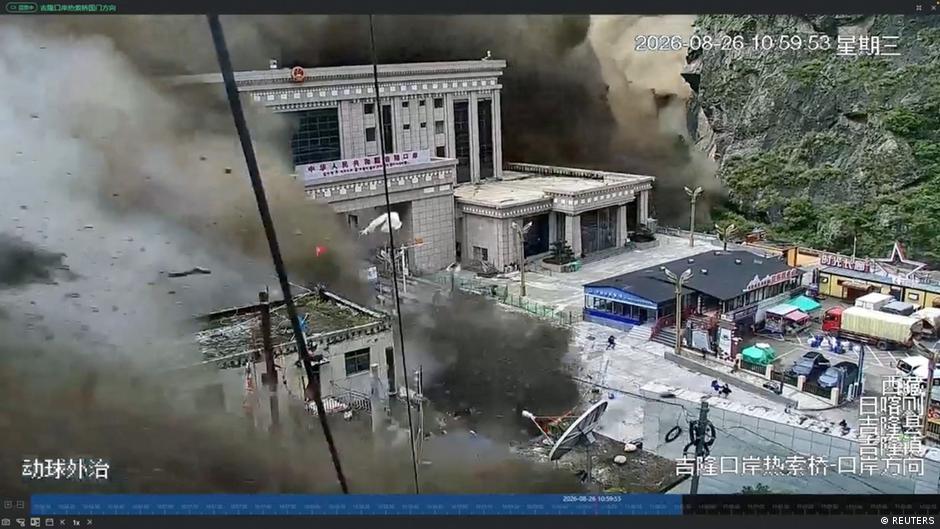
In an article titled “An Unrecorded Mudslide Rushes into Gyirong Port” on China’s WeChat, a universal app that combines messaging with payment options and social media functions, local blogger “Matou Qingnian” described the chaotic scene.
“The most terrifying moment happened at the Gyirong Port,” the author wrote, describing video footage of crowds, including children, fleeing in panic before a pitch-black torrent swallowed the camera’s view.
Within hours, both the article and the raw video footage had vanished from Chinese social media.
[…]
According to China Digital Times (CDT), an independent watchdog that tracks Chinese internet censorship, the video of the collapsing border gate was systematically blocked from being shared on WeChat, even in private messages.
“The footage itself contained no graphic violence, no protests, and no political slogans,” explained Mira, a CDT editor who specializes in tracking sensitive keywords and media. “The target of the censorship was the symbol itself: the National Gate.”
Digital analysts note that this censorship highlights a significant upgrade in China’s internet policing tools. Instead of merely filtering text-based keywords, platforms now rely heavily on video fingerprinting, image hashing and machine-learning models to recognize specific visual scenes.
Once a visual sequence is blacklisted, it is intercepted before it can ever be posted.
[…]
The suppression of the Gyirong Port disaster reflects a broader shift in Beijing’s strategy: from mass deletion to “precision surgery” and narrative flooding.
A search for “Tibet mudslide” on Xiaohongshu — China’s popular lifestyle and search platform [which is known in English as Rednote — reveals the mechanics of this “saturated information environment.”
Rather than showing an empty search page, the platform’s algorithm feeds users a carefully curated stream of state-media reports from China’s state broadcaster CCTV and news agency Xinhua.
The visual landscape is dominated by high-resolution, sterile graphics: “before-and-after” comparisons, maps of high-altitude glacial collapses — the official scientific cause of the disaster — and state-approved aerial drone footage.
The raw, chaotic cellphone videos recorded by eyewitnesses at the border are entirely absent.
By filling the digital space with a high volume of “safe” and visually appealing official content, the state satisfies the public’s immediate curiosity while preemptively suffocating independent reporting or organic discussions, analysts note.
[…]
On Weibo, China’s microblogging giant, the narrative arc was similarly managed. While “Tibet mudslide” briefly trended on August 26, the domestic casualty figures were quickly frozen the next morning at three dead and 558 missing.
Almost immediately, the platform’s trending topics were redirected toward the government’s swift response.
Two heavily publicized, lengthy official reports dominated the news cycle: Chinese President Xi Jinping convening a Central Politburo meeting to coordinate rescue and relief efforts, and Premier Li Qiang arriving in Gyirong to personally direct operations on the ground.
[…]
Beneath the veneer of efficient state rescue efforts lies a deeper, systemic vulnerability that Beijing was desperate to hide: a history of structural negligence.
On August 27, a hashtag briefly slipped through the censors and trended on Weibo: “Gyirong Port Reopened Only Half a Year Ago.” It amassed over 347,000 views in less than an hour before it was abruptly deleted. The hashtag pointed to a damning timeline of infrastructure failures.
[…]
In July 2025, Gyirong Port was completely shut down after being devastated by another severe flash flood. It took nearly six months to rebuild and reopen the port on January 1 of this year. Eight months later, the port has been destroyed again.
As the deleted “Matou Qingnian” article noted, Gyirong Port has now suffered mudslides during the flood seasons of 2024, 2025 and now 2026. In 2025, several Chinese personnel went missing or were killed.
By erasing the “half-year” trend, censors blocked an inevitable and dangerous train of public inquiry.
If the state-of-the-art border facility was destroyed twice in 14 months, it raises critical questions about site selection, shoddy infrastructure construction, and the complete failure of glacial lake monitoring and early-warning systems in Tibet.
[…]
The informational firewall does not stop at China’s borders; it has also created a diplomatic rift with neighboring Nepal, which has borne the brunt of the disaster’s human toll.
[…]
Parshuram Kaphle, a prominent Nepalese foreign policy journalist, publicly accused Beijing on X (formerly Twitter) of failing to share critical trans-boundary data.
“Nepal has been addressing the legitimate security concerns of our neighbors,” Kaphle wrote in a post that has since been deleted. “However, it must be said with sadness that our northern neighbor has significantly undermined us. By failing to provide early warning of such a massive disaster, we suffered immense loss of human life.”
He further wrote: “We have continually faced crises originating from their territory, while we continue to address all their concerns, necessary or unnecessary. Why must Nepal alone pay the price of one-sided love?”
[…]
The Chinese government has rejected any accountability.
[…]
Some time ago, I read an article that fits the current news situation in China:
The Communist Party’s original promise was economic prosperity for the Chinese people in exchange for obedience. After a steep rise at the end of the last century—as part of the opening-up policy—lifted large segments of the population out of the bitter poverty of the early years of the People’s Republic, that rise has slowed steadily in recent years. So much so that the promise of prosperity has lost its credibility (a reality felt particularly acutely by well-educated young Chinese who have worked hard and made many sacrifices for their education). Reasons include, among other things, natural limits to growth, corruption inherent in the Chinese system—partly caused by the capitalist economic model… but not least the Communist Party’s manipulation of China’s economy, which prioritizes a policy of overseas expansion over increasing prosperity for the majority of the population (consider the heavy state subsidies for companies and the artificial devaluation of the currency).
Since the promise of prosperity has not been kept, the CCP’s new offer now provides security in exchange for obedience.
And a failure of the state’s warning and disaster response systems—as in the case of the recent flood—does not fit into this offer. Therefore, news regarding this event is rigorously censored.
Pretty disgusting. Can’t let people know what’s going on in the occupied territories. They do the same narrative control outside of china as well. You can see it when a new report about carbon emissions is released every few years.