Most people I know that want an end to borders also want the end of government.
Idk about that. The line I’ve always seen is that most people want a system which protects-but-does-not-bind. And what they recoil at is a system that binds-but-does-not-protect.
I want the border to be frictionless for me. But I don’t want the border to be frictionless for people I don’t like.
But I don’t want the border to be frictionless for people I don’t like
And therein lies the rub: if their government doesn’t like you, the border then binds you but does not protect you. Borders exist because it projects power onto people within, and gives arbitrary rules for entry without. If you want truly free movement, you can’t have projections of power
if their government doesn’t like you, the border then binds you but does not protect you.
Okay, but that’s just why this is the most important election of our lives and you need to turn out to vote or we’ll be under the boot of the vile fascist-communist government of the Other Party That Doesn’t Like Me.
Borders exist because it projects power onto people within
I mean, that’s a very narrow perspective. Borders exist as a compromise between neighboring governments, indicating where one set of legal codes ends and another begins.
If you want truly free movement, you can’t have projections of power
Free movement is power projection. It’s just projection by the people (and their attendant organizations and ideologies) doing the moving.
The whole neoliberal One Big Global Market wet dream was about projecting the power of Western financial and regulatory authorities around the globe. Open Borders can be as much about projecting power as closed ones. And whether you believe that’s good or bad really hinges on whether you believe you’re aligned with the people doing the power projection.
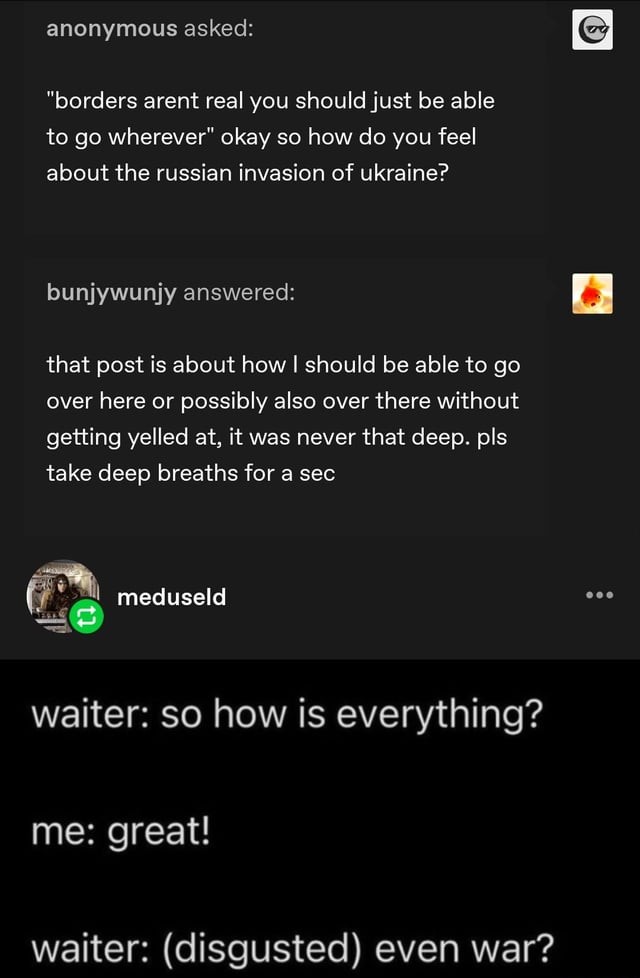
You absolutely could describe the Russian invasion of Ukraine (or the US invasion of Iraq/Afghanistan/Libya/Syria) as a kind-of Open Borders policy under the Bush Doctrine. The borders are simply open to those with a big enough battering ram to kick through the door.


Idk about that. The line I’ve always seen is that most people want a system which protects-but-does-not-bind. And what they recoil at is a system that binds-but-does-not-protect.
I want the border to be frictionless for me. But I don’t want the border to be frictionless for people I don’t like.
And therein lies the rub: if their government doesn’t like you, the border then binds you but does not protect you. Borders exist because it projects power onto people within, and gives arbitrary rules for entry without. If you want truly free movement, you can’t have projections of power
Okay, but that’s just why this is the most important election of our lives and you need to turn out to vote or we’ll be under the boot of the vile fascist-communist government of the Other Party That Doesn’t Like Me.
I mean, that’s a very narrow perspective. Borders exist as a compromise between neighboring governments, indicating where one set of legal codes ends and another begins.
Free movement is power projection. It’s just projection by the people (and their attendant organizations and ideologies) doing the moving.
The whole neoliberal One Big Global Market wet dream was about projecting the power of Western financial and regulatory authorities around the globe. Open Borders can be as much about projecting power as closed ones. And whether you believe that’s good or bad really hinges on whether you believe you’re aligned with the people doing the power projection.
You absolutely could describe the Russian invasion of Ukraine (or the US invasion of Iraq/Afghanistan/Libya/Syria) as a kind-of Open Borders policy under the Bush Doctrine. The borders are simply open to those with a big enough battering ram to kick through the door.