Conversations on this subject will continue to stagnate and miss the important points as long as people continue to act like the discussion of ethics is the same as the discussion of efficacy. People who disagree with AI on a principle of its impacts being negative will often call it “a lying machine which is regularly wrong and offers no utility”.
May I suggest that people with criticisms of the ethics and impact of AI take a charitable position towards the utility offered by AI. Accept something along the lines of a positive account given by an experienced software engineer - it’s useful, it presents risks but also it presents new ways to get certain work done well in much less time etc.
Even if you do not believe this, the point is it is a much more ambiguous argument than the ethical argument or the concerns over the impact of AI on the species, environment or society. You weaken those arguments by putting them along side poorly justified, somewhat falsifiable claims that AI just doesn’t work.
Accept something along the lines of a positive account given by an experienced software engineer - it’s useful, it presents risks but also it presents new ways to get certain work done well in much less time etc.
I agree to the utility of finding security bugs but the general utility of using LLMs is often overblown. There are studies that say that 95% of companies do not see any measurable positive impact.
The Linux kernel is likely a special case. But for other open source developer communities, it seems to have some negative impacts, too. And the full effects on maintainability of code will only be visible after some years.
I dislike LLMs/GenAI mostly due to ethical reasons (I’m aware the code quality from LLMs has increased over time), but I’ve already accepted the fact it’s gonna be used a lot. In most cases, I can avoid software using it in favor of alternatives, but that’s not always possible, such as Linux itself. I’m not gonna risk staying on outdated kernels, and I don’t have the time and knowledge to maintain a fork of a whole kernel.
As for my own code, I refuse to let AI touch it because I like thinking about how to code something, and I get really happy when it works.
This mindset is the entire problem. “Oh we don’t need to worry about ethics or morals, just efficiency” is exactly the issue with every pro-AI argument and every pro-capatalism argument. Its the issue with our governments, with investing, with corporations.
I say fuck anyone who argues ethics is not important when talking about efficacy. Fuck that mindset and fuck AI.
I think the point is that it actually hurts an ethics-based anti-AI argument to also claim that it has no utility, because the no-utility argument is weak and therefore makes the rest of the stance (i.e., the ethics-based argument) look weak by association.
Exactly, if you say that AI is ethically bad and doesn’t work, to someone who uses it and clearly sees it works well for them, it just invalidates your argument.
If you just stick to the ethics your argument can’t be dismissed in that way.
Yes! Another problem is, not everyone is using AI in the sense that people think of.
AI is a large field, it studies many different methodologies and aspects of automation, prediction, generation and observation, yet today most people outside the field use it for LLMs and image generation, which throws the baby out with the bath water.
In addition to that, there are publicly available LLMs, some have datasets obtained entirely from consenting parties and public domain works. You don’t have to pay billionaire technocratic fascist a single dime to use such marvelous tools computer scientists worked decades to bring forth.
A machine can never create art, it can never take responsibility and should never be allowed to make decisions, it’s a tool.
And you can also have at home your own LLM that you can supply your own power.
I feel like everyone here would like the same overall: not killing the planet, not build more data-centres in the middle of communities, and last but not least having a tool to assist and not to generate unreviewed slop.
We do need to develop now a way to protect the human curated content, that is the part that we want and care about.
Neocities is an interesting subject in this matter, most people there reject LLMs and have their own hand crafted page and content:


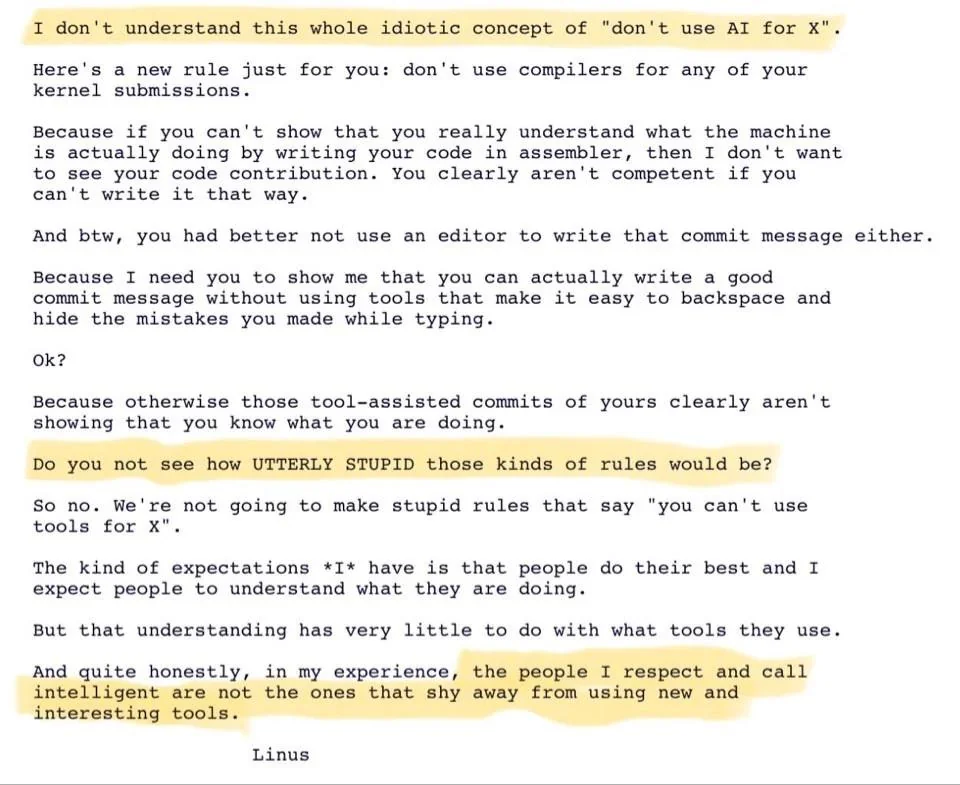
Conversations on this subject will continue to stagnate and miss the important points as long as people continue to act like the discussion of ethics is the same as the discussion of efficacy. People who disagree with AI on a principle of its impacts being negative will often call it “a lying machine which is regularly wrong and offers no utility”.
May I suggest that people with criticisms of the ethics and impact of AI take a charitable position towards the utility offered by AI. Accept something along the lines of a positive account given by an experienced software engineer - it’s useful, it presents risks but also it presents new ways to get certain work done well in much less time etc.
Even if you do not believe this, the point is it is a much more ambiguous argument than the ethical argument or the concerns over the impact of AI on the species, environment or society. You weaken those arguments by putting them along side poorly justified, somewhat falsifiable claims that AI just doesn’t work.
I agree to the utility of finding security bugs but the general utility of using LLMs is often overblown. There are studies that say that 95% of companies do not see any measurable positive impact.
The Linux kernel is likely a special case. But for other open source developer communities, it seems to have some negative impacts, too. And the full effects on maintainability of code will only be visible after some years.
I dislike LLMs/GenAI mostly due to ethical reasons (I’m aware the code quality from LLMs has increased over time), but I’ve already accepted the fact it’s gonna be used a lot. In most cases, I can avoid software using it in favor of alternatives, but that’s not always possible, such as Linux itself. I’m not gonna risk staying on outdated kernels, and I don’t have the time and knowledge to maintain a fork of a whole kernel.
As for my own code, I refuse to let AI touch it because I like thinking about how to code something, and I get really happy when it works.
This mindset is the entire problem. “Oh we don’t need to worry about ethics or morals, just efficiency” is exactly the issue with every pro-AI argument and every pro-capatalism argument. Its the issue with our governments, with investing, with corporations.
I say fuck anyone who argues ethics is not important when talking about efficacy. Fuck that mindset and fuck AI.
I think the point is that it actually hurts an ethics-based anti-AI argument to also claim that it has no utility, because the no-utility argument is weak and therefore makes the rest of the stance (i.e., the ethics-based argument) look weak by association.
Exactly, if you say that AI is ethically bad and doesn’t work, to someone who uses it and clearly sees it works well for them, it just invalidates your argument.
If you just stick to the ethics your argument can’t be dismissed in that way.
Yes! Another problem is, not everyone is using AI in the sense that people think of.
AI is a large field, it studies many different methodologies and aspects of automation, prediction, generation and observation, yet today most people outside the field use it for LLMs and image generation, which throws the baby out with the bath water.
In addition to that, there are publicly available LLMs, some have datasets obtained entirely from consenting parties and public domain works. You don’t have to pay billionaire technocratic fascist a single dime to use such marvelous tools computer scientists worked decades to bring forth.
A machine can never create art, it can never take responsibility and should never be allowed to make decisions, it’s a tool.
And you can also have at home your own LLM that you can supply your own power.
I feel like everyone here would like the same overall: not killing the planet, not build more data-centres in the middle of communities, and last but not least having a tool to assist and not to generate unreviewed slop.
We do need to develop now a way to protect the human curated content, that is the part that we want and care about.
Neocities is an interesting subject in this matter, most people there reject LLMs and have their own hand crafted page and content:
https://neocities.org/