What is the accelerating rise of m-dashes from approximately 2014-2019 about? That trend apparently continued until very recently, even slowed down a bit, before exploding at some point in 2025 or 2026 for obvious reasons.
I wonder how many em dashes are real vs interpreted.
I love an em-dash, but I have never typed one on purpose; they are all just two minus in a row and I use them wrong – with a space around (*inspect source to see that lemmy translates for me). I abuse them like I abuse semicolons. They are a typographical tick that indicates a pause or pivot when I translate my thoughts to text.
I can imagine a human manuscript editor turning punctuation like a comma into an em-dash when it makes sense, but I can’t imagine a developer ever specifically typing out one – with the need to either know or look up the unicode for it. The only relevant place would be a comment, but even then IDE’s are not generally known for their tendency to replace typed characters with something else.
Maybe some tool in the pretty-print/code-formatter ecosystem added that as a feature? But var-- is so common that I can’t imagine that’d be a good idea, even in a comment.
If the graph is not just using made up data, then it also measures absolute em-dashes, not em-dash density, so possibly could be an increase in interest in contributing to the kernel?
By a factor of roughly 10-fold? Maybe. It could indeed be a measure of overal absolute contribution. But post 2025 that could be influenced by m-dash density especially.


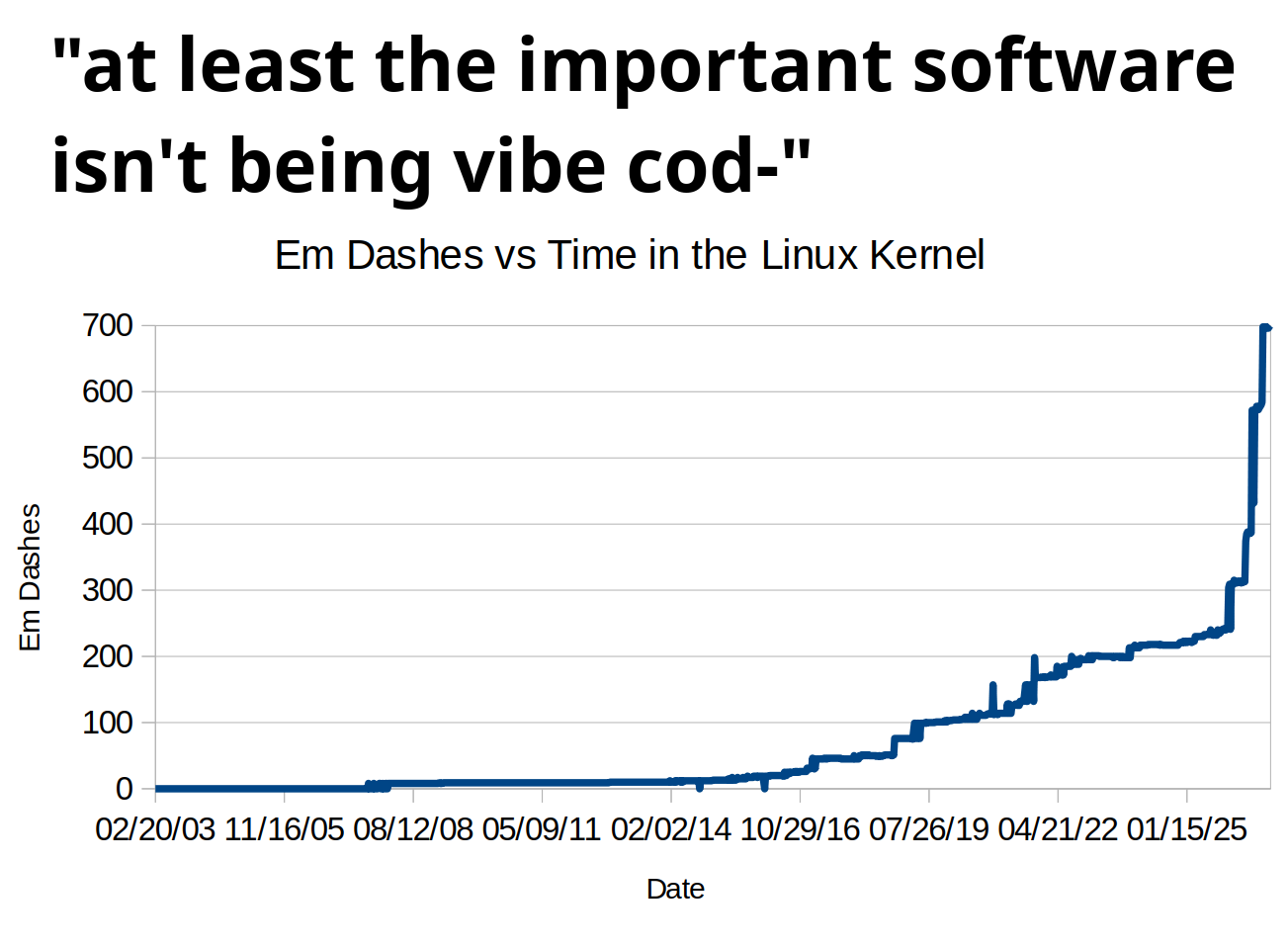
What is the accelerating rise of m-dashes from approximately 2014-2019 about? That trend apparently continued until very recently, even slowed down a bit, before exploding at some point in 2025 or 2026 for obvious reasons.
Does anyone have a theory?
I wonder how many em dashes are real vs interpreted.
I love an em-dash, but I have never typed one on purpose; they are all just two minus in a row and I use them wrong – with a space around (*inspect source to see that lemmy translates for me). I abuse them like I abuse semicolons. They are a typographical tick that indicates a pause or pivot when I translate my thoughts to text.
I can imagine a human manuscript editor turning punctuation like a comma into an em-dash when it makes sense, but I can’t imagine a developer ever specifically typing out one – with the need to either know or look up the unicode for it. The only relevant place would be a comment, but even then IDE’s are not generally known for their tendency to replace typed characters with something else.
Maybe some tool in the pretty-print/code-formatter ecosystem added that as a feature? But
var--is so common that I can’t imagine that’d be a good idea, even in a comment.They probably write code in Microsoft Word
People slowly learned to use their keyboards for proper typography?
That was a good one.
If the graph is not just using made up data, then it also measures absolute em-dashes, not em-dash density, so possibly could be an increase in interest in contributing to the kernel?
By a factor of roughly 10-fold? Maybe. It could indeed be a measure of overal absolute contribution. But post 2025 that could be influenced by m-dash density especially.
No, the comment I responded to was about the ~2014 uptick, not the recent one.
The recent one is obviously AI one way or another. Absolute contribution rate is higher due to AI as well.
Yeah sure, no I am not surprised about post 2025. My question was indeed about the post 2014 uptick.
I assume it’s due to phone keyboards.