It does sound counterintuitive, doesn’t it. It’s actually the opposite of what you’d expect, at least in my case.
When I wrote my own binary clock I first tried using one 5-bit word to visually represent 0–23, and another 6-bit word to represent 0–59. But I found it hard to quickly read at a glance. Especially the minutes.
I found the 4-bit representation of 1–12 simpler to read at a glance, and then use the 5th bit to represent am/pm. In fact, I could skip the am/pm bit completely, because who tf doesn’t know whether it’s before or after noon when looking at a 12h clock, unless you’re in complete isolation from the outside.
Then, obviously 6 bits for the minutes is even harder to glance, and more noise, so I made that into a 2-bit thing where the most significant bit is whether or not we are past the half hour, and the least significant bit represents whether or not we are past the 15 or 45-minute mark, which tells me which quarter of the hour we are in. It served me enough granularity to be on time for meetings etc. 😄




It does sound counterintuitive, doesn’t it. It’s actually the opposite of what you’d expect, at least in my case.
When I wrote my own binary clock I first tried using one 5-bit word to visually represent 0–23, and another 6-bit word to represent 0–59. But I found it hard to quickly read at a glance. Especially the minutes.
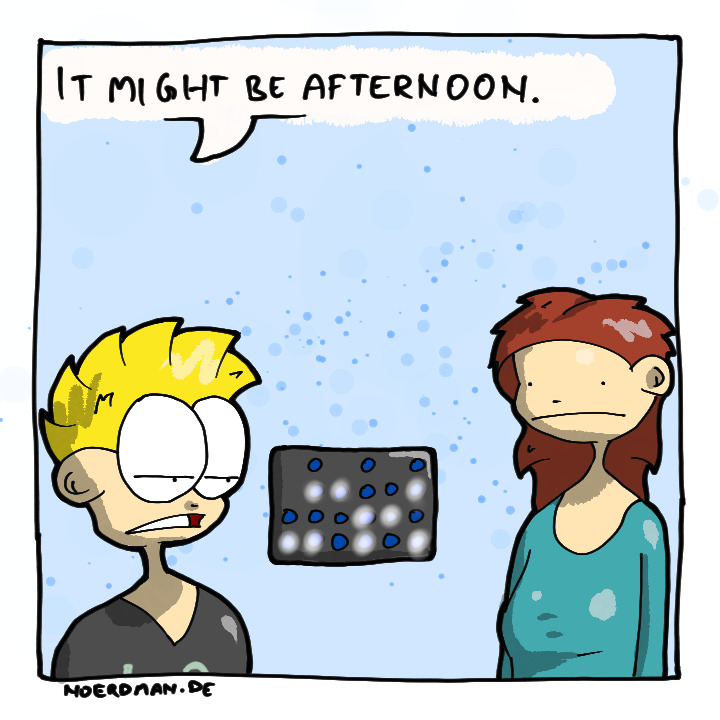
I found the 4-bit representation of 1–12 simpler to read at a glance, and then use the 5th bit to represent am/pm. In fact, I could skip the am/pm bit completely, because who tf doesn’t know whether it’s before or after noon when looking at a 12h clock, unless you’re in complete isolation from the outside.
Then, obviously 6 bits for the minutes is even harder to glance, and more noise, so I made that into a 2-bit thing where the most significant bit is whether or not we are past the half hour, and the least significant bit represents whether or not we are past the 15 or 45-minute mark, which tells me which quarter of the hour we are in. It served me enough granularity to be on time for meetings etc. 😄