
cross-posted from: https://hexbear.net/post/7430766
cross-posted from: https://news.abolish.capital/post/22243
After the Great Depression, a wave of industrial unionism breathed new life into the labor movement and the U.S. working class. Faced with a severe economic downturn, unemployment, and poverty, workers across the country began waging militant strikes for union recognition and better conditions.
At the center of this class battle was Teamsters Local 574. Led by Trotskyists from the Communist League of America — Carl Skoglund, the Dunne brothers, and Farrell Dobbs — the Teamsters emerged as militant leaders willing to fight the iron grip of the bosses. Having organized a successful three-day strike of coal yard drivers in February 1934, Teamsters then organized transportation workers across Minneapolis. By April, Local 574 had grown to represent thousands.
Community and Self-Organization, Against the Bosses
In response to this powerful movement, the bosses mobilized a private army of spies and thugs to destroy the working-class organizations. Local labor leaders prepared their forces for a larger confrontation with the employers. When trucking companies refused to recognize the union, 6,000 workers answered the call to go on strike on May 15.
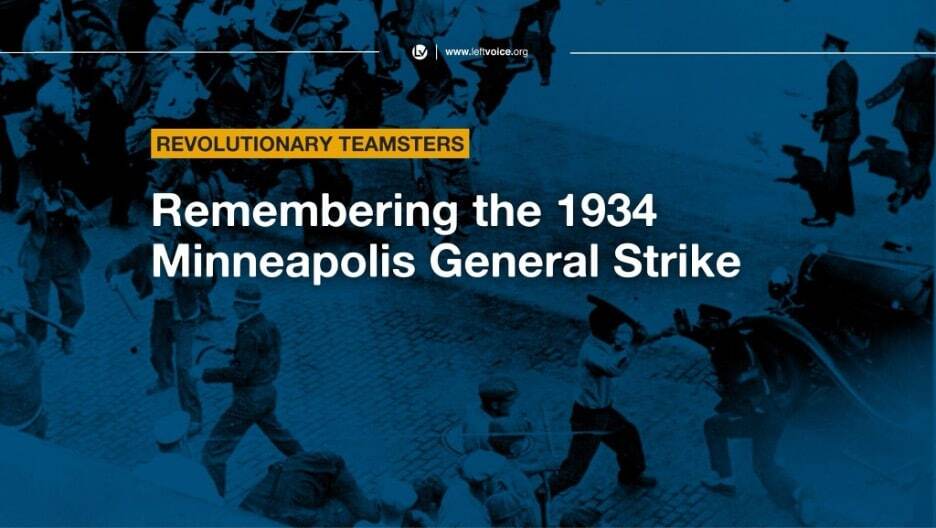
Over the next two months, workers waged bloody battles against the bosses, the police, and the National Guard. At every moment, the capitalists and their protectors were met with militant working-class resistance. Local 574 elected a strike committee, published a daily strike bulletin, and held mass meetings to keep all the workers well informed.
Behind these thousands of organized workers stood the working class of Minneapolis. Skoglund and the Dunne brothers had enlisted allies in the unemployed councils, other unions, and diverse community organizations including farmers. The leaders of the strike fostered the self-organization of workers, even in terms of their own defense. They set up a Women’s Auxiliary which helped organize a food pantry for the strikers and their families, marched on City Hall, and even fought with clubs in hand on the picket lines when it came to it. Workers organized rapid response patrols of cars and trucks that stopped trucks full of scabs, also known as “flying pickets.” At every moment, the broadest working-class alliance was achieved.
On May 21 and 22 — the Battle of Deputies Run — the striking Teamsters, as well as thousands of other working-class people organized behind them, faced off with the bosses and their hired thugs. Faced with the formidable force of organized workers, many fled. The strike entered its final phase after the events of Bloody Friday on July 20, when the police opened fire into a crowd of picketers while escorting scab trucks. Two workers were killed, almost 70 injured, and key leaders arrested.
The funerals of John Belar and Henry Ness drew a crowd of up to 100,000 people. Other unions began to strike in sympathy, as well, or offered financial support. Ultimately, the strikers held strong and forced the employers to give in to their main demands, including the “inside” warehouse workers.
Lessons for the Working Class Today
The strike in Minneapolis was one of three major strikes that shook the labor movement in 1934. Yet, this “Teamster rebellion” was likely the most advanced expression of working-class militancy and solidarity. The success in Minneapolis would help inspire a whole generation of workers who formed the Congress of Industrial Organization (CIO). In just a couple of years, sit-down strikes and other bold tactics would be key to organizing auto, steel, rubber, and other industries.
Over eight decades later, the experience of the Minneapolis Teamsters remains more relevant than ever as a new generation of workers are looking to fight back. By learning from the past, workers of all industries can face the present and prepare for the future.
Now, in the face of ICE’s terror and the imperialist attacks on Venezuela, is the time to rekindle the spirit of ’34.
Today, working people in Minnesota are shutting it all down to demand ICE out of our communities and justice for Renee Nicole Good. Unions must mobilize, as they did in 1934, to harness the power of organized labor and go on strike.
ICE out for good! Solidarity forever!
The post Revolutionary Teamsters: Remembering the 1934 Minneapolis General Strike appeared first on Left Voice.
From Left Voice via This RSS Feed.