
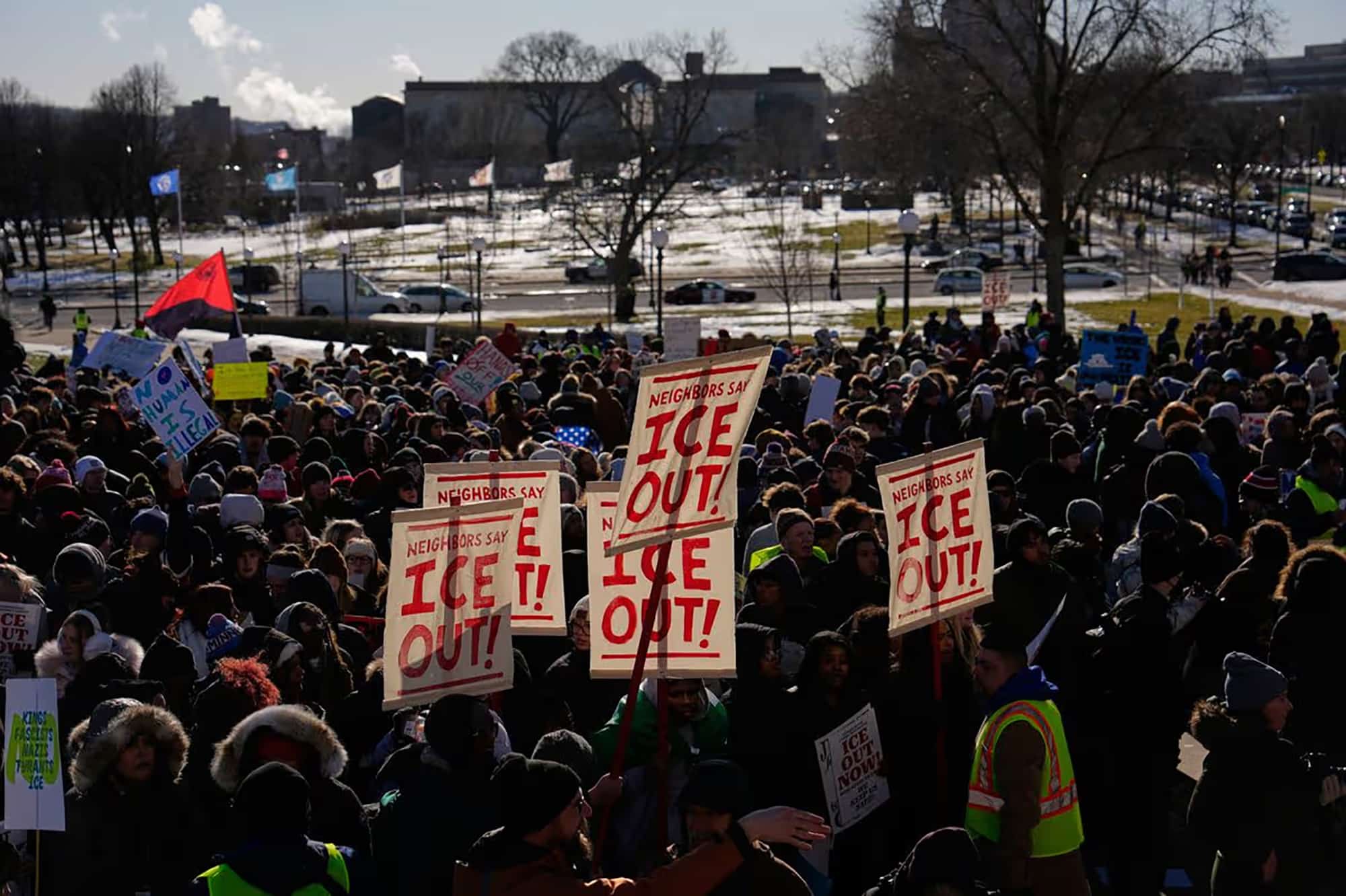
There’s something major happening in the ranks of the labor movement in Minnesota.
At a press conference ahead of the January 23 day of action — dubbed the Day of Truth and Freedom with “no work, no school, no shopping” — SEIU Local 26 president Greg Nammacher declared, “members started telling us in large numbers that they were going to honor the call of the 23rd. 95% of them said they were planning not to go to work.”
At another rally, Marcia Howard, the president of the Minneapolis Federation of Educators Local 59, declared, “we’re not fighting to get back to 2025. These are our streets and we’re taking them back, one block at a time.” Nammacher and Howard are not alone; all week, as we inch closer to Friday, we’ve heard similar declarations from other sectors of the labor movement, all of whom are rearing to go in this fight against Trump’s anti-immigrant offensive in the state and against ICE’s presence in the streets.
Since the original call was made by a coalition of labor, faith and community leaders — including major unions such as St. Paul Federation of Educators, Unite Here Local 17, SEIU Local 26 and the Amalgamated Transit Union Local 1005 — other unions and federations have joined in the call, including the Minneapolis Regional Labor Federation, AFL-CIO along with other regional labor councils throughout the state. The Minneapolis Nurses Association (MNA) has also voiced strong solidarity with the call, though they have clarified that they will not be breaking the “no-strike” clause in their contracts.
This massive mobilization is not happening in a vacuum. It is a direct response to the terror that Trump has unleashed upon Minnesota. Under the banner of “Operation Metro Surge,” the Trump administration has deployed upwards of 3,000 ICE agents into the state, who have operated with impunity and reined terror on immigrant communities. This violence reached a breaking point earlier this month with the brutal killing of Renee Nicole Good, a 37-year-old mother and legal observer who was shot and killed by ICE agent Jonathan Ross.
Despite the outpouring of rage since Good’s murder, ICE’s brutality hasn’t retreated. The Trump administration is preparing 1,500 active-duty soldiers in Alaska for a possible deployment to Minnesota. ICE agents have also been conducting “blind” raids in apartment complexes, pulling people from their cars, and even shooting at bystanders. Just a week after Good’s death, ICE agents shot a Venezuelan immigrant in the foot.
Yet, even in the face of this violence, the people haven’t backed down. In the weeks since Renee Nicole Good’s murder, the resistance has been relentless. Protesters have not only filled the streets but have taken the fight directly to ICE, trying to block their operations during the day. Noise demonstrations have become a nightly occurrence outside the hotels where ICE agents are being housed.
Labor has been at the very center of this defense. Educators, in particular, have transformed schools into sanctuaries. Teachers are organizing themselves in safety committees and coordinating with students and parents to create “early warning” systems and safety corridors. As one educator told Left Voice a few weeks ago, “We’re the front lines for our students, so we’re trying our best to show up and be these rocks for our students.”
The Legacy of Labor
The working class in Minnesota has a storied history of class struggle. In 1934, the Minneapolis Teamsters strike turned the city into a bastion of class struggle. Led by Trotskyists from the Communist League of America, Carl Skoglund, the Dunne brothers, and later Farrell Dobbs, the strike was a masterclass in class solidarity. When truckers faced off against the police, National Guard, and the “Citizens Alliance”—a local paramilitary group of business elites—the entire city mobilized in solidarity. The strike wasn’t just about wages or union recognition; it posed the question of who ran the city. Strikers not only walked off the jobs, but organized with other unions, unemployed workers and the community to halt production and battle against the bosses and the state’s repressive forces, setting up flying pickets, patrols of cars and trucks that stopped scab trucks. They faced “Bloody Friday,” where police killed two strikers and wounded dozens more, but they didn’t back down. The victory of 1934 turned Minneapolis from an “open shop” town into a union stronghold.
That tradition of defiance continued into the 1980s with the P-9 Hormel strike in Austin, Minnesota. The meatpackers of Local P-9 defied both the company’s wage cuts and their own international union leadership who opposed the strike to launch a historic, rank-and-file-led struggle. They faced down the National Guard and built a massive “Adopt-a-Striker” solidarity network that helped sustain striking workers for months at end.
But these shows of force aren’t just relics of the past. In 2020 during the Black Lives Matter protests after the murder of George Floyd, bus drivers, part of ATU Local 1005, refused to cooperate with the Minneapolis Police Department, declining to transport arrested protesters or police officers to the front lines. They showed that workers can directly sabotage state repression by withholding the very infrastructure the state relies on.
In 2022, public school teachers in Minneapolis went on strike for three weeks in the bitter cold of March to demand a better contract that not only addressed their needs, but also improved the learning conditions of their students. Indeed, as they said, their working conditions are their students’ learning conditions. Now too, educators, forged in the fire of those struggles, are at the frontlines of defending their communities.
As federal agents continue to occupy the same streets, we need to channel that same spirit.
The Potential of a Real Strike
The day of action on January 23 is reminiscent of the great boycotts of the Civil Rights Movement, such as the Birmingham campaign, where the economic withdrawal of an entire community forced the hand of a segregationist power structure. But there is a crucial part here that is essential above all: the role of organized labor. While a consumer boycott can hurt the bottom line of businesses for a bit, it is the withdrawal of labor that can bring the entire system to a grinding halt.
It is significant that unions have endorsed the call for Jan 23, and union leaders are speaking passionately about defending our immigrant neighbors because, as we’ve long said, an injury to one is an injury to all. But to take the demand for “no work” to its logical and most powerful conclusion, labor must do more than support it—it must mobilize to strike.
The response of the union leaderships now is a clear reaction to the enormous pressure from the rank-and-file. The thousands who are mobilizing and defending immigrants are workers from across industries, unions and workplaces. Teachers, especially, have been at the forefront of organizing the self-defense at the schools. It is the clamor of the rank-and-file that has made the call for January 23 a reality. Now, we must make the strike effective, with tens of thousands of transport workers, teachers, healthcare workers, and factory and service workers paralyzing everything and imposing a militant strike from below.
Imagine if transit workers actually struck and shut down transport for the day. That action would have the power to impose the strike on other sectors, like hundreds of thousands of unorganized workers, students, and commuters who rely on that system to get to their jobs, schools, or wherever they’re going. This is the “chain reaction” of solidarity that only the power of organized labor can trigger, making the promise of “no work, no school, no shopping” a grinding reality.
Without relying on the individual efforts of workers to participate in the day of action and withhold their labor, unions need to mobilize the power of rank-and-file workers who are enthusiastic to “shut it down.” We can take direct inspiration from the 1934 Teamsters strike, organizing on the shop floor to meet, discuss and decide how to not only make the strike a reality on Friday, but also continue that momentum in the days and weeks following it until we kick ICE out of our communities. In 1934, it was the power of these rank-and-file strike committees working in coordination with the community that was able to expand the strike and win against the bosses and the state’s repressive forces. We can do that again now.
Such a mobilization, furthermore, can have a ripple effect across the country. Even now, this day of action is being met with a national response. Solidarity actions are being organized across the country for Friday. In New York City, major unions including the United Federation of Teachers (UFT), SEIU 1199 and 32BJ, and Teamsters Local 804 have called for a parallel day of action. On the West Coast, SEIU Local 721 in Los Angeles is mobilizing its members. The rage against Trump’s attacks and ICE’s terror is universal. The labor movement, when it acts, can coordinate a response that transcends state lines.
Labor leaders are beginning to realize what the rank and file has known for months, that workers are itching to fight back against the relentless attacks of Trump and the billionaire class. It is precisely this desire to fight that has UAW president Shawn Fain campaigning for a general strike in 2028. But we can’t defer our struggle to a point in the distant future when the struggles we face are in the immediate. The momentum behind January 23 shows it: working people are angry and ready to fight now. As Ximena Goldman puts it,
“Imagine what would happen if UAW called meetings at workplaces to organize active solidarity for their brothers and sisters in Minneapolis. It could change the tide in the fight to kick ICE out of their cities, even as the Trump administration sends more agents to the area and promises immunity to agents who use brutal, even deadly force. Active solidarity in someplace like Detroit, where the UAW has a particular influence, would be an incredible boost to the fight against ICE in Minneapolis, and throughout the country.”
The success of a massive, disruptive work stoppage in one city can demonstrate the real, tangible power of labor and bolster a wave of confidence and militancy across the country. It can bring the slogan of a “general strike” from an aspiration into reality.
From the attacks on immigrants and democratic rights here at home, to his brutal imperialist offensive abroad—including the recent bombing of Venezuela and kidnapping of Nicolás Maduro, Trump has shown us, a year into his second term, on how he plans to govern. We cannot rely on Congress or the courts, or hold out hope for a better administrator of this imperialist system. The only force capable of checking this power is that of the organized working class, acting independently of the two parties of capital.
The “Day of Truth and Freedom” can — and must — be more than a single day of protest. It must be the opening salvo of a working class going on the offensive, against ICE, against the attacks of U.S. imperialism; and for a future that is fully, and finally, ours.
Removed by mod