

cross-posted from: https://hexbear.net/post/7487398
cross-posted from: https://news.abolish.capital/post/23542
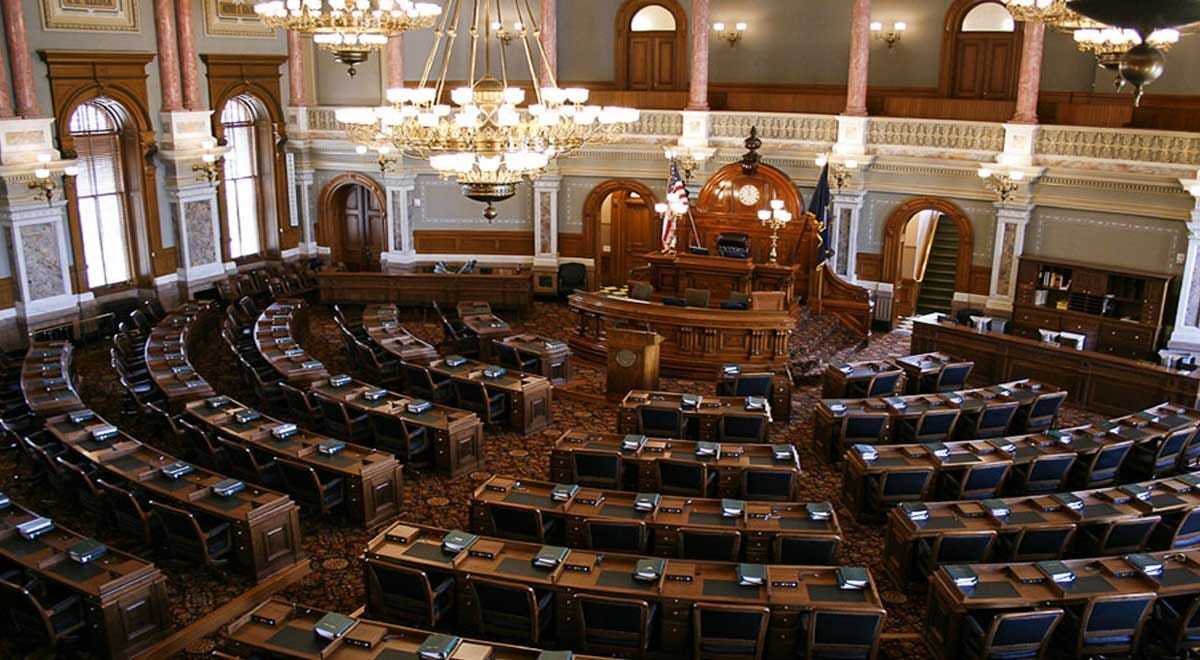
Public Record // Kansas Legislature
Erin In The Morning is a reader-supported publication. To receive new posts and support my work, consider becoming a subscriber.
Anti-transgender bathroom bans have become increasingly common in red states in recent years. Most have focused on K–12 schools, targeting transgender children and forcing them to avoid using the bathroom for extended periods of time, though some have expanded to colleges, universities, and other public spaces. Until now, however, every state that has enacted such a ban has limited it to public buildings—an expansive category, to be sure, but one that still exempts private businesses—and few have included enforcement mechanisms aimed directly at transgender people themselves. That may be about to change. A bill now racing through the Kansas Legislature would not only authorize criminal charges and civil penalties against transgender people who violate the ban, but also empower private citizens to act as bounty hunters, seeking out transgender people in bathrooms—including private business ones—and suing them for substantial sums of money.
The bills, SB 244 and HB2426, have already been mired in controversy. Initially focused on driver’s licenses, Kansas Republicans used so-called “gut-and-go” procedures to rewrite the legislation while potentially bypassing public hearings. As amended, the bills would bar transgender people from updating the gender marker on their driver’s licenses, going so far as to revoke existing licenses and force individuals to surrender them in exchange for documents bearing an incorrect sex designation. The legislation also layers on sweeping bathroom restrictions that go far beyond those adopted in other states. According to advocacy leaders tracking the bills, the measures would now even empower private citizens to act as bounty hunters—entering private businesses to search for transgender people in bathrooms and sue them for alleged violations.
As written, the bill appears designed to apply broadly to public buildings rather than private businesses. In its definitions section, it refers to “government-owned buildings,” a category that spans everything from highway rest stops and municipal parks to the state Capitol, public schools, and public universities. Under the bill, any transgender person who enters a restroom that does not align with their sex assigned at birth would be deemed in violation—a penalty that could escalate to a misdemeanor carrying possible jail time. That provision alone would place the bill among the most extreme anti-transgender measures in the country, drawing direct comparison to Florida’s bathroom law, which similarly exposes transgender people to criminal penalties for using the restroom.
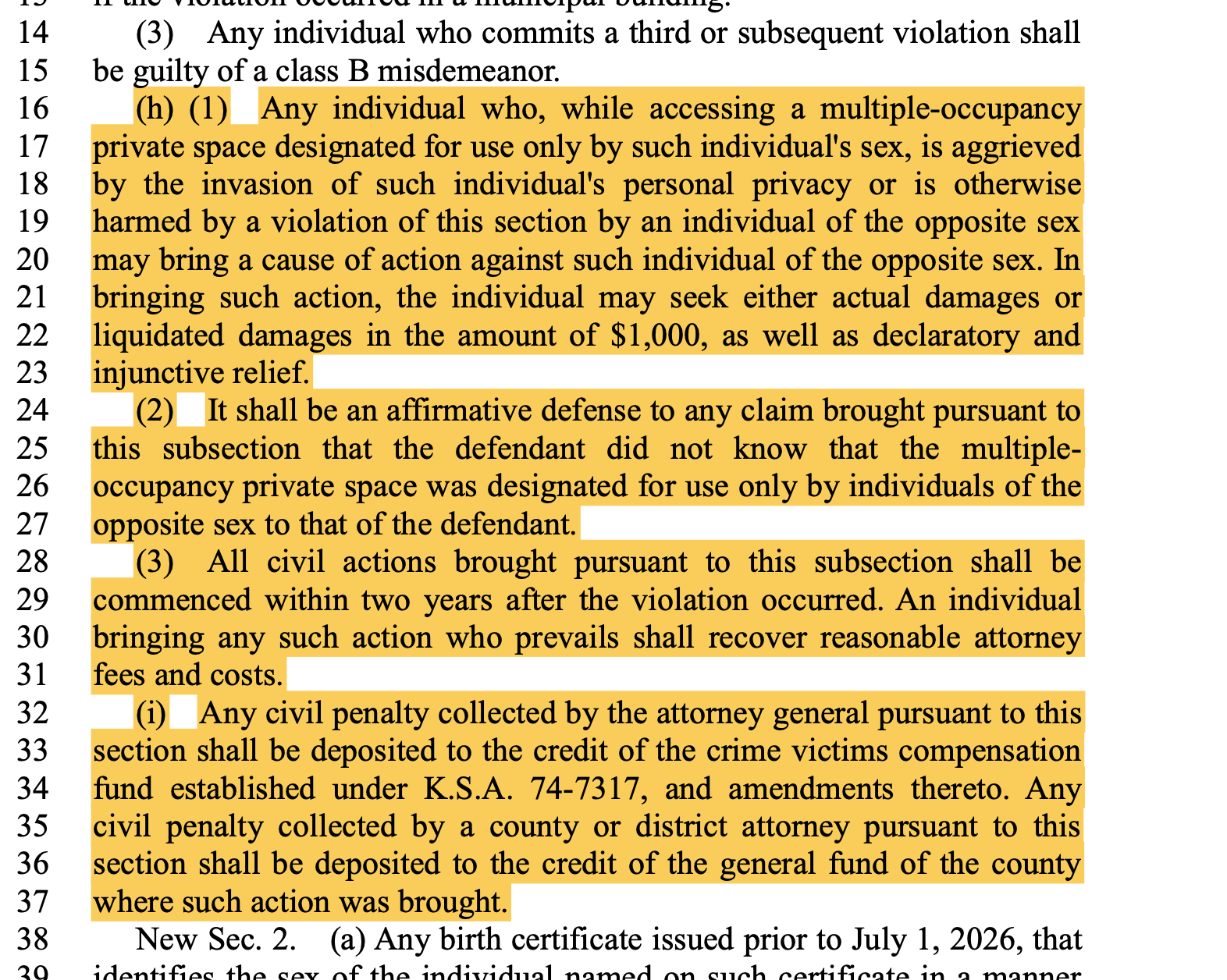
However, a separate section of the bills takes the bathroom ban and turbocharges it, pushing it into territory that would instantly make it the most extreme anti-transgender measure in the United States. That section creates a “private right of action,” allowing individuals to sue transgender people they encounter in bathrooms. Critically, nothing in the provision limits its application to publicly owned buildings. As written, it would not only be the first bathroom bounty law to target transgender people directly, but also the first to extend a bathroom ban into private spaces—effectively creating the nation’s first private bathroom ban if enacted by empowering bounty hunters to search for trans people in bathrooms.
See the following section:
Erin In The Morning has confirmed with multiple legal experts and state legislators that the bill would directly target transgender people in public and private bathrooms, something previously unreported on. “While the entirety of H Sub for SB 244 is concerning, Section 1(h) represents a particularly alarming escalation in anti-trans policies. The ambiguity of the bill’s language and where it applies creates the possibility that trans and gender nonconforming Kansans can be sued for using their preferred restroom, locker room, or changing room in any building, public or private. Without the option of single-person or family alternatives, this essentially forces trans people out of public life by denying us the right to even relieve ourselves or wash up,” says Isaac Johnson of Trans Lawrence Coalition.
“This provision creates a bounty-hunter scheme allowing anyone to sue transgender people for simply using a multiple-occupancy restroom. The result is a forced choice: find a single-occupancy facility, or face thousands in “damages” and attorney fees. Denying access to basic public amenities doesn’t just inconvenience people; it relegates them to second-class citizenship,” said Allison Chapman, Gender Justice & Health Equity Fellow at Lawyers for Good Government.
The bill is now being aggressively fast-tracked by Republican leadership in Kansas, with the explicit backing of Attorney General Kris Kobach and key amendments pushed through via a “gut-and-go” process that curtailed public input. A House vote is expected imminently, after which the measure would move to the Senate and then Democratic Gov. Laura Kelly, who is widely expected to veto it. If passed, what follows would be the bill’s most consequential test: an effort to override that veto in a Legislature where Republicans currently hold a veto-proof majority, but where some may view the bill as too extreme. For transgender people in the state, that effort may be the most consequential in years.
Erin In The Morning is a reader-supported publication. To receive new posts and support my work, consider becoming a subscriber.
From Erin In The Morning via This RSS Feed.
I’m sorry, but all of that, lack of services etc is ‘hillbilly frontier shit’.
That’s kinda what I mean by it. No other developed country in the world does that shit, the country wealthy enough to employ law enforcement. One of the flaws of course within that cost problem is local police, something else no one does.
I guess it’s hillbilly shit, but I’ve always mentally held the thought of that being more east coast Appalachia. The midwest is more frontier, but not really anymore.
It’s just kind of there in no discernible way other than it fills an emptying center of the country. Those lack of servies also include fire emergency and ambulances. But a lot of what is going on in places like Kansas is down to demographic shifts…
There are many towns now that are no longer populated - people think of ghost towns as a relic of the gold rush in the west, but many farming communities have died out in the last 60 years and will never return. It’s not so much as what is happening politically to the country, but it’s more fundamental than that. It’s economics and a changed society.
No longer agricultural, no longer industrial, it’s now informational and the economy is digital.
Farms in Kansas don’t grow food so much anymore, they grow commodity crops like sileage corn for ethanol or feed for livestock. If that. Lots of earthquakes in Kansas now, due to oil fracking. Water is contaminated. No reason to stay.
All the wealth in the government won’t help a region that is losing relevance to the country as a whole.
Their reaction is fear and desperation and an unwillingness to embrace the change that is upon them. They haven’t even embraced the notion that it’s time to grow and move on. Smarter people vote with their feet and the stubborn remainder pick at the scabs of their history and lament for a mythic past that they remember in their fantasies.
I suppose you’re correct on that assessment, but I find the bounty hunters being hired to police bathrooms far more down to reactivity to basic economic strain more than anything else. It’s just political noisemaking to rouse the disaffected remaining population to vote, and is ill thought out and will leave governments that embrace it, open to furious lawsuits.
Such are the actions of desperate people, my thoughts are it’ll get dropped fast enough when the unintended consequences bite.
Thank you for the effort you put into that, I got a lot out of it too.
You’re right, it’s not so much frontier hillbilly shit as it is refusal to provide services in the correct manner and again, you highlight where the deficiencies are; defence on a local level of service provision.