

- cross-posted to:
- Aii@programming.dev
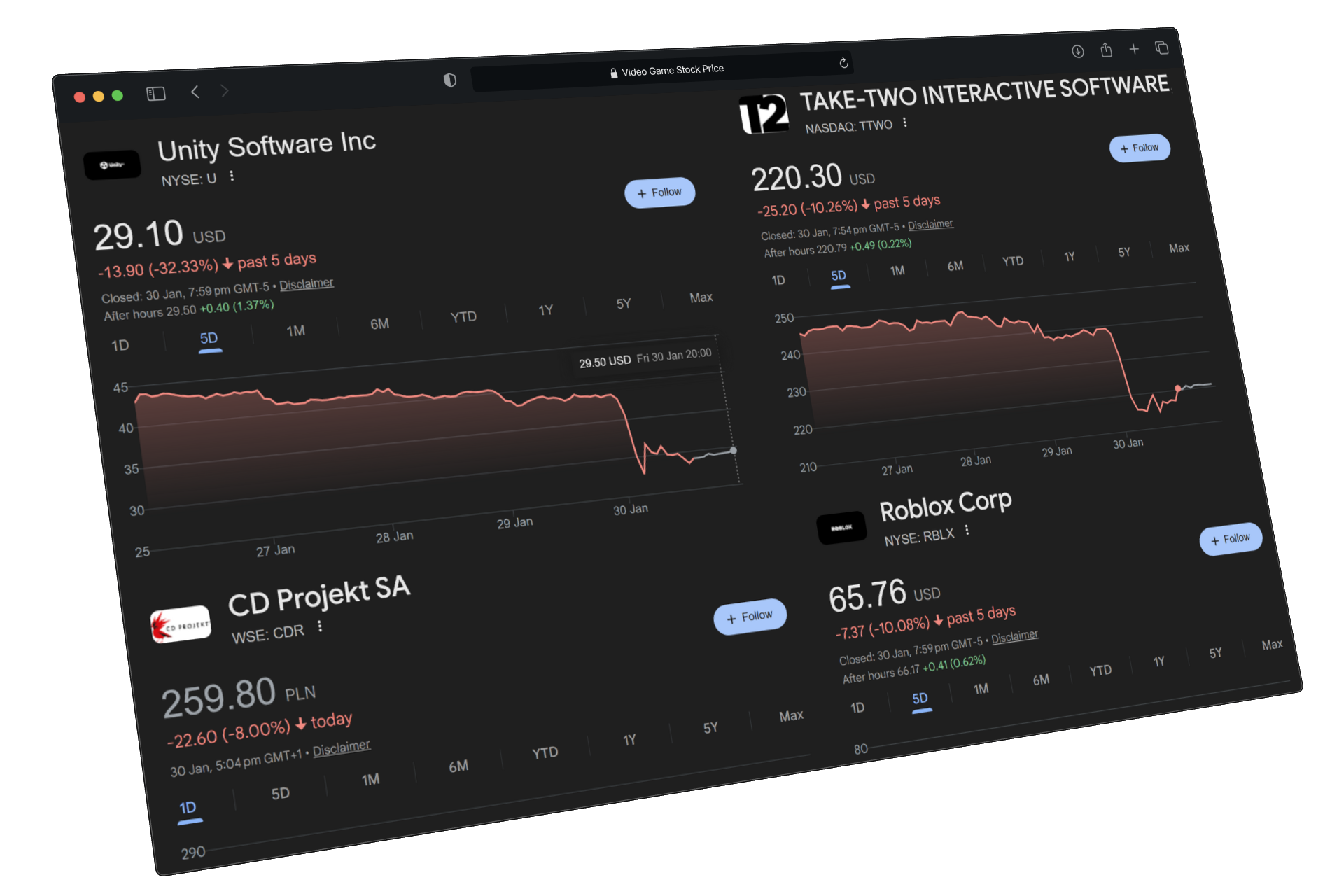
Yesterday, Google announced Project Genie, a new generative AI tool that can apparently create entire games from just prompts. It leverages the Genie 3 and Gemini models to generate a 60-second interactive world rather than a fully playable one. Despite this, many investors were scared out of their wits, imagining this as the future of game development, resulting in a massive stock sell-off that has sent the share prices of various video game companies plummeting.
The firms affected by this include Rockstar owner Take-Two Interactive, developer/distributors like CD Projekt Red and Nintendo, along with even Roblox — that one actually makes sense. Most of the games you find on the platform, including the infamous “Steal a Brainrot,” are not too far from AI slop, so it’s poetic that the product of a neural network is what hurt its stock.
Unity’s share price fell the most at 20%, since it’s a popular game engine. Generally speaking, that’s how most games operate: they use a software framework, such as Unity or Unreal Engine, which provides basic functionality like physics, rendering, input, and sound. Studios then build their vision on top of these, and some developers even have their own custom in-house solutions, such as Rockstar’s RAGE or Guerrilla’s Decima.
I see a couple of major practical reasons why game (engine) devs are under no threat from this even if it gets better in the future:
Scale. Like all things AI, this is not going to scale well. This doesn’t generate code, 3D models and textures, both making games and playing them requires running the model. So if you want a game to have a persistent environment where the world behind you doesn’t get regenerated into something different after taking 8 steps, the context window is going to get real large real fast. And unlike programmed games, you can’t make choices about what’s worth remembering and what isn’t, what can be kept on persistent storage and is only loaded when it becomes relevant etc., because it’s all one big, opaque blob of context, generated by a black box; you either have it remember everything or it becomes amnesiac in a way that makes it useless. Memory availability also isn’t increasing at a rate where this becomes a non-issue any time soon.
Control. Manipulating the world though a text prompt gives a lot of control, but it’s also very course. It’s easy enough to tell it that you want a character that can run and jump, but how fast does it run? Does it accelerate and decelerate or start and stop instantly? Does it jump in a fixed arc or based on the running speed and duration of the jump button being pressed? How far and how high? You’re going to run in the limits both of what you can convey and what the language model will understand pretty quickly. And even when you can get it to do exactly what you want, it would have been faster and more practical to manipulate values directly or use a gizmo place things. But there’s no way to extract and manipulate those values, because again: big, opaque blob of context.
Wish I could upvote your comment more than once. Thank you for the injection of clarity.
This is sadly irrelevant though to the investment world. Opportunities that present potential for market disruption are where money is made and yeah, AI looks like a gas engine rolling out from the Benz workshop when steam engines were the norm. What I do not understand though is scientists and ethical entities outlawed cloning in the early 2000s because of how dangerous it could become if an unknown virus got created whilst trying to clone an animal, yet we’re sitting here with our thumbs in our ass having data engineers play god with a technology that could wipe out humankind if found in the wrong hands.