

- cross-posted to:
- socialism@midwest.social
- socialism@lemmy.ml
- cross-posted to:
- socialism@midwest.social
- socialism@lemmy.ml
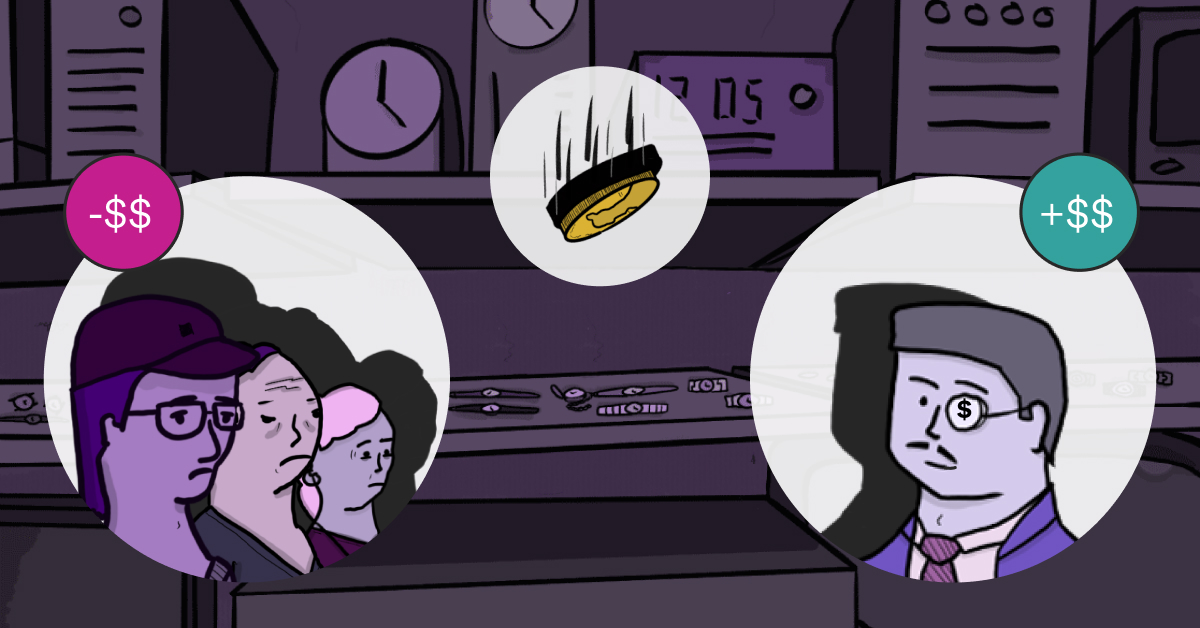
The simple math of the Yard-Sale Model shows that if everybody started out with equal money in a fair economy, the outcome tends toward one person holding all of the money. The cool graphical simulations on this page demonstrate why.
I don’t think this is as good a model as you or the oop seem to think it is. Nobody is under the impression that you can make even by buying and selling random things. And gambling your money against other people isn’t something people can afford to do unless they already have money to live comfortably. Real people have fixed needs they have to buy and usually a fixed value they can create to make money.
I don’t think a model that doesn’t share any similarities with the system can be used to prove that inequality is baked into the system. I don’t mean that it isn’t, but I couldn’t in good conscience claim so based on this alone. Please keep your standards for evidence high yall.
Also the article completely misses the reason why wealth accumulates in the model. It has nothing to do with compound ratios being confusing or the amount one can afford to wager. This is simply a normal distribution with flipped axes and a bottom cap of 0. Inequality arises even if you change the game so that richer people give more when they lose and receive less when they win.
If it’s not a good model, then you are welcome to pick it apart. However, the study that applied it for the 2017 paper in Scientific American found that it matches observed data about our economy stunningly well when applied.
As the author of that study was quoted here saying, the simple Yard Sale Model here can’t begin to explain a complex economy, but its function is like an X-ray to cut through the complexity to see the bones of the thing.
In any case, we know empirically that Trickle Up is the actual effect of the capitalist system. If there’s a model that can explain the mechanism more accurately, I’d be happy to hear it.