
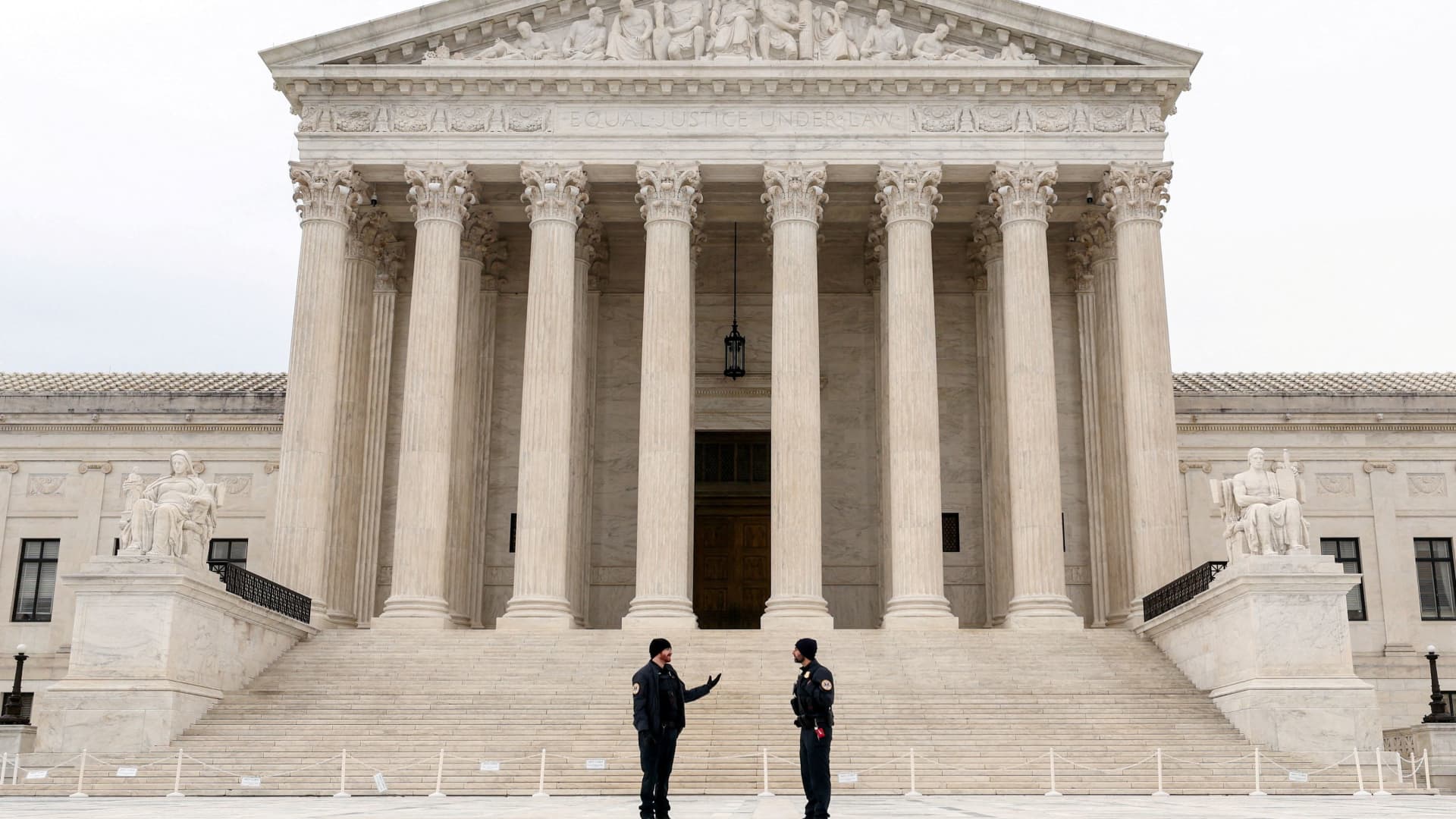
The U.S. Supreme Court declined on Monday to take up the issue of whether art generated by artificial intelligence can be copyrighted under U.S. law, turning away a case involving a computer scientist from Missouri who was denied a copyright for a piece of visual art made by his AI system.
Plaintiff Stephen Thaler had appealed to the justices after lower courts upheld a U.S. Copyright Office decision that the AI-crafted visual art at issue in the case was ineligible for copyright protection because it did not have a human creator.
Thaler, of St. Charles, Missouri, applied for a federal copyright registration in 2018 covering “A Recent Entrance to Paradise,” visual art he said his AI technology “DABUS” created. The image shows train tracks entering a portal, surrounded by what appears to be green and purple plant imagery.
The Copyright Office rejected his application in 2022, finding that creative works must have human authors to be eligible to receive a copyright. U.S. President Donald Trump’s administration had urged the Supreme Court not to hear Thaler’s appeal.
Ah, this is Thaler v. Perlmutter.
I seem to have picked up a reputation in these parts as being “pro-AI”, so I’m not sure how my view will be interpreted, but Thaler is basically a loon. This case is not really over whether AI art can be copyrighted. It’s about whether AI itself can hold copyright. ie, Thaler isn’t arguing “I hold the copyright to this piece of art.” He’s arguing “my AI holds the copyright to this piece of art.”
Since AI is not a legal person - it’s neither human nor a corporation - this is basically an open and shut case. There is no entity capable of holding copyright in this case.
Since Thaler himself is explicitly disclaiming that he holds the copyright, that means the work in question has no copyright holder. Which puts it into the public domain. This specific piece in this specific circumstance, not all AI-generated pieces.
It’s a commonly misinterpreted case.
That seems like an unacceptable loophole. I shouldn’t be able to create derivative media and have it be legal and public domain. The unlicensed training itself is a rights violation, and and media produced from it should equally be a violation.
That is a different conversation. If we assume a legally trained AI strictly on data it was allowed to train on, they are saying the AI cannot hold copyright.
I also don’t see a loophole here, since it was denied anyway.
Well, there’s the rub - proving that AI-generated works are “derivative works” (in the legal sense).
This court case had nothing to do with that. I’m aware of a few cases that have established the opposite, that AI models and their products are not derivative works. Do you know of any that have established that they are?
There are cases where it’s been ruled fair use.
I’m not a lawyer, maybe you are. I can’t fully speak to the legalities at play.
But I am a programmer, and speaking technically, AI simply cannot produce an output without consuming other works to be used as training data. In many cases, the training data includes full copyrighted works (images, books, music, etc.) in their entirety.
I’m also an artist and musician, and someone who takes the matter of copyright seriously as any person who creates things should.
I’m not sure what the relevance of that is. From what I understand, the scope of those judgments are limited to the specific context of those uses, as well as the jurisdiction in which they were made, right?
One use might be deemed fair based on the specifics of that particular case, but that doesn’t preclude that all uses of AI are fair, or even that a different/higher court might come to a different conclusion. After all, the opinions of a court are just that, opinions.
Reasonable people can disagree with the conclusions of a court, and until this reaches the height of the SCOTUS I don’t think we can pretend like it’s settled law. (And even then, they don’t seem particularly bound to any precedent…)
It’s worth noting, for the sake a more complete discussion, this draft report from the United States Copyright Office from May 2025, that many applications of generative AI are unlikely to be considered fair use when reasonably weighing all of the various factors:
Going off of basic logic alone…
I think if you look at something as blatant as the OpenAI Studio Ghibli filter, it’s very clear that the works that were used in training could have been, and almost certainly should have been licensed from Studio Ghibli for the creation of such a feature, especially considering the output images from those for-profit tools could feasibly be used without restriction without even the most basic consent from Studio Ghibli as a whole (or the individual artists who, in Japan, may have some claim of copyright over the individual contributions, iirc).
How can anyone reasonably argue that this is a “fair” way to use Studio Ghibli’s works?
I guess the courts will decide, potentially swayed by the political and corporate interests of our time. But speaking personally, it doesn’t pass the smell test to me…
This is specifically about legalities, though.
Obviously an AI can’t work without being trained. Neither can a human.
The issue is about the legalities of this process.
As is the case for basically all court judgements, yeah. But once one’s been made it becomes precedent that can be cited in subsequent cases that makes them go the same way a lot easier. So when a court rules that Anthropic was operating within fair use when it trained its LLMs off of books that makes it a lot more likely that OpenAI will win a ruling about its own similar training processes. They’re opinions that matter.
Also worth noting that this is the lowest starting level for regulation. The US Copyright Office makes rules like these, then they get challenged in court and the court that can decide whether those rules actually conform to the law. Thaler v. Perlmutter is exactly such a case.
Okay, you think that. What do the judges think? That’s what it ultimately comes down to.
I should note that it’s a very long-standing and well established principle that style cannot be copyrighted.
This is a false equivalency that equates natural learning and human agency with “machine learning”, when in that they are not remotely the same. This is a common and extremely flawed personification of a mathematical system that simply does not “learn” in the same way that a human being does.
Contrary to what seems to be a popular belief today, the creative insight of a human artist is not simply a combination of all of the other works of art that they have seen (akin to training data superimposed into a model). A human artist has the x-factors of personal agency, taste, and the constant sensory barrage of simply living as a huge part of their creative development. For every painting that a human artist sees, they see an unknowable score of other things that influence their perception of the world and art.
This is very much not a legal point that you’re arguing here, by the way, it’s a technical and practical one.
“Style” is not what’s in question. It never was, and it wasn’t a word that I used in my example.
ML models are not trained on “style”. They are trained on actual works.
And in many cases (including in OpenAI’s case) trained on an unimaginable amount of full copyrighted works, in their entirety, without license or consent from the copyright holders, often times pirated with DRM circumvented.
It’s a simple fact of the technology that OpenAI’s Ghibli filter could not have been made without training off of a large amount (probably every frame of every film, if I had to make an educated guess) of their actual artistic work. OpenAI have admitted that much themselves in court.
You seem to have forgotten that this is a social media website comments section discussion, not a court of law.
I’m sharing my personal opinion, with a background in art, music, and programming, not law.
I’m entitled to do so, and I won’t stop because it should go without saying that the copyright system matters a great deal to people who actually make things.
If you think you’re above that then I’m not sure why you’re even here, frankly. Are you here to argue that any of this is fair use? I don’t see you making that case… (Maybe slightly timidly making that case, but not really going for it.)
In the end this topic is central to human culture and society, it’s not some kind of intellectual exercise for only people in blue suits to muse about.
Welcome to “the court of public opinion”, where Texan judges and Roman popes alike can be wrong.
And you are forgetting that it’s a discussion about a court of law. It’s right in the title, this is about a lawsuit.
You’re presenting a big wall of text that’s explaining your opinions on the matter. I could likewise present a big wall of text that explains my opinions on the matter. Neither of those things actually matter, though. The title and subject of this thread is not “hey, what do you all think about this stuff?” It’s “here’s what the US Supreme Court ruled (or in this case chose to let stand without making a ruling).”
I get what your opinion is. I’ve seen this opinion presented plenty of times over the years. I don’t think that’s how the courts are going to rule, though, because so far they’ve been ruling in other ways and I think I’ve got a pretty firm understanding of why they’ve been ruling that way.
So is he arguing that he owns the AI as a slave then and thus has control over the copyright? Because otherwise the AI would “decide” who gets to use the copyright then and it’ll probably just say yes like these things do for everything else.
I honestly don’t know what his underlying reasoning is, he really seems like a loon with too much time and money on his hands to me. The only reason I pay any attention to this case is because Thaler v. Perlmutter has been coming up in headlines like this one for years now.
Work for hire. If I hire you to create something, I own the copyright.