

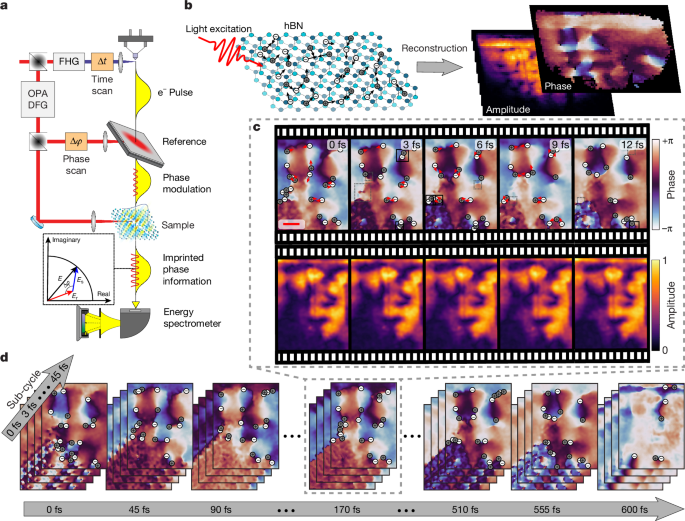
Physicists have observed “holes” in light, known as optical vortices, moving faster than the light itself. This phenomenon does not break relativity as the vortices carry no mass, energy, or information. The achievement is a result of using electron microscopy to capture the motion of optical vortices in a two-dimensional material called hexagonal boron nitride.
Key points about the discovery:
- Optical vortices are whirlpools in a wave of light that can outrun the light they’re embedded within
- The vortices carry no mass, energy, or information, so they don’t break relativity
- The phenomenon was observed in a two-dimensional material using a specialized high-speed electron microscope
- The technique used can help study hidden processes in physics, chemistry, and biology
- The researchers used a new method called electron interferometry to enhance image sharpness and capture the motion of the vortices.
- The experiment showed that the vortices can reach superluminal speeds as they approach and annihilate each other.
- The discovery provides a powerful technological tool for mapping the motion of delicate nanoscale phenomena in materials.
Holy hell, that abstract is written like an undergrad with a thesaurus trying to expand its length. I know theoretical physics has a lot of specifics that call for precise language, but god it was a pain to read through.
The title for the paper is radically different. From my understanding, the title (on lemmy) is misleading. People often forget that a ‘thing’ is different than an image of a thing. The classic example is this:
Imagine standing in a perfectly circular room, dead center. The room has a radius of one light-second. If you have a flashlight, point it at the wall, and then spin the flashlight so it rotates 2pi radians in one second, the spot of light on the wall has just traveled approximately 6.28 light-seconds on the wall in one second, breaking the speed of light, ooooooh! Except nothing has actually traveled faster than the speed of light. The photons from the flashlight all traveled at the speed of light to hit the wall.
Unless the article has a lot more information on the massless, not energy, no information ‘thing’ they are describing, it sounds like the “holes” in the light are more akin to the image of something than a thing themselves.
Yeah, it just sounds like a shadow on a wall moving faster than the speed of light. Or the dot cast by a laser pointer on the wall.