

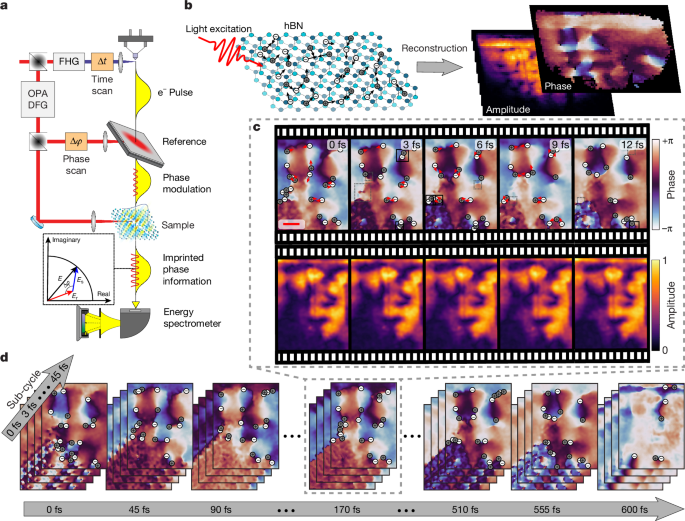
Physicists have observed “holes” in light, known as optical vortices, moving faster than the light itself. This phenomenon does not break relativity as the vortices carry no mass, energy, or information. The achievement is a result of using electron microscopy to capture the motion of optical vortices in a two-dimensional material called hexagonal boron nitride.
Key points about the discovery:
- Optical vortices are whirlpools in a wave of light that can outrun the light they’re embedded within
- The vortices carry no mass, energy, or information, so they don’t break relativity
- The phenomenon was observed in a two-dimensional material using a specialized high-speed electron microscope
- The technique used can help study hidden processes in physics, chemistry, and biology
- The researchers used a new method called electron interferometry to enhance image sharpness and capture the motion of the vortices.
- The experiment showed that the vortices can reach superluminal speeds as they approach and annihilate each other.
- The discovery provides a powerful technological tool for mapping the motion of delicate nanoscale phenomena in materials.
I think this means once a stream of photons is established it is theoretically possible to somehow perturb them in a way that a detectable lack of photon can be transmaiited along the beam FTL. This could be huge in 50 years.
Doesn’t mean much for travelling FTL, but information could be transmitted FTL in a vacuum?
I’m picturing Mars to Earth communication where we beam lasers back and forth.
Would be nice to reduce the delay
I wish I understood the nature of these vortices.
No, there’s no FTL communication here unfortunately. The speed of light puts a hard limit on anything, even information.