This architectural style is called, no kidding, Soviet Brutalism, and was the primary architectural style featured in the Soviet Union from the 1950s to the 1980s.
It’s a divergence from Western brutalism, focusing more on utopian and futuristic themes.
So, no, it’s not anything political. It’s a cultural thing.
Boston City Hall, for example:
The campus of the Rochester Institute of Technology, a.k.a. “Brick City”:
You should check the link I posted. Honolulu has a crapton of brutalism, so I wouldn’t associate it necessarily with any political movement.
I think where brutalism exists now is more a function of when an area was being developed, and it just happens that those areas underwent substantial development while brutalism was en vogue (late 50’s - late 1970s).
So, no, it’s not anything political. It’s a cultural thing.
Soviet housing either followed or was contemporary with Le Corbusier’s ideas of affordable ‘habitation units’, the now-famous cookie-cutter blocks with minimal decoration. The OOP is quite correct in calling it leftist, since the purpose was to have lots of cheap housing: the USSR had huge expansion of it during the fifties-seventies, with massive migration from rural areas to cities (following the less-neat redistribution of housing, wooden barracks, and communal living in the thirties).
Can’t say I like the outcome too much, because arguably same population density can be achieved with lower-rising houses, since they don’t require huge areas between them to have any sunlight. Khrushchev-era districts can be much cozier than later ones, since five-storey buildings are placed closer and have trees right outside the windows.
It’s also not left wing architecture. It’s the cross roads of a left wing housing initiative, and a right wing refusal to spend money on the public good. What you get is something akin to unsecured prison architecture.
So, again, no. This isn’t an example of left-wing architecture. This makes it an example of bad politics.
Soviet right wing refused to spend money on the public good when building millions of buildings across the country? What in the hell are you talking about?
I already gave a lesson in architectural styles. I don’t feel particularly obligated to educate you in Soviet history, nor to engage in a debate on the subject.


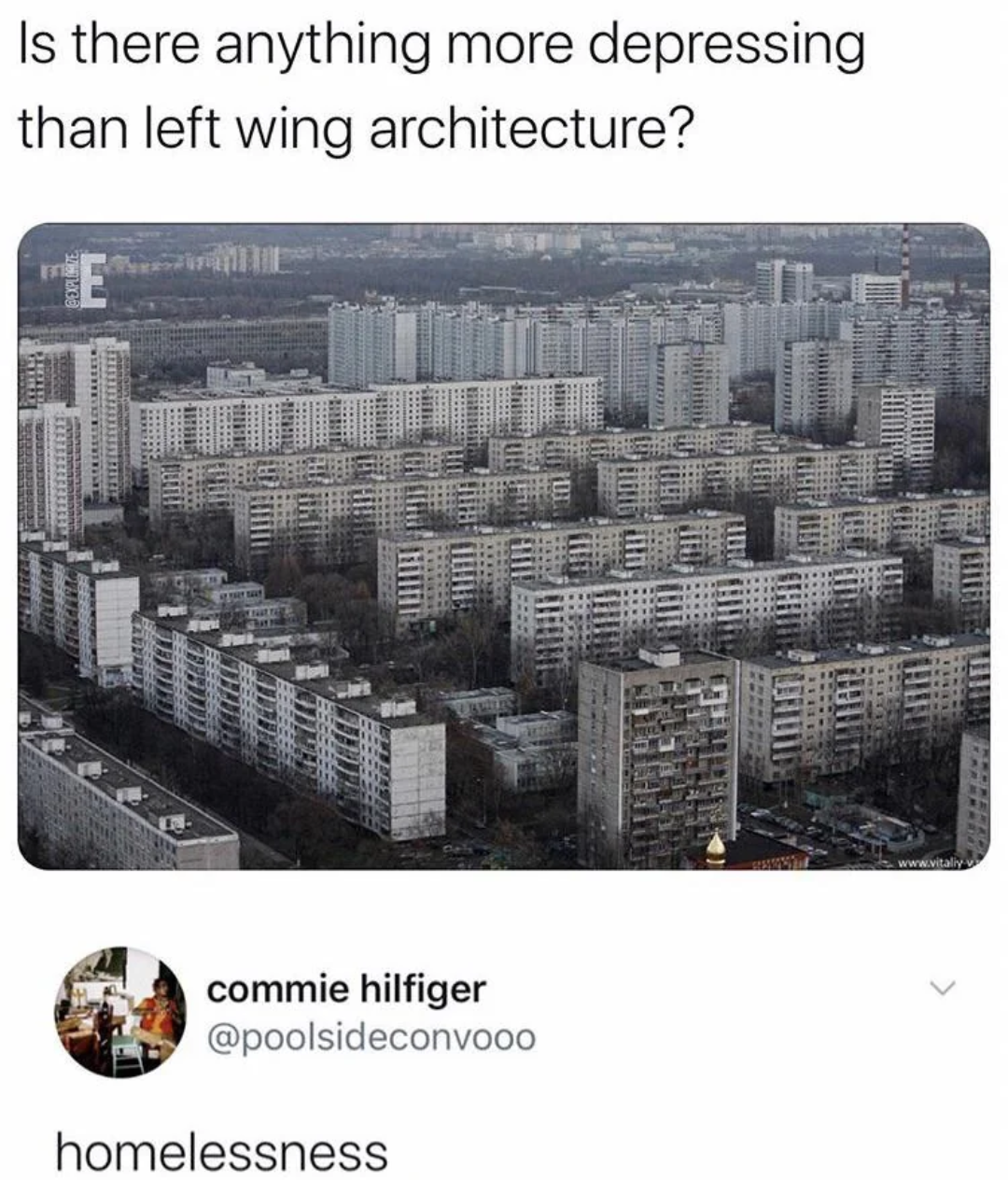
This architectural style is called, no kidding, Soviet Brutalism, and was the primary architectural style featured in the Soviet Union from the 1950s to the 1980s.
It’s a divergence from Western brutalism, focusing more on utopian and futuristic themes.
So, no, it’s not anything political. It’s a cultural thing.
Boston City Hall, for example:
The campus of the Rochester Institute of Technology, a.k.a. “Brick City”:
I would say “socialist modernism”, not " soviet brutalism". Because there are a lot of examples not from ex USSR.
This is Belgrade, Serbia (ex-Yugoslavia):
Museum of Modern Arts:
Hotel “Yugoslavija”:
You should check the link I posted. Honolulu has a crapton of brutalism, so I wouldn’t associate it necessarily with any political movement.
I think where brutalism exists now is more a function of when an area was being developed, and it just happens that those areas underwent substantial development while brutalism was en vogue (late 50’s - late 1970s).
Honolulu has a bunch of brutalism, along with a bunch of other architectural movements
https://thinktechhawaii.com/more-tropical-brutalism-humane-architecture/
I had to screen grab it, but there is actually a brutalist bhudist temple in Chinatown in Honolulu
It wasn’t so much a “style” as what happens when you can only afford to build projects in rubles.
It actually started in France in the 1940s
Soviet housing either followed or was contemporary with Le Corbusier’s ideas of affordable ‘habitation units’, the now-famous cookie-cutter blocks with minimal decoration. The OOP is quite correct in calling it leftist, since the purpose was to have lots of cheap housing: the USSR had huge expansion of it during the fifties-seventies, with massive migration from rural areas to cities (following the less-neat redistribution of housing, wooden barracks, and communal living in the thirties).
Can’t say I like the outcome too much, because arguably same population density can be achieved with lower-rising houses, since they don’t require huge areas between them to have any sunlight. Khrushchev-era districts can be much cozier than later ones, since five-storey buildings are placed closer and have trees right outside the windows.
As was aptly, stated by another commenter here:
So, again, no. This isn’t an example of left-wing architecture. This makes it an example of bad politics.
Soviet right wing refused to spend money on the public good when building millions of buildings across the country? What in the hell are you talking about?
I already gave a lesson in architectural styles. I don’t feel particularly obligated to educate you in Soviet history, nor to engage in a debate on the subject.
Indeed, it was already quite clear that you have no idea what you’re speaking of.
Love me some brutalism.