

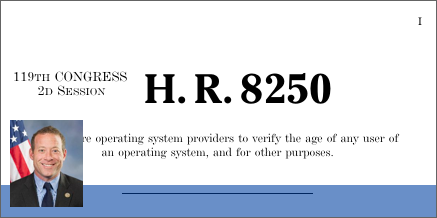
So, OS-level age-gating is going federal, which will effectively kill your rights to device ownership and what’s left of free speech and expression.
Enjoy your free speech while you still have it because this is a clear attempt to erase that right.
SOPA never died, it just went into hiding until time to reemerge, and now’s that time, this is basically SOPA in a save the kids trenchcoat.
I see how this is bad from a privacy standpoint, but how does it affect device ownership?
I would argue it does not directly or obviously impact device ownership. However, to the best of my knowledge, it would be the first time that the US Government has publicly required a specific set of features for consumer software.
To make matters worse, this is an Operating System level requirement, which means it has more permissions than any other piece of software you run. Every device you run today has an Operating System of some kind, so this bill could impact all devices.
So, I think the conclusion that you no longer own the device stems from the fact that it has software on it doing things and collecting information you did not approve. For normal people, there will be no way to avoid it. Tech savvy users will of course find ways to dodge it unless there are enforcement mechanisms and penalties that are sufficiently punitive.
Definitely not a path we should be going down if we actually cared about freedom, much less privacy. Not to mention, this opens up the whole “slippery slope” argument for more direct government control over software.
That’s not a given, it could easily be implemented as a normal application with normal permissions, that the OS starts when needed.
It could be a dangerous path indeed, giving the government full access to your phone. I’m not sure the bill says that though.
But I think most people already do… A huge bunch of apps collect everything they can on you; tiktok used to be the worst. I wouldn’t trust a government less than a private company.
I dunno, maybe forcing companies to put (or remove) specific features on their software could set an interesting legal precedent: it could be used to stop companies from pushing features people don’t want or designing apps with dark patterns.
Yeah, you are right that we already have huge attack surfaces from apps on phones and the phones themselves.
I also agree some regulations and/or laws that prevent companies from engaging in their shady practices and dark patterns would be great if they were enforced and were not simply used to prevent competition by the large companies. I won’t hold my breath though.
If you don’t control it, you don’t really own it. Modern cars can be remotely disabled on the whim of the car maker. Is it really YOUR car if someone else can cripple it or completely disable it without your permission?
It’s already the case with your phone if you use OEM OS: manufacturers can do pretty much whatever they want remotely.
Now it’s the turn of the computers: either it has a “compliant OS” (remotely controllable by 3rd party), or you will be cut off a growing part of basic use.
I’m not sure, but it could erode it when someone else decides if you’re old enough, or maybe later have no convictions, or maybe you’re a reporter the government doesn’t like, and you can’t even verify into the devices you own.
Probably in the sense that you are basically at the mercy of a company that can shut you off of you computer, phone or (depending how far this goes) car.
Ok but isn’t it already the case anyway? How would age verification make it easier?
This is absolutely not the case, and has historically never BEEN the case.
Think of your computer like an old CD player. If you own the player and the CDs you can play them. Forever. NOBODY else gets a say. You can’t be stopped. That’s what ownership MEANS. It means YOURS. Not right now - not a license - not until you don’t get a security update - not “as long as you don’t try to play CDs we don’t like on it”… it means until either you or it physically DIE.
This is how EVERY SINGLE THING you own should be, and every single instance where that is NOT the case is one where something has been stolen from you - every bit as much as if I walked into your house, picked it up, and walked out with it. If my taking something from your house and walking out pisses you off, so should this. I have no idea how to make “I have paid money for something to then have it taken away from me” more anger inducing than it should already be.
It is not always the case today. For instance you can now use Linux on your computer with a local account called myaccount, not tied to your identity in any way. That, by the way, used to be the case with Windows too, until Microsoft killed local accounts not too long ago.
In an age-verification world, if a Linux distro wants to do age verification, you would have to connect to a third party that can certify your age somehow; I haven’t read enough on this to know for sure, but I can’t think of a way to do it without telling that third party who you are, uploading your id or similar privacy-unfriendly things.
Now, that third party has acquired a power on your ability to use your device that they don’t have today.
Then your OS will have to store your age (and hopefully only that) and share it with any of the installed apps that need to verify it, which opens its own can of worms