

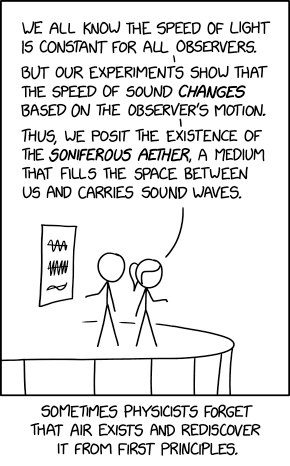
Title text:
Imagine you could ride alongside a sound wave. It would probably be pretty cool, right? We’re putting in a departmental budget request to buy a really fast plane so we can check it out.
Transcript:
Transcript will show once it’s been added to explainxkcd.com
Source: https://xkcd.com/3238/
That is not the speed of light through fiber. That is the speed of light bouncing at diagonal angles as it travels through fiber.
It appears to travel slower because it’s not traveling in a straight line. But I promise, every individual photon is traveling at exactly c. Photons emmited simultaneously will not all arrive at a destination at the same time, but this isn’t because they’re traveling at different speeds, it’s because they’re taking different paths, reflecting and refracting slightly differently.
Do the individual photons slow down? No. But those photons get absorbed by atoms along the way and then a new photon of light is emitted (nearly, but not literally, instantly) which then continues along it’s merry way at C until it encounters another atom. What slows down is the net speed of transport through a given medium.
Not really. Yes of course that is a relevant effect. But photons travel as slower speeds in different materials. Thats what the refractive index indicates of a material.
Edit wait I meant to post this to the other dude, sry. I’m just gonna literally double down.
In 1999, she led a Harvard University team who, by use of a Bose–Einstein condensate, succeeded in slowing a beam of light to about 17 metres per second, and, in 2001, was able to stop a beam completely.[2] Later work based on these experiments led to the transfer of light to matter, then from matter back into light,[3] a process with important implications for quantum encryption and quantum computing.
https://en.wikipedia.org/wiki/Lene_Hau
Not to split hairs here, but that’s also kind of the same thing.
Like what does “refractive” mean? Does it mean moving slower or bouncing around?
In 1999, she led a Harvard University team who, by use of a Bose–Einstein condensate, succeeded in slowing a beam of light to about 17 metres per second, and, in 2001, was able to stop a beam completely.[2] Later work based on these experiments led to the transfer of light to matter, then from matter back into light,[3] a process with important implications for quantum encryption and quantum computing.
https://en.wikipedia.org/wiki/Lene_Hau
Well the name refers to the relative incident and internal angles because that’s what scientists first measured. The light slows down due to interactions with the electrons (mostly) in the material. It causes them to move which drags the light. You can model this as an interference from the light produced by the resulting electron movement. I don’t see that as bouncing, especially not like the bouncing on the internal surfaces of fiber optics. But obviously it’s not like anything we can tangibly understand, so whatever mental model works for you is cool.
That’s fair. Nearly everything at that scale is up for interpretation. I find that nothing in physics works the way it intuitively seems like it should.
So if I bend my internet tube in the right way I can get faster internet?
Get it just right, and yeah, lower latency. It’s not likely to change the bandwidth though. 😉
I thought the majority of the slowdown was because of the refractive index of the glass, where the wave does actually travel slower through the fiber even if it was going in a completely straight line.
Individual photons still travel at exactly c, but there is an effect which I don’t understand that causes the light to slow down (I was taught that this was because light was absorbed and reemitted by the glass molecules but from googling it that’s not true)
Good explanation. It is the same with air, I guess. :)
Exactly, at least that’s my understanding!