No, I mean that the lictors had no power beyond that of other citizens. The lictors had no ability beyond what we would regard as a “citizen’s arrest”. They had no power of their own. If a Praetor told a random citizen on the street to arrest another, the process would be entirely and exactly the same, as well as the punishment for not doing so - nil. A detainment by a lictor was not any more legally binding than a detainment by anyone else. Lictors had no authority, and even the authority of their magistrate was extremely limited in that their detainments, likewise, were not regarded as more lawful than any other citizen bringing in another to court.
hence the rest of the comment. They served a critical role for the local rulers and magistrates.
Not really? Lictors were overwhelmingly ceremonial at any time beyond the earliest years of the Republic.
They were the embodiment and a measurement of the imperium which gave authority over government and military command. Not every citizen held that authority or command, nor does it mean lictors acted independently in their role.
Getting back to it, this meme appears to require a very specific and literal use of ‘cop’ to work.
They were the embodiment and a measurement of the imperium which gave authority over government and military command.
Imperium was by the nature of Roman law extremely limited and specific. What you’re saying has no relevance to the authority of a magistrate to make detentions of citizens on the grounds of criminal or civil wrongdoing.
Getting back to it, this meme appears to require a very specific and literal use of ‘cop’ to work.
“Getting back to it”
Your entire point is that lictors are, in your view, cops, so there’s no ‘back to it’ involved.
If you feel so strongly about the word usage, please define ‘cop’ for me in such a way that would not imply that anarchist polities also have ‘cops’.
My initial point being that they did state sanctioned violence, which was their role, ceremonial and otherwise.
Only insofar as state sanctioned violence is here defined as “any violence acknowledged as legitimate by the state”, which would make every use of self-defense in a modern context also state-sanctioned violence.
So: the association with being a direct embodiment of state authority and power of violence.
So let me get this straight, just so I know what I’m arguing against - your definition of police, in this context, is anyone symbolically associated with the use of violence legitimized by the standards of the polity, even without any attendant legal power.


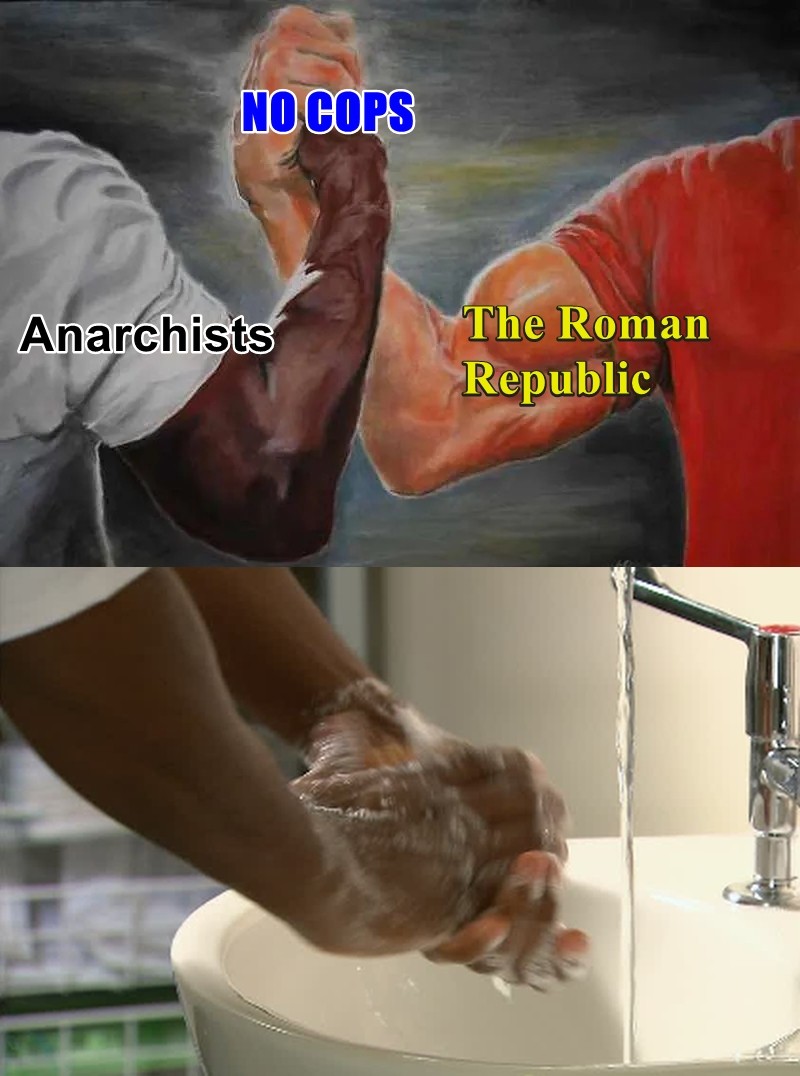
Are you just forgetting about the Lictor? They were a fixture of regal, republic, and imperial Rome. You know, the guys with the fasces?
They were a direct and specific role doing state sanctioned violence for the Praetor. It seems overly selective to exclude this role in Roman society.
Who had no independent power to arrest or detain individuals beyond the power held by other citizens.
‘Other citizens’ such as: the Praetor; hence the rest of the comment. They served a critical role for the local rulers and magistrates.
No, I mean that the lictors had no power beyond that of other citizens. The lictors had no ability beyond what we would regard as a “citizen’s arrest”. They had no power of their own. If a Praetor told a random citizen on the street to arrest another, the process would be entirely and exactly the same, as well as the punishment for not doing so - nil. A detainment by a lictor was not any more legally binding than a detainment by anyone else. Lictors had no authority, and even the authority of their magistrate was extremely limited in that their detainments, likewise, were not regarded as more lawful than any other citizen bringing in another to court.
Not really? Lictors were overwhelmingly ceremonial at any time beyond the earliest years of the Republic.
They were the embodiment and a measurement of the imperium which gave authority over government and military command. Not every citizen held that authority or command, nor does it mean lictors acted independently in their role.
Getting back to it, this meme appears to require a very specific and literal use of ‘cop’ to work.
Imperium was by the nature of Roman law extremely limited and specific. What you’re saying has no relevance to the authority of a magistrate to make detentions of citizens on the grounds of criminal or civil wrongdoing.
“Getting back to it”
Your entire point is that lictors are, in your view, cops, so there’s no ‘back to it’ involved.
If you feel so strongly about the word usage, please define ‘cop’ for me in such a way that would not imply that anarchist polities also have ‘cops’.
My initial point being that they did state sanctioned violence, which was their role, ceremonial and otherwise.
So: the association with being a direct embodiment of state authority and power of violence.
Only insofar as state sanctioned violence is here defined as “any violence acknowledged as legitimate by the state”, which would make every use of self-defense in a modern context also state-sanctioned violence.
So let me get this straight, just so I know what I’m arguing against - your definition of police, in this context, is anyone symbolically associated with the use of violence legitimized by the standards of the polity, even without any attendant legal power.
-Includes the role the lictors played for the praetor.