
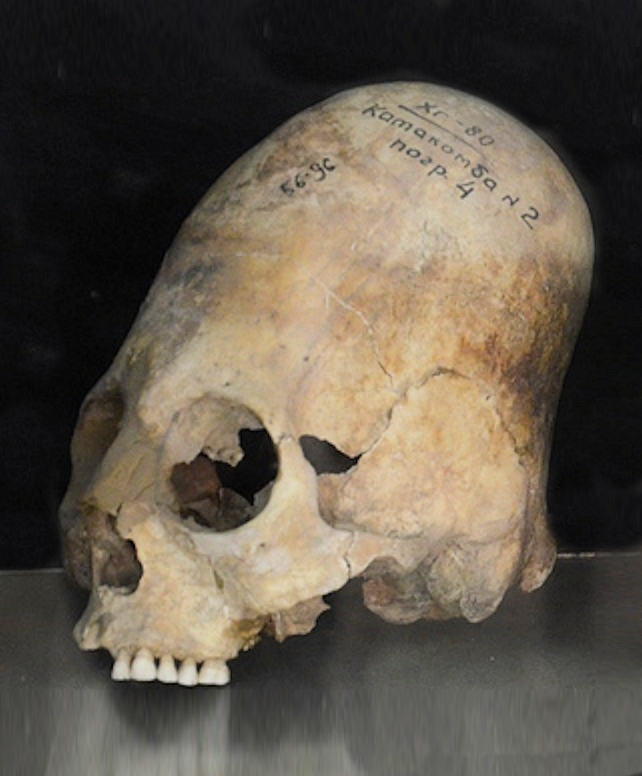
Artificial cranial deformation or modification, head flattening, or head binding is a form of body alteration in which the skull of a human being is deformed intentionally. It is done by distorting the normal growth of a child’s skull by applying pressure. Flat shapes, elongated ones (produced by binding between two pieces of wood), rounded ones (binding in cloth), and conical ones are among those chosen or valued in various cultures.
Alchon kings are generally recognized by their elongated skulls, a result of artificial skull deformation. Archaeologist Cameron Petrie wrote that “The depictions of elongated heads suggest that the Alchon kings engaged in skull modification, which was also practised by the Hun groups that appeared in Europe.” The elongated skulls appear clearly in most portraits of rulers in the coinage of the Alchon Huns, and most visibly on the coinage of Khingila. These elongated skulls, which they obviously displayed with pride, distinguished them from other peoples, such as their predecessors the Kidarites. On their coins, the spectacular skulls came to replace the Sasanian crowns which had been current in the region’s coinage. This practice is also known among other peoples of the steppes, particularly the Huns, and as far as Europe, where it was introduced by the Huns themselves.
The custom of binding babies’ heads in Europe in the twentieth century, though dying out at the time, was still extant in France, and also found in pockets in western Russia, the Caucasus, and in Scandinavia among the Sámi. The reasons for the shaping of the head varied over time, from aesthetic to pseudoscientific ideas about the brain’s ability to hold certain types of thought depending on its shape.
The pre-colonial standard of beauty among these groups were of broad faces and receding foreheads, with the ideal skull dimensions being of equal length and width. The devices used to achieve this include a comb-like set of thin rods known as tangad, plates or tablets called sipit, or padded boards called saop. These were bound to a baby’s forehead with bandages and fastened at the back.
He reported that in the central Philippines, people placed the heads of children between two boards to horizontally flatten their skulls towards the back, and that they viewed this as a mark of beauty. Other historic sources confirmed the practice, further identifying it as also being a practice done by the nobility (tumao) as a mark of social status, although whether it was restricted to nobility is still unclear.
Deformation usually begins just after birth for the next couple of years until the desired shape has been reached or the child rejects the apparatus.
It has also been suggested that the practice of cranial deformation originated as an attempt to emulate groups in which an elongated head shape was a natural condition. The skulls of some ancient Egyptians are among those identified as often being naturally elongated, and macrocephaly may be a familial characteristic.
There is no statistically significant difference in cranial capacity between artificially deformed skulls and normal skulls in Peruvian samples.