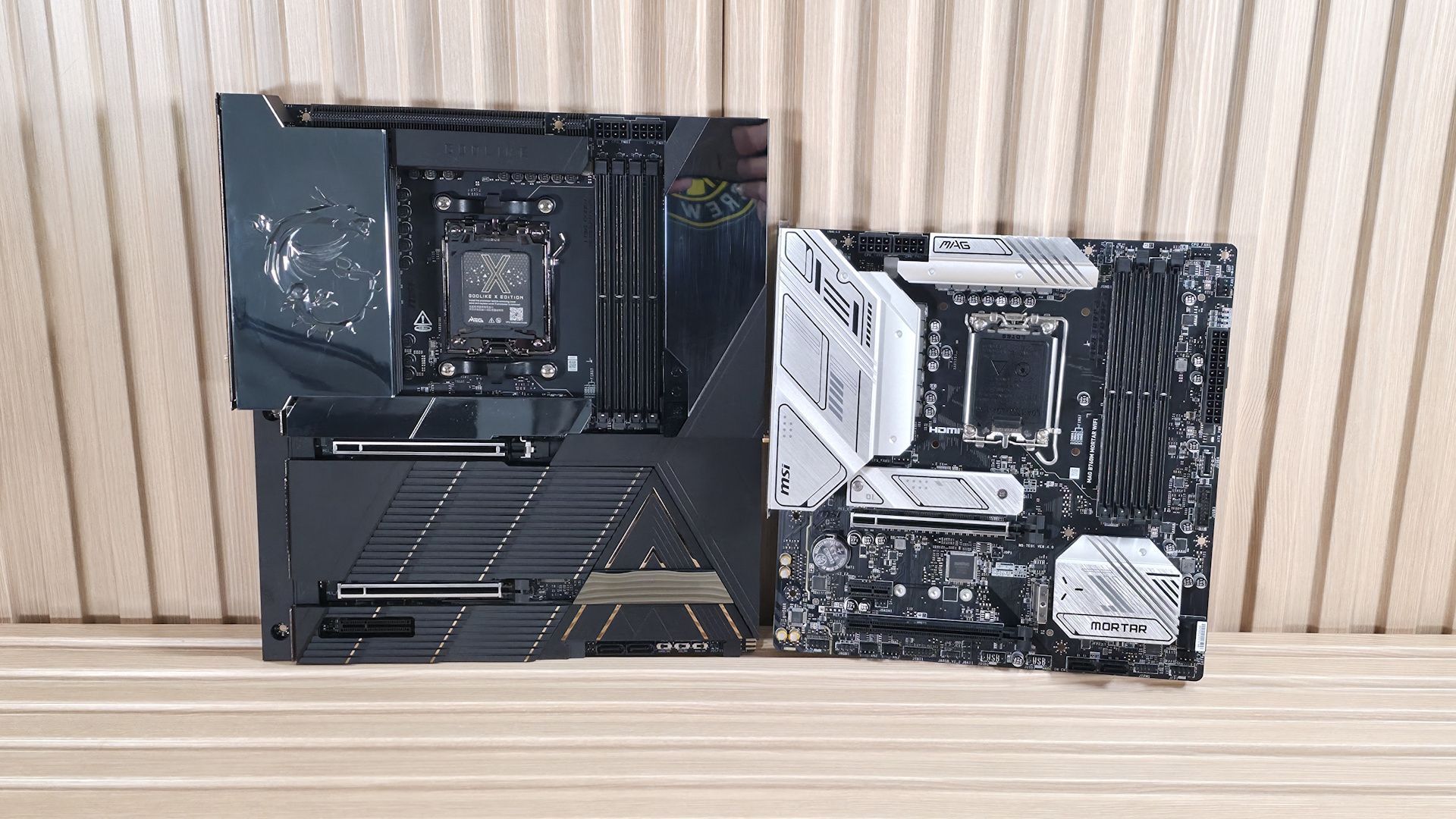
I mean to some degree I can understand it because they offer features that they did not use to offer.
High in numbers of PCIe 16 and PCIe X1 lanes, multiple NVMe connections in addition to typically still four SATA connections, on-board Wi-Fi, BIOS redundancy, dual ethernet connections, multiple USB 5, 10, 20, and even 40 GBPS connections, sometimes with onboard power up to 65 watts.
You do get a lot for a premium motherboard these days.
But honestly, it doesn’t matter if your motherboard costs you $200 if the RAM that you need in order to do what you want to do with it costs $1,300. So what that you can get a really good CPU for 300 bucks when the GPU is 700 for a mid-tier.
A middle of the road computer should not cost $4,000. A middle of the road computer should cost about $1,000, potentially less.
I get your point on features but I’ll push back a bit on specifics. In the early 2010s we already had the many PCIe x16 slots. We used to have 3-way SLI / Crossfire boards with 3x x16 slots since way back when. These days it’s hars to find a board with proper 3x x16 slots for AMD. I was looking the other day at X870E - best I could find was 2x x16 running at x8. Dual BIOS, fat LAN, WiFi and shit ton of USB have been mainstays on high end boards for 15 years. NVMe slots became a thing in the second half of 2010s. The only thing that’s available now which wasn’t when high end boards MSRPed for $300 is the USB-C and its power options as well as the higher speeds on various components - they’re all faster now. You could say that the interconnects are more expensive to make for higher speed buses, and they are. But are they 2x or 3x more expensive? I don’t think so.
Just look at this beast from 2017. This MSRPed fot $290:
I want to also highlight an important economic point that isn’t mentioned often enough. In capitalism where firms optimize for growing profits, in most markets for most firms costs are not connected to prices. Firms do not “pass on” savings or costs. They set prices as high as they can until sales volume starts falling. Prices are set where price times volume is the highest. It doesn’t matter if the producrion cost is $0.1, $10, $100 or $1000. At the same time cost is kept as low as possible. It doesn’t matter what the price is. Both the price and the cost are set independently from each other as they are set on differrent markets where the firms have different market power and level competition. ASRock sells boards in the PC mobo market which bears certain prices. Their costs come from IC and other chip supplier markets that have completely different producers and consuners in numbers, sizes, etc. Only when the market ASRock sells into has high competition (not just several competitors but at least ten-twenty) that appear to fight on price, only then, their prices get cmpressed close to their costs and a relationship between cost and price forms where rising/lowering costs increase/lower prices. Now here’s the other important bit - such competitive environments where prices are connected to costs are rare and temporary. Losers in these environments either disappear or get bought by the winners, over time getting to a consolidated industry where competition does not play a significant role in prices and the connection to costs is gone. I know business people, especially those running firms that charge us high prices love to tell us through corpo media that costs have gone up and they’ll have to charge us more but that is more often than not - bullshit. Whether they give us any more product than they gave us before or not. They set prices as high as the market will bear. Not to their cost plus some number they feel they deserve on top. Their goal, as set by their board and ultimately major shareholders is to grow profit. If they don’t, they get replaced by someone who would. This is what a growing stock price (or dividend) requires and the system collapses when too many lines don’t go up. So the business man has to charge you as much as he can for that motherboard… and RAM…and eggs…
I apologise for the wall of text. I hope it was entertaining. 😄


I mean to some degree I can understand it because they offer features that they did not use to offer.
High in numbers of PCIe 16 and PCIe X1 lanes, multiple NVMe connections in addition to typically still four SATA connections, on-board Wi-Fi, BIOS redundancy, dual ethernet connections, multiple USB 5, 10, 20, and even 40 GBPS connections, sometimes with onboard power up to 65 watts.
You do get a lot for a premium motherboard these days.
But honestly, it doesn’t matter if your motherboard costs you $200 if the RAM that you need in order to do what you want to do with it costs $1,300. So what that you can get a really good CPU for 300 bucks when the GPU is 700 for a mid-tier.
A middle of the road computer should not cost $4,000. A middle of the road computer should cost about $1,000, potentially less.
Motherboards
I get your point on features but I’ll push back a bit on specifics. In the early 2010s we already had the many PCIe x16 slots. We used to have 3-way SLI / Crossfire boards with 3x x16 slots since way back when. These days it’s hars to find a board with proper 3x x16 slots for AMD. I was looking the other day at X870E - best I could find was 2x x16 running at x8. Dual BIOS, fat LAN, WiFi and shit ton of USB have been mainstays on high end boards for 15 years. NVMe slots became a thing in the second half of 2010s. The only thing that’s available now which wasn’t when high end boards MSRPed for $300 is the USB-C and its power options as well as the higher speeds on various components - they’re all faster now. You could say that the interconnects are more expensive to make for higher speed buses, and they are. But are they 2x or 3x more expensive? I don’t think so.
Just look at this beast from 2017. This MSRPed fot $290:
https://www.techpowerup.com/review/asrock-x299-taichi/
Capitalism
I want to also highlight an important economic point that isn’t mentioned often enough. In capitalism where firms optimize for growing profits, in most markets for most firms costs are not connected to prices. Firms do not “pass on” savings or costs. They set prices as high as they can until sales volume starts falling. Prices are set where price times volume is the highest. It doesn’t matter if the producrion cost is $0.1, $10, $100 or $1000. At the same time cost is kept as low as possible. It doesn’t matter what the price is. Both the price and the cost are set independently from each other as they are set on differrent markets where the firms have different market power and level competition. ASRock sells boards in the PC mobo market which bears certain prices. Their costs come from IC and other chip supplier markets that have completely different producers and consuners in numbers, sizes, etc. Only when the market ASRock sells into has high competition (not just several competitors but at least ten-twenty) that appear to fight on price, only then, their prices get cmpressed close to their costs and a relationship between cost and price forms where rising/lowering costs increase/lower prices. Now here’s the other important bit - such competitive environments where prices are connected to costs are rare and temporary. Losers in these environments either disappear or get bought by the winners, over time getting to a consolidated industry where competition does not play a significant role in prices and the connection to costs is gone. I know business people, especially those running firms that charge us high prices love to tell us through corpo media that costs have gone up and they’ll have to charge us more but that is more often than not - bullshit. Whether they give us any more product than they gave us before or not. They set prices as high as the market will bear. Not to their cost plus some number they feel they deserve on top. Their goal, as set by their board and ultimately major shareholders is to grow profit. If they don’t, they get replaced by someone who would. This is what a growing stock price (or dividend) requires and the system collapses when too many lines don’t go up. So the business man has to charge you as much as he can for that motherboard… and RAM… and eggs…
I apologise for the wall of text. I hope it was entertaining. 😄