PC games are pretty much locked down to the original purchaser. Console games could be bought and sold used. Once I was done with a console generation I just sold everything on ebay and made back a bunch of my money (especially since I bought most of it used as well).
PC games are a whole different beast. But now that most console games are locked to an account… there’s really no benefit of them anymore. Just get a PC for your living room and install SteamOS (or similar).
Back in the era of physical media PC games too could be bought and sold used (though only some: it really boiled down to whether it used phone-home DRM or not, something which in the PC world was all over the place).
But yeah, you were right that console games could be bought and sold used in a much more standardized way, whilst that wasn’t really a value proposition in the PC were such possibility was not at all a standard feature of PC games and it wasn’t really reliably supported in the broader ecosystem (for example, with game stores not usually buying back used PC games as they often did for console games).
Naturally, as a unique value proposition (vs PC games) used as bait to get users inside the console walled garden in earlier days, this feature of console games was taken away from users with their enshittification.
Personally, I always thought that in the PC world the absence of this was balanced by games being a lot cheaper and even piracy for those for whom even the cheaper PC games weren’t cheap enough, and in the long run, as we see, the “much cheaper” part is being way harder for PC publishers to try and undo (they’ve definitely tried of late, and IMHO it’s failing which is why AAA game publishers are bitching and moaning that their market share is falling) than the used console games market was, and the piracy part is even harder.
If there’s one think I learned early on in Tech as a professional already back in the 90s is that in the mid and long term sticking to open tech will save you from getting squeezed, both as a professional when choosing 3rd party tech stacks and as a consumer. This has just become more so as the normalization of always-on Internet connectivity meant that the external 3rd party could control much more tightly and and in realtime how the software they provided was used, including adding further restrictions on use at a later stage.


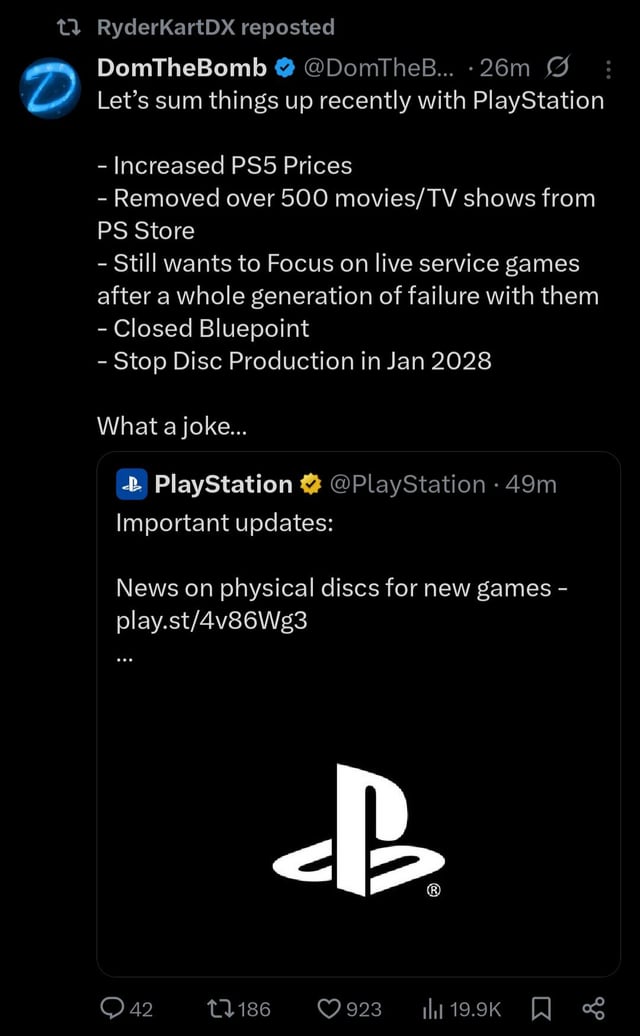
PC games are pretty much locked down to the original purchaser. Console games could be bought and sold used. Once I was done with a console generation I just sold everything on ebay and made back a bunch of my money (especially since I bought most of it used as well).
PC games are a whole different beast. But now that most console games are locked to an account… there’s really no benefit of them anymore. Just get a PC for your living room and install SteamOS (or similar).
Back in the era of physical media PC games too could be bought and sold used (though only some: it really boiled down to whether it used phone-home DRM or not, something which in the PC world was all over the place).
But yeah, you were right that console games could be bought and sold used in a much more standardized way, whilst that wasn’t really a value proposition in the PC were such possibility was not at all a standard feature of PC games and it wasn’t really reliably supported in the broader ecosystem (for example, with game stores not usually buying back used PC games as they often did for console games).
Naturally, as a unique value proposition (vs PC games) used as bait to get users inside the console walled garden in earlier days, this feature of console games was taken away from users with their enshittification.
Personally, I always thought that in the PC world the absence of this was balanced by games being a lot cheaper and even piracy for those for whom even the cheaper PC games weren’t cheap enough, and in the long run, as we see, the “much cheaper” part is being way harder for PC publishers to try and undo (they’ve definitely tried of late, and IMHO it’s failing which is why AAA game publishers are bitching and moaning that their market share is falling) than the used console games market was, and the piracy part is even harder.
If there’s one think I learned early on in Tech as a professional already back in the 90s is that in the mid and long term sticking to open tech will save you from getting squeezed, both as a professional when choosing 3rd party tech stacks and as a consumer. This has just become more so as the normalization of always-on Internet connectivity meant that the external 3rd party could control much more tightly and and in realtime how the software they provided was used, including adding further restrictions on use at a later stage.