These pressures arise due to desire for profits, as well as the tendency for citizens to feel a lack of agency when they dont control their economic freedom, and therefore voting for the trumps of the world.
We could try regulation again, but thats what FDR did, and look where we are.
As much as economists like to pretend, capitalism is not a political system. The goal is exploitation because we choose so. As a society we could just as easily choose to make our goal the maximal fulfillment of the needs of the public. All that takes is preventing those without a personal concept of “enough” from controlling capital.
Capitalism is an exploitation system. It will exploitation what it needs to, to ensure it continues. If that is policies then it will do so. Preventing those without the concept of enough from controlling capital is an an uphill battle. Easier said than done
Theft and rape get muddy but we still prosecute those. Society needs to draw a line somewhere.
For example say 100% tax after $50 million net worth. Or 1 year in jail for executive officers of a company if the net income (stock counts as income valued at the price when acquired) of the highest paid person in a company makes more than 30x the lowest paid person. Or we just drone strike Forbes richest person every year. We just need to draw a line.
That’s just not possible when you factor in both accumulation of wealth (it’s exponential like compound interest) and the competition between capitalists for profit. The competition does not come from their moral beliefs but from the incentives created by the system itself.
All that takes is preventing those without a personal concept of “enough” from controlling capital.
This would require to remove capital from the hands of individuals and either throw it in the hands of the state, or change its (corporate) ownership to co-op model (one worker - one vote). Both have been shown to work but that would no longer be capitalism but instead a form of socialism, as private capital would no longer dictate what’s produced in the economy and how it’s distributed. Instead it would be dictated by the state which is controlled by the people through some form of democracy, or democratically by the workers within each corporation, or both. In both cases what’s produced is dictated by the needs of the majority of the workers in that state. And that’s textbook socialism.
Das Kapital was published in 1867. Modern psychology is considered to have begun in 1879. The first DSM was not published til 1952. Marx understood economics but he has an archaic understanding of human psychology which cripples his work.
Modern economic theory incorporates behavioral economics. In reality people don’t always act rationally or optimally. Time restraints, cognitive limitations, emotional attachment, and trauma all affect decision making.
We are living in an example of how the working class will vote against their own material interests and how deprivation of resources doesn’t inevitably lead to a proletariat uprising.
Nowhere within Capital does Marx actually say proletarian uprising is inevitable; he arguably alludes to this in the Afterword to the Second German Ed. but it’s actually a difficult question whether proletarian revolution is inevitable in Marxism in the first place.
It was obviously known in Marx’s time that people don’t always act rationally or optimally. This isn’t the basis for Marx’s theory.
None of that goes against Marx, though. Marxist economics does not depend on people acting rationally 100% of the time. The working classes do not control bourgeois elections, the fact that you think this is a point against Marx points to unfamiliarity with Marxism more than anything.
Accumulated wealth is a choice. We can tax inheritance at 100% beyond a certain point (say 100,000x the federal minimum wage).
The competition does not come from their moral beliefs but from the incentives created by the system itself.
Disagree. It is a choice to not say to yourself “I have enough. I am stopping work and donating all this wealth I don’t need to charity.” It is a choice not to make your fortune, retire, and then give ownership of the company to the employees who made you successful. Society once chose to treat homosexuality as a mental illness. No reason we couldn’t do the same for greed.
We say people can’t use slave labor. We say kids can’t work. There is no reason we couldn’t say people above a certain wealth threshold can’t work. That’s just regulation, not socialism.
You cannot separate economics from politics, they are infinitely intertwined. The only way to actually control political economy by humans, rather than the capitalist control system, is through socialism. Collectivizing production and distribution and running it on a common plan, rather than profit, is the path to overcoming the way the profit motive shapes society and the state.
The fundamental problem is scarcity. If someone has to choose between themselves experiencing scarcity or someone else, people will almost always choose someone else. In that sense profit will always exist.
Personally I see capitalism and socialism as tools which can each be used when appropriate. Capitalism is great for getting 30 flavors of breakfast cereal (innovation with failure being acceptable). Socialism is great for things like healthcare or firefighting (failure is not acceptable, innovation not essential).
With the fire department , the government owns the means of production (fire houses, trucks, etc) and sets the prices instead of the free market (paid for by taxes). That is socialism. Public healthcare may or may not be depending on what system it is.
That isn’t capitalism or socialism. Both are modes of production dependent on which aspect of the economy is principal, ie rising and dominant, and which class controls the state. You’re horribly mixing up welfare for socialism.
Both are modes of production dependent on which aspect of the economy is principal,
which class controls the state
This is an interesting element. The USSR under Stalin was controlled by a few elites. That doesn’t make it capitalist. The US is a democracy, so it is controlled by the people . That doesn’t make it socialist. An economic system is not a political system and vice versa.
Welfare can be a part of a capitalist or socialist system, but is not those systems itself. You are trying to slice up parts of a cohesive system and treat those constituent parts as though they form an independent system themselves, but this is incorrect. The consequences of this error result in confused understandings of bodies like the US military as “socialism,” despite being a tool of monopoly finance capital. This is why the identity of an overall system is in its principal aspect, as this principal aspect determines how the rest of the system functions.
As for the USSR, it was run by the working classes. Classes are relations to ownership of production and distribution, not simply income levels or levels of administrative authority. You are referring to workers in the central committee and CPSU as “elites,” yet they were paid wages and did not own any capital. Just like a principal is the same class as a teacher, so too are administrators in socialist economies the same class as factory workers. The USSR had a form of democracy that began at the local level, and laddered upwards through councils called Soviets.
The US Empire is not democratic. The only viable political parties are those run and owned by capitalists, so candidates are representatives of that class. The media is owned by the capitalist class as well. The majority does not run society, they pick between outcomes already decided as okay by the capitalist class.
In trying to slice up systems and pretend there is no meaningful interaction between these, and that instead these systems are functionally independent, you are making metaphysical errors in analysis.
You are trying to slice up parts of a cohesive system and treat those constituent parts as though they form an independent system themselves, but this is incorrect.
Ah, I see the issue here. I am not arguing that the system is entirely capitalist or socialist. I am arguing that a system can contain sectors that operate under one system while other sectors operate under the other. The “principal aspect” certainly applies as a general description of the whole, but that doesn’t change the nature of individual elements.
Classes are relations to ownership of production and distribution, not simply income levels or levels of administrative authority
I would argue classes are determined by power. In the USSR, the power was held by the government and organized crime, not workers.
The US is a democratic republic. No matter how much capital you have, you can’t gain power without convincing people to vote for you. Granted money makes this easier, but it is not sure thing. Look at Elon Musk. He tried to use his money to force his way into government with that DOGE thing, but it failed miserably and he was pushed back.
The majority does not run society, they pick between outcomes already decided as okay by the capitalist class.
Was it any different in the USSR with the party making all the choices? Power always sets up the game board we all play on.
Exploitation is fundamental to the existence of capitalism, it cannot exist without it, at least in my opinion, and the opinion of many other economists.
In neoclassical economics (or at least to plenty of neoclassical economists - neoclassical being the prevalent theory in modern western society), the term “exploitation” refers to the exploitation of labour, which is when wages are lower than the marginal productivity of labour.
To put it simply, surplus value is the difference between the value added by the labourer (for example, the assembly of car parts into a car, or turning raw materials into a product), and the wages they are paid.
Surplus value also has another name: profit.
The whole basis of capitalist economics is to prioritize, reward and encourage the maximization of profit. Based on my statements above, there is only one way to do that: exploiting labour. Thus, exploitation is not only prevalent in capitalism, but encouraged, rewarded, and required, otherwise the business will fail because it cannot keep up.
The definition of capitalism has nothing to do with how the profits are distributed. As long as individuals or businesses own the means of production and prices are determined by the free market rather than the government, that is capitalism.
A free market is often (not necessarily) a characteristic of capitalism, but it’s not what makes a system capitalist. Capitalism is specifically when the means of production (the “capital”) are privately owned (by a single “capitalist” or a group of shareholder capitalists).
This is opposed to socialism where the working class owns the means of production. Socialism vs capitalism basically comes down to who owns the mills and factories , the people who work there or some fat cat on a yacht somewhere? You can Google it for better explanations than I can give.
I don’t see why someone would. You are obliged to do the minimum research yourself if you want to meaningfully participate in these discussions. You are arguing for your gut feeling as reality, and being belligerent with people who disagree. This is an incredibly common pattern and it indicates that everyone is better off just ignoring you.
Capitalism doesn’t have a monopoly over the idea of exchanging goods and services. It’s all about accumulation of wealth and will pursue it endlessly because it has no endgame. Union busting; laying off 8,000 employees on leave (Meta); appeasing shareholders over the customers that made them wealthy; burying us all in AI slop.
Man, the amount of people that think capitalism is a system of money exchange almost seems like one of the major issues somehow, as if people are afraid that they won’t be able to afford things, because there won’t be money. Neglecting that they already can’t afford things, because capitalism is a parasite that kills the host, not because tokens of value can exist outside that perversion.
Capitalism necessarily creates a class of owners of capital that shrink in size and gain in assets. This then shapes the state and controls it. You cannot truly think the dominance of capitalists is compatible with democracy, democracy can only be achieved under socialism, when the working class is the ruling class.
Maybe it is, but they’re definitely at odds regarding the structure of society.
The core principle of democracy is equality: every person gets one vote, law applies to everyone equally, and so on.
Capitalism tends towards a pyramidal form, with few rich people at the top and masses of poor people at the bottom.
With checks and balances you can try to flatten the pyramid a bit and make it viable, sure. But there’s always the risk of moving from democracy to something whose structure aligns with the capitalist pyramids, which we usually call fascism.
To be fair, it never worked. Debate-as-bloodsport is largely a bourgeois way of viewing ideological conflict. Leftist pedagogy is more collective than classic models. The idea of a “marketplace of ideas” assumes that logical victors of an argument survive, but instead people license themselves into agreeing with that which they believe benefits them. The ruling class further propogates ruling class ideology, and uses this idea of a “winners survive” debate market to legitimize the prevalence of bourgeois ideology as such due to logically surviving, even if it never did. The marketplace of ideas is a sham.
They generally do still! The internet has given both alternate means of subverting and enforcing cultural hegemony. This struggle of underground vs. above-ground ideological conflict has historically unfolded in similar ways. We need to advance and understand how best to gain leverage, asserting proletarian ideology. Leftist pedagogy is understudied for how critical it is.


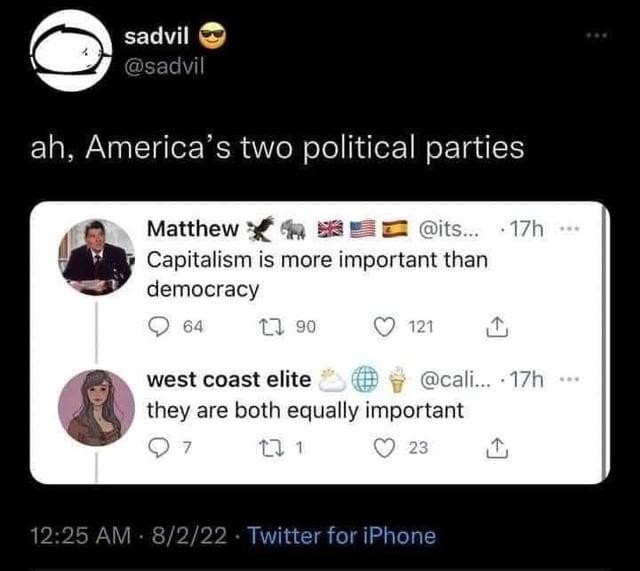
Removed by mod
In the long term, I don’t believe it is.
The pressure from capitalism to:
These pressures arise due to desire for profits, as well as the tendency for citizens to feel a lack of agency when they dont control their economic freedom, and therefore voting for the trumps of the world.
We could try regulation again, but thats what FDR did, and look where we are.
No not really. Capitalism seeks to exploit, it will exploit democracy (see:the world)
As much as economists like to pretend, capitalism is not a political system. The goal is exploitation because we choose so. As a society we could just as easily choose to make our goal the maximal fulfillment of the needs of the public. All that takes is preventing those without a personal concept of “enough” from controlling capital.
Capitalism is an exploitation system. It will exploitation what it needs to, to ensure it continues. If that is policies then it will do so. Preventing those without the concept of enough from controlling capital is an an uphill battle. Easier said than done
Not if you make greed a capital offense (pun intended).
Sure but who will enforce that what is defined as greed? It gets very muddy
Theft and rape get muddy but we still prosecute those. Society needs to draw a line somewhere.
For example say 100% tax after $50 million net worth. Or 1 year in jail for executive officers of a company if the net income (stock counts as income valued at the price when acquired) of the highest paid person in a company makes more than 30x the lowest paid person. Or we just drone strike Forbes richest person every year. We just need to draw a line.
Love that idea!
That’s just not possible when you factor in both accumulation of wealth (it’s exponential like compound interest) and the competition between capitalists for profit. The competition does not come from their moral beliefs but from the incentives created by the system itself.
This would require to remove capital from the hands of individuals and either throw it in the hands of the state, or change its (corporate) ownership to co-op model (one worker - one vote). Both have been shown to work but that would no longer be capitalism but instead a form of socialism, as private capital would no longer dictate what’s produced in the economy and how it’s distributed. Instead it would be dictated by the state which is controlled by the people through some form of democracy, or democratically by the workers within each corporation, or both. In both cases what’s produced is dictated by the needs of the majority of the workers in that state. And that’s textbook socialism.
How to make a cluekess dude read Marx? It’s baffling that we have to answer the same questions again and again.
Das Kapital was published in 1867. Modern psychology is considered to have begun in 1879. The first DSM was not published til 1952. Marx understood economics but he has an archaic understanding of human psychology which cripples his work.
Can you elaborate? How does Marx’s understanding of human psychology hold back his work?
Modern economic theory incorporates behavioral economics. In reality people don’t always act rationally or optimally. Time restraints, cognitive limitations, emotional attachment, and trauma all affect decision making.
We are living in an example of how the working class will vote against their own material interests and how deprivation of resources doesn’t inevitably lead to a proletariat uprising.
Nowhere within Capital does Marx actually say proletarian uprising is inevitable; he arguably alludes to this in the Afterword to the Second German Ed. but it’s actually a difficult question whether proletarian revolution is inevitable in Marxism in the first place.
It was obviously known in Marx’s time that people don’t always act rationally or optimally. This isn’t the basis for Marx’s theory.
None of that goes against Marx, though. Marxist economics does not depend on people acting rationally 100% of the time. The working classes do not control bourgeois elections, the fact that you think this is a point against Marx points to unfamiliarity with Marxism more than anything.
Yes, let’s hear it from the liberal.
New questions for you to answer: https://archive.org/details/19thcenturyphil
Sheesh. 🤷♂️
Accumulated wealth is a choice. We can tax inheritance at 100% beyond a certain point (say 100,000x the federal minimum wage).
Disagree. It is a choice to not say to yourself “I have enough. I am stopping work and donating all this wealth I don’t need to charity.” It is a choice not to make your fortune, retire, and then give ownership of the company to the employees who made you successful. Society once chose to treat homosexuality as a mental illness. No reason we couldn’t do the same for greed.
We say people can’t use slave labor. We say kids can’t work. There is no reason we couldn’t say people above a certain wealth threshold can’t work. That’s just regulation, not socialism.
You cannot separate economics from politics, they are infinitely intertwined. The only way to actually control political economy by humans, rather than the capitalist control system, is through socialism. Collectivizing production and distribution and running it on a common plan, rather than profit, is the path to overcoming the way the profit motive shapes society and the state.
The fundamental problem is scarcity. If someone has to choose between themselves experiencing scarcity or someone else, people will almost always choose someone else. In that sense profit will always exist.
Personally I see capitalism and socialism as tools which can each be used when appropriate. Capitalism is great for getting 30 flavors of breakfast cereal (innovation with failure being acceptable). Socialism is great for things like healthcare or firefighting (failure is not acceptable, innovation not essential).
Socialism is not when the state owns or regulates some things. There is nothing inherently socialist about public healthcare or firefighters.
With the fire department , the government owns the means of production (fire houses, trucks, etc) and sets the prices instead of the free market (paid for by taxes). That is socialism. Public healthcare may or may not be depending on what system it is.
No, it isn’t.
Why?
That isn’t capitalism or socialism. Both are modes of production dependent on which aspect of the economy is principal, ie rising and dominant, and which class controls the state. You’re horribly mixing up welfare for socialism.
Welfare can be and often is socialism.
This is an interesting element. The USSR under Stalin was controlled by a few elites. That doesn’t make it capitalist. The US is a democracy, so it is controlled by the people . That doesn’t make it socialist. An economic system is not a political system and vice versa.
Welfare can be a part of a capitalist or socialist system, but is not those systems itself. You are trying to slice up parts of a cohesive system and treat those constituent parts as though they form an independent system themselves, but this is incorrect. The consequences of this error result in confused understandings of bodies like the US military as “socialism,” despite being a tool of monopoly finance capital. This is why the identity of an overall system is in its principal aspect, as this principal aspect determines how the rest of the system functions.
As for the USSR, it was run by the working classes. Classes are relations to ownership of production and distribution, not simply income levels or levels of administrative authority. You are referring to workers in the central committee and CPSU as “elites,” yet they were paid wages and did not own any capital. Just like a principal is the same class as a teacher, so too are administrators in socialist economies the same class as factory workers. The USSR had a form of democracy that began at the local level, and laddered upwards through councils called Soviets.
The US Empire is not democratic. The only viable political parties are those run and owned by capitalists, so candidates are representatives of that class. The media is owned by the capitalist class as well. The majority does not run society, they pick between outcomes already decided as okay by the capitalist class.
In trying to slice up systems and pretend there is no meaningful interaction between these, and that instead these systems are functionally independent, you are making metaphysical errors in analysis.
Ah, I see the issue here. I am not arguing that the system is entirely capitalist or socialist. I am arguing that a system can contain sectors that operate under one system while other sectors operate under the other. The “principal aspect” certainly applies as a general description of the whole, but that doesn’t change the nature of individual elements.
I would argue classes are determined by power. In the USSR, the power was held by the government and organized crime, not workers.
The US is a democratic republic. No matter how much capital you have, you can’t gain power without convincing people to vote for you. Granted money makes this easier, but it is not sure thing. Look at Elon Musk. He tried to use his money to force his way into government with that DOGE thing, but it failed miserably and he was pushed back.
Was it any different in the USSR with the party making all the choices? Power always sets up the game board we all play on.
Screwing your fellow person isn’t what profit is.
Exploitation is fundamental to the existence of capitalism, it cannot exist without it, at least in my opinion, and the opinion of many other economists.
In neoclassical economics (or at least to plenty of neoclassical economists - neoclassical being the prevalent theory in modern western society), the term “exploitation” refers to the exploitation of labour, which is when wages are lower than the marginal productivity of labour.
To put it simply, surplus value is the difference between the value added by the labourer (for example, the assembly of car parts into a car, or turning raw materials into a product), and the wages they are paid.
Surplus value also has another name: profit.
The whole basis of capitalist economics is to prioritize, reward and encourage the maximization of profit. Based on my statements above, there is only one way to do that: exploiting labour. Thus, exploitation is not only prevalent in capitalism, but encouraged, rewarded, and required, otherwise the business will fail because it cannot keep up.
What would differ is where the profit goes. It doesn’t have to go to one individual.
It ought to go to the people who created the value, but that wouldn’t be capitalism unless they are self-employed.
The definition of capitalism has nothing to do with how the profits are distributed. As long as individuals or businesses own the means of production and prices are determined by the free market rather than the government, that is capitalism.
Removed by mod
That’s not what capitalism means. Nice projection though!
Removed by mod
A free market is often (not necessarily) a characteristic of capitalism, but it’s not what makes a system capitalist. Capitalism is specifically when the means of production (the “capital”) are privately owned (by a single “capitalist” or a group of shareholder capitalists).
This is opposed to socialism where the working class owns the means of production. Socialism vs capitalism basically comes down to who owns the mills and factories , the people who work there or some fat cat on a yacht somewhere? You can Google it for better explanations than I can give.
Maybe you should try a cursory internet check for the definition first
Removed by mod
I don’t see why someone would. You are obliged to do the minimum research yourself if you want to meaningfully participate in these discussions. You are arguing for your gut feeling as reality, and being belligerent with people who disagree. This is an incredibly common pattern and it indicates that everyone is better off just ignoring you.
deleted by creator
Capitalism doesn’t have a monopoly over the idea of exchanging goods and services. It’s all about accumulation of wealth and will pursue it endlessly because it has no endgame. Union busting; laying off 8,000 employees on leave (Meta); appeasing shareholders over the customers that made them wealthy; burying us all in AI slop.
Man, the amount of people that think capitalism is a system of money exchange almost seems like one of the major issues somehow, as if people are afraid that they won’t be able to afford things, because there won’t be money. Neglecting that they already can’t afford things, because capitalism is a parasite that kills the host, not because tokens of value can exist outside that perversion.
Thats commercialism not capitalism lol
When money is power, votes mean nothing.
Capitalism necessarily creates a class of owners of capital that shrink in size and gain in assets. This then shapes the state and controls it. You cannot truly think the dominance of capitalists is compatible with democracy, democracy can only be achieved under socialism, when the working class is the ruling class.
Maybe it is, but they’re definitely at odds regarding the structure of society.
The core principle of democracy is equality: every person gets one vote, law applies to everyone equally, and so on.
Capitalism tends towards a pyramidal form, with few rich people at the top and masses of poor people at the bottom.
With checks and balances you can try to flatten the pyramid a bit and make it viable, sure. But there’s always the risk of moving from democracy to something whose structure aligns with the capitalist pyramids, which we usually call fascism.
Really? How come the “free market” fails entirely without regulation?
How did the “market of ideas” work prior to the internet?
To be fair, it never worked. Debate-as-bloodsport is largely a bourgeois way of viewing ideological conflict. Leftist pedagogy is more collective than classic models. The idea of a “marketplace of ideas” assumes that logical victors of an argument survive, but instead people license themselves into agreeing with that which they believe benefits them. The ruling class further propogates ruling class ideology, and uses this idea of a “winners survive” debate market to legitimize the prevalence of bourgeois ideology as such due to logically surviving, even if it never did. The marketplace of ideas is a sham.
i was gonna say that prior to the internet the ruling class had a monopoly on public opinion but that works too
They generally do still! The internet has given both alternate means of subverting and enforcing cultural hegemony. This struggle of underground vs. above-ground ideological conflict has historically unfolded in similar ways. We need to advance and understand how best to gain leverage, asserting proletarian ideology. Leftist pedagogy is understudied for how critical it is.
How can an economic system that encourages and rewards concentration of power be compatible with democracy?
In the same way licking the elephants foot is compatible with life, yeah.