

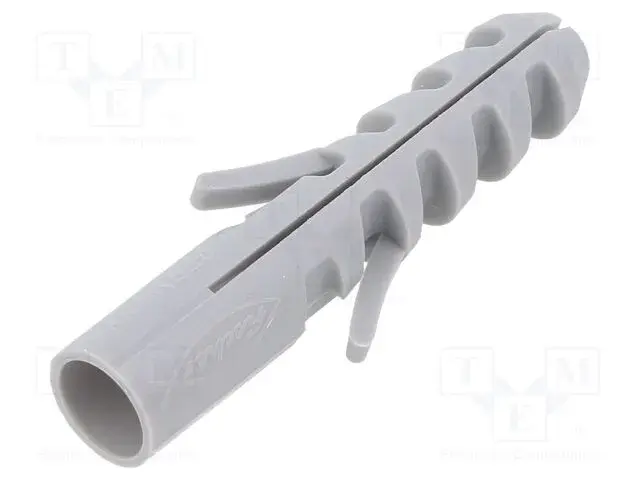
I used a 10mm masonry bit to drill for a 10mm plastic anchor like that pictured. The anchor spins freely in the hole, which I think is expected. I thought I read somewhere that the screw size should be 2mm less than the anchor. Thus 8mm for a 10mm ø anchor. But an 8mm screw is fat enough to rub sides of the anchor as it is inserted because I suppose the anchor is only 1mm thick at the opening. The guy at the shop confirmed that 8mm is too big. He said a 6mm screw matches and sold me those. After installing and loading, the anchor started to pull out.
Do I need a 7mm ø screw? Odd sizes get decreasingly common above 5mm. Yet 10mm sleeves are very common… so it’s not adding up.
I would like to have a reliable PDF chart of bore,anchor, and screw sizes – in metric. It seems there are plenty of such charts for Imperial/English units, like these:
- http://nfaspace.com/services/Forms_files/Anchor Classification Guide.pdf
- https://anchors.dewalt.com/anchors/_documents/uploads/DWANF_ICDWANCHSG_r01.pdf?1659150839
I’m not sure what a “#10” screw or anchor is (sometimes also written as “№10”). Does that refer to the metric size despite being in an imperial system?
(update)
The brick is rendered over with ~10mm plaster. The anchor is flush with the wall so about 10mm of the anchor is wasted. I think the anchor needs to be pushed in to be flush with the brick. But that’s a struggle. I think the proper approach is to screw in the screw just a couple rotations and then to hammer on the screw. But the anchor is either too big for the hole or something. The screw drives in but the anchor does not go with it. I think I will try softening the anchor with a heat gun and then try to push it in deeper. Or maybe I need a fatter screw just to drive the anchor in more.
The problem is worsened by the fact that as I screw, the anchor is coming out by about 5mm. So it’s even shallower than when I start screwing.
(update 2)
Now I see why I cannot get the anchor to be flush with the brick: I only drilled the hole deep enough for the anchor to be flush with the plaster layer.
So one theory is that I need to drill 10mm deeper so the anchor can be flush with the brick not the (useless) plaster. OTOH, the collar of the ancher seems a bit useless anyway for about 10mm.
I don’t care about the plastic but my concern is that I would make it so tight that it cracks the brick.
I’m sure the bricks are solid; likely 150+ years old, back when all bricks were solid. But since they are old, they are probably fragile despite being solid.
Hmm, yeah. Old burned bricks can be too powdery for regular anchors to hold well. There are anchors meant to be used with an special putty you put into the hole first and which seep into the brick to some extend.
Sounds like chemical anchor, which is a 2-component epoxy. I used that when installing anchors on my roof to use for abseiling. Did that because my life depended on it. But otherwise I try to avoid chemical anchors indoors because they cannot be removed later. I could get out an angle grinder at that point, but there may be a day when I decide to remove all the render to expose the natural brick, in which case the anchor would always be an eyesore.
Otherwise I quite like chemical anchors because there is less stress on the wall, and yet they are stronger than mechanical anchors.