
Okay so the paper is actually interesting, and they have a explainer website: https://zheng-dai.github.io/AblationBasedCounterfactuals/
https://www.nature.com/articles/s41467-026-75667-5
https://github.com/zheng-dai/counterfactualuniverses
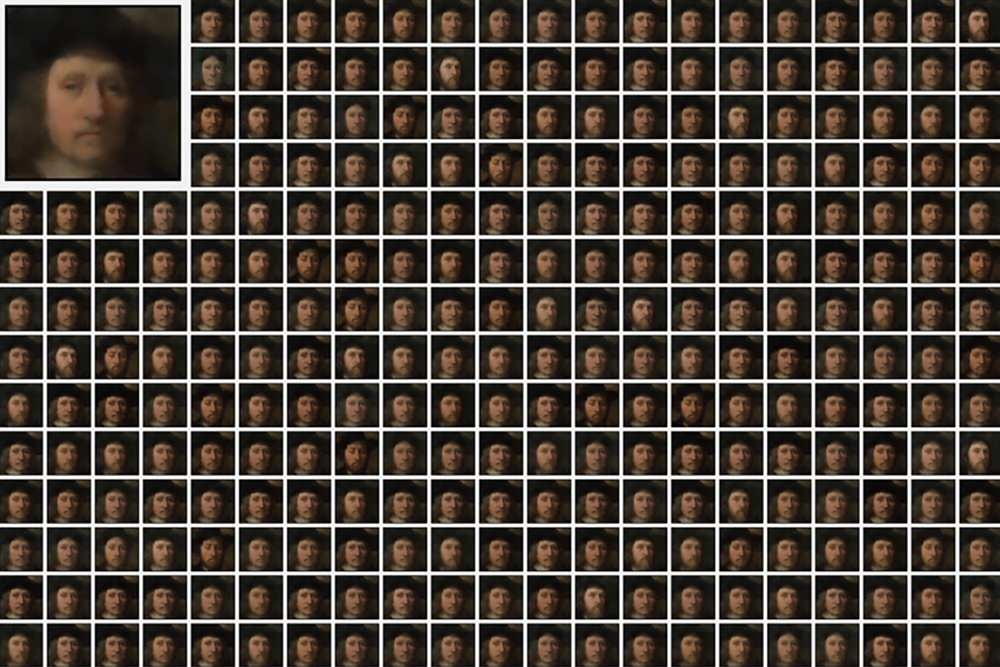
Amongst other things, they experimented with “what happens to a generation if you remove one image from the training dataset,” particularly the “source” image for the target generation. What makes it interesting is they tested this at scale. There’s (expectedly, somewhat janky) demo code to illustrate the spread. One example I exported myself:

Where each generation (the “counterfactual”) in the top row corresponds to the image that was removed from the dataset in the bottom.
…Personally, I don’t find the conclusion surprising.
These are models.
Lets say you make a model to predict hurricanes. With a small dataset/model, exclude the hurricane most similar to the one you’re trying to predict, and it won’t do a good job. But do the same with a model based on a huge dataset, and it should still model the novel hurricane reasonably well.
Diffusion models are no different.
I think AI Bros have overly anthropomorphized them with terms like “creativity” and such; they don’t have this. But at the end of the day, they can model things that aren’t strictly in their dataset. That’s kind of the basic premise.
Yeah people don’t understand the math behind these things. They are statistical models, like demographics or climate models. They are interesting and potentially useful, but not necessarily useful for the things we are trying to and want to use them for. They can predict certain things and trends very reliably in a general, high-level sense, but they will get the details wrong if you try to use them outside of their area of applicability, just like if you try to use national climate models to determine what day your basement is going to flood, it may come up with a specific date, but just as obviously that’s not actually going to be correct in reality. It doesn’t mean it’s a bad model, it means you’re using it wrong.
And lots of AI bros and AI companies are using these things desperately wrong, and for very wrong reasons. They want to sell things to you. They want to control you and manipulate you. They don’t care if they’re using the model properly, they only care if it’s profitable for them to do it.
The entire term of “Artificial Intelligence” is basically a misnomer, false advertising, even fraud. It is merely an advanced “correlation engine”. It is the output of an algorithm, and has no concept of what anything is. It does not “know” anything. It is the result of the 1’s and 0’s humans input as training data or context, or give it access to query via the internet etc; including all the misinformation, disinformation, errors, and bias. There is no intelligence or critical thought. It does not get the difference between causation and correlation. It just responds based on some internal probability matrix or distribution; correlations compressed into weights/coefficients from all of the training data.
The only thing that makes its responses appear stochastic is the randomization seed and context, or other techniques harnesses use to dogfood its own responses into itself. Without those, you can have the exact same conversation, byte for byte, and the responses become evidently deterministic and “dumb”.
All of the “novel” solutions I’ve seen to date are not actually novel at all, having merely applied some technique documented in a far removed discipline, entirely explained by the properties of a gargantuan working memory and no off switch. We don’t call a computer “super intelligent” because it can process trillions of mathematical calculations a second. Those are merely properties we explicitly engineered into the machine.
People forget that a checkers algorithm is also AI.
…Perhaps. But I’m not sure what any of this has to do with the paper. It doesn’t claim anything like that, and the term “Artificial Intelligence” does not appear in anywhere in the work.
It does illustrate that a toy diffusion model can approximate an image outside its dataset. In fact, the target image being present in the dataset has a remarkably small effect as training scale goes up.
I don’t think this is really all that surprising if you understand how diffusers actually work. They don’t just draw contours and shit. They apply sequential transformations across a matrix of pixels in an iterative fashion, the transformation varies each iteration based on prompt embeddings and the surrounding pixels of each respective transformation, typically starting from a seed of arbitrary static. A lot of images share overwhelmingly identical techniques, with a tiny sliver being responsible for the truly creative deltas. Diffusers effectively learn techniques so it tracks that dropping singular training data here and there doesn’t change much.
I mean, most people can’t recognize slop vs creativity normally. I think the results affect less the anthropomorphizing issue, since oir brains do run similar predictive processes in how we generate words based on context,
Although it can’t actively update its weights while navigating novel concepts, which is why you need a person to create novelty alongside the tool, or correct its mistakes, much like when you say the wrong thing and backtrack and correct. Your word generating process isn’t perfect, but it’s a useful tool that is useful alongside all of your other ‘tools.’
What i think the study is a better answer to is the people who call it a theft machine because it learned from things that exist.
That being said, rich assholes should not be able to turn around and claim ownership of the result of the learning based on the collective development and accomplishment of mankind, or life more broadly. We ‘steal’. A lot of useful intelligent tools from nature.
It’s hard to start that conversation though when the ‘bad’ thing they are doing is just learning or training.
We had the slop of 90s-2000s Disney sequels, even if it was a bunch of human interns having their time and energy pilfered with the threat of basic survival or right to spend time creating art instead of flipping burgers. All proper and copyright safe, but closer to the actual problem than some artists trying to actually create novel things with these models replacing the Disney interns that only Disney has ‘rightful’ access to, despite gaining success off of public domain, and then lobbying to shrink the public domain.
But people are more eager to be mad at the technology than the complexity of dealing with the opportunistic assholes that will use every tool, technology or otherwise, to ensure they get to have power over our collective rights and autonomy.

Bit off-topic, but here is a higher quality version of this:
It just doesn’t feel right without the compression artifacts :(
Fair point, here’s a lower quality version of this:

needs more jpeg
I just want a picture of a gawd dang hot dog!
The colors are muddy.
🔵 Read the article to see what it’s actually saying
I encountered this playing with stable diffusion. I was doing Art Nouveau images. With “Mucha” as a prompt I got lots of images in his style but none matched any piece I was familiar with. Whereas if I used “Klimt”, everything was pretty close to a couple of his more famous paintings. Just a variation in the amount of individual works in the training data…
On the one hand, sure, models generalize. It’s cool they established that.
On the other hand, the copyright argument seems to be that they stole so much data that the contribution of any individual image rounds down to zero, therefore it’s not infringing? Wha??Are they really claiming that one infringement is a a tragedy, but a million infringements is a statistic?
Of course, a clever architecture only matters if it still works as a generator. So the team put the ensembles head to head with 24 conventional diffusion models trained on the exact same data. The images came out looking about as good by standard measures. One nice surprise in the numbers: The more training data, the better the ensembles held up against their single-model counterparts, a hint that they may actually be more data-efficient. “When you have low amounts of data, they do very poorly,” says Dai. “But if you have more data, it actually scales better compared to the vanilla diffusion model.”
This is an interesting side note. It almost sounds like a “mixture of experts” diffusion model, except that analogy isn’t quite right either.
Even if generated images originally could be traced to the training data, I think that maybe just maybe the shady gigacorps would have some incentive to remove or obfuscate the copyright & IP violation paper trail from their trillion-dollar toys.