Feeling weird/outed this is a shitpost. Just last year searched for copper bottomed carbon steel pan for this exact reason. Didn’t find anything, but I still like the idea. Carbon steel is pretty shit at conduction.
Copper pans exist but they can be a pain to cook with. The high thermal conductivity means they heat up much faster than you expect, so it’s easier to accidentally burn stuff, and they also cool down much more quickly once off the heat which can also be annoying. Plus you need to worry about oxide formation and food sticking much more than you do with steel pans.
I know but a copper bottom to improve conductivity really helps carbon steel pans which are really bad about getting hot spots. I have a copper plate I put under mine and it works great. You don’t want a pure copper pan as it doesn’t have the nonstick properties, easy maintenance, and it would also be expensive. But a coper bottom would be nice.
I don’t want to contradict your lived experience but I’m quite sceptical that the improvement is real. Adding a layer of solid material between the heat source and the steel can only reduce the amount of energy transferred to the steel, as some will be absorbed by the material no matter how conductive it is.
In this case it isn’t about improving heat transfer through the bottom of the pan, it’s about improving heat transfer across the bottom of the pan.
The heat will travel through the pan more slowly because of the added material, but due to coppers extremely high heat conductivity, the copper base will heat very evenly, even if the heat source is unevenly applied, and therefore evenly transfer that heat through the steel layer.
If you have the materials can avoid taking my word for it. Use a temp gun and check 5 spots or so on a carbon steel pan on the burner. Use a larger pan and smaller burner to exgaerate the effect. Repeat with a copper plate (needs to be at least size of pan bottom, bigger doesn’t seem to detract from effect. You’ll see much more consistent heating. Works for cast iron too - actually more notable at first and the the effect diminishes somewhat as the thick iron holds onto heat and becomes more uniform (still helps though)
Another version that can work is if you have two pans where the bases are both say 5mm, but one of them is all steel while the other is 3mm copper welded to 2mm steel, the copper one should heat up faster than the all steel one. No idea how well copper welds to steel though.


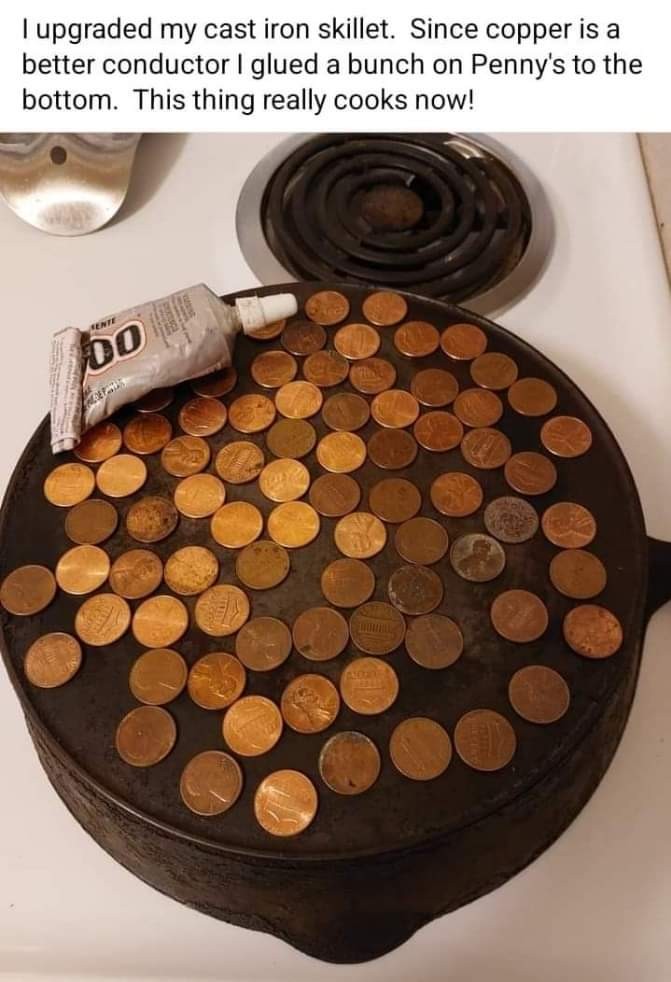
Feeling weird/outed this is a shitpost. Just last year searched for copper bottomed carbon steel pan for this exact reason. Didn’t find anything, but I still like the idea. Carbon steel is pretty shit at conduction.
Copper pans exist but they can be a pain to cook with. The high thermal conductivity means they heat up much faster than you expect, so it’s easier to accidentally burn stuff, and they also cool down much more quickly once off the heat which can also be annoying. Plus you need to worry about oxide formation and food sticking much more than you do with steel pans.
I know but a copper bottom to improve conductivity really helps carbon steel pans which are really bad about getting hot spots. I have a copper plate I put under mine and it works great. You don’t want a pure copper pan as it doesn’t have the nonstick properties, easy maintenance, and it would also be expensive. But a coper bottom would be nice.
I don’t want to contradict your lived experience but I’m quite sceptical that the improvement is real. Adding a layer of solid material between the heat source and the steel can only reduce the amount of energy transferred to the steel, as some will be absorbed by the material no matter how conductive it is.
In this case it isn’t about improving heat transfer through the bottom of the pan, it’s about improving heat transfer across the bottom of the pan.
The heat will travel through the pan more slowly because of the added material, but due to coppers extremely high heat conductivity, the copper base will heat very evenly, even if the heat source is unevenly applied, and therefore evenly transfer that heat through the steel layer.
If you have the materials can avoid taking my word for it. Use a temp gun and check 5 spots or so on a carbon steel pan on the burner. Use a larger pan and smaller burner to exgaerate the effect. Repeat with a copper plate (needs to be at least size of pan bottom, bigger doesn’t seem to detract from effect. You’ll see much more consistent heating. Works for cast iron too - actually more notable at first and the the effect diminishes somewhat as the thick iron holds onto heat and becomes more uniform (still helps though)
Oh right! I didn’t realise you were talking about distributing heat more evenly, that’s my bad. Yes I can definitely see that being effective.
Another version that can work is if you have two pans where the bases are both say 5mm, but one of them is all steel while the other is 3mm copper welded to 2mm steel, the copper one should heat up faster than the all steel one. No idea how well copper welds to steel though.
If I remember right, copper-steels welds are horribly difficult unfortunately
Also can’t cook acidic foods like tomatoes and vinegar if the copper pan is unlined. Since the copper will leech into the food.
Can’t really cook those in carbon steel without oxidizing it either.
Like aluminium, even worse than copper 😱
They also have to be re-tinned somewhat regularly IIRC.