You must log in or register to comment.
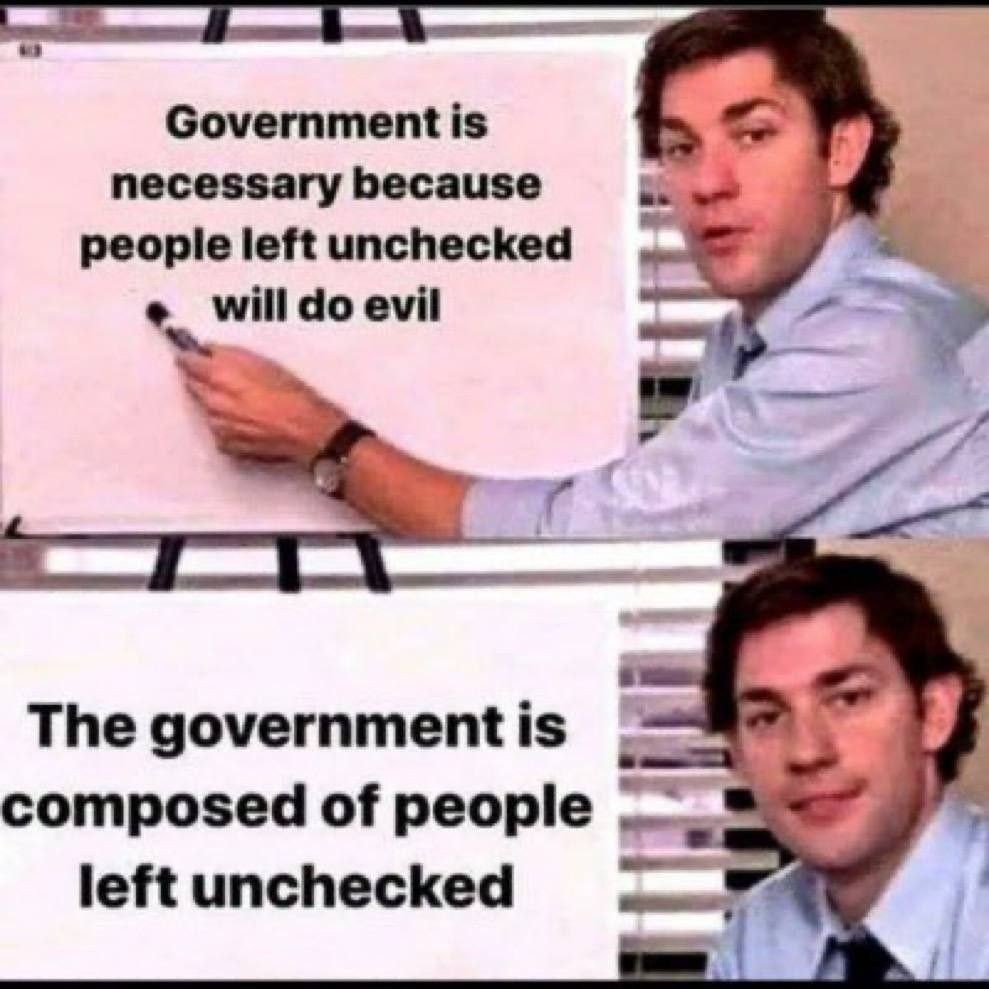
Isn’t that what voting is for? When the general population doesn’t like what the people in government are doing, they check them by voting them out of government. How else would you check people above the village scale?
Can’t vote them out when every choice is a shit sandwich, also they have billions behind them of propaganda so your neighbor hates you instead of the politician they voted for that makes their life worse (cue MAGA flags draped over shanty town across the US)
It really needs to all be torn down.
Yeah but torn down and replaced with what? Tearing down the government doesn’t stop billions in propaganda, or charismatic narcissists finding any position of power they can. What do you replace it with that has a more effective check on people doing bad things?
Ive yet to figure it out.
For starters, a system that doesnt allow pedophiles to run a country (or walk free), no money in politics, and make billionaires illegal.
Those are more policy positions than an underlying system. Disallowing pedophiles and billionaires requires some mechanism of enforcement.
There are better variants of voting than what we are doing, that make the system harder to game. GCP Grey has a series on it.
Replace it with anarchism. Hard to have a position of power when society is not built around hierarchy and authority.
That’s just a defunctional system, there are working ones out there even if yours is shit.
Yes. And it’s also what institutional counterweights are for. It’s also what protests are for.
The issue is representative democracy.
Democracy in itself is not bad but unless people understand what and how their decisions influence, there is a tendency to just let go to others.
My country had a very rough patch after throwing down the fascist government in the seventies. Although there was as official government, the daily running of things was done by people.
Hospitals became self run by the doctors, nurses and all the other staff. Schools organized through the teachers to created conditions for all to access teaching. Private companies had their directors reigned in, with severe salary cuts, work schedules were redrawn and off days were finally recognized. Enough said it was an era of huge unionizing and collective action; people actively worked together for a common and better good.
Then, through a series of political maneuvers, a representative democracy was installed and influence was taken away from the common person and put into politicians that recursively entrench into self serving and protecting schemes.
Policy is not something to be handed off to “leaders”. Policy is done through collective will. Politians would be a much more careful if they were to be held responsible by their decisions when instead any politian can wave any consequence away by just stating they were doing the best they knew in face of the events. That is political immunity, oversimplified.
Democracy in itself is not bad but unless people understand what and how their decisions influence, there is a tendency to just let go to others.
Most people don’t understand though, that’s the problem. Sure, doctors and staff have a good idea of how to run a hospital, and teachers have a good idea of how to run a school. But those are specific domains of expertise, and doctors and teachers are experts in those domains. A country is more complicated than an individual institution, and average citizens are not experts. In a way, what you’ve described is a form of representative democracy: hospitals run by doctors, not patients; schools run by teachers, not students or parents. Random citizens don’t know enough about medicine to run a hospital, so the doctors represent them.
Policy is not something to be handed off to “leaders”. Policy is done through collective will.
I’m sure you’re informed enough to do the research to make rational policy decisions, and so am I. But I don’t think that paints an accurate picture of the general population. Sure, there’s plenty of common sense human rights policy, but there’s also plenty of complex nuanced bureaucratic policy.
The main issue though is time. Even in a world where everyone is well-informed on the problems and solutions, and also takes their civic duty seriously, it still takes forever to draft and pass policy in direct democracy. In a world where everyone is knowledgeable, conscientious, and quick to consensus, direct democracy is the obvious answer. But I just don’t think we live in that world, at least not at scale.
Most people don’t understand though, that’s the problem.
Most people have been taught or led to believe in the figure of saving heroes and leaders; we can stretch the reasoning a bit and argue it is an inheritance from religious systems. But that is not the concern here.
[…] A country is more complicated than an individual institution, and average citizens are not experts. In a way, what you’ve described is a form of representative democracy: hospitals run by doctors, not patients; schools run by teachers, not students or parents. Random citizens don’t know enough about medicine to run a hospital, so the doctors represent them.
Even patients had their say; they had the right to be heard and were. The same for schools and every other activity had participation from every part involved. There were meetings and gatherings to discuss concerns and people could and would be relieved of their duties or at least seriously constrained in their freedom of action if their stance was deemed inadequate.
I’m sure you’re informed enough to do the research to make rational policy decisions, and so am I. But I don’t think that paints an accurate picture of the general population. Sure, there’s plenty of common sense human rights policy, but there’s also plenty of complex nuanced bureaucratic policy.
I’m fairly certain of my ignorance. What I am able to is to ask questions and request further clarification on any subject, if I have the space for it. Which is not conceded under current day representative democracies. The system is predicated on pushing decision making and interference further and further away from the people and funneling it into bodies of more often than not non elected individuals.
The main issue though is time.
I agree. Everyone is so worried about it, yet is so often wasted.
Even in a world where everyone is well-informed on the problems and solutions, and also takes their civic duty seriously, it still takes forever to draft and pass policy in direct democracy.
More interventive and direct democracies must necessarily by navigated by long term goals. It’s the image of the jar full of rocks, pebbles and sand. It must not be a race to pile as much as possible on the table and drown out the attention.
In a world where everyone is knowledgeable, conscientious, and quick to consensus, direct democracy is the obvious answer. But I just don’t think we live in that world, at least not at scale.
I’m willing to chance we can “sit” and chat amiably for a bit and find a couple of subjects we can see eye to eye and build on each other point of view to reach consensus and solutions. Political parties, polititians and by extension politics, as they currently exist today, are not predicated on consensus but opposition.
But that is not the concern here.
The concern is that they don’t care. I used to believe in direct democracy, but then I started organizing meetups and worked in customer facing roles for 15+ years. The average person doesn’t think about policy and is easily swayed by charismatic con men.
There were meetings and gatherings to discuss concerns and people could and would be relieved of their duties or at least seriously constrained in their freedom of action if their stance was deemed inadequate
That’s still representative.
More interventive and direct democracies must necessarily by navigated by long term goals
Someone still needs to prioritize policies then
I’m willing to chance we can “sit” and chat amiably for a bit and find a couple of subjects we can see eye to eye and build on each other point of view to reach consensus and solutions.
Having actually done that in relatively small groups, reaching consensus is a lot more difficult and tedious than you suspect.
Facts.