Metric is the first part, but it is also the second part. The entire point of imperial units is that they ARE humanistically intuitive measurements.
Science = metric, relatable = imperial.
Imperial doesn’t care about how many units of energy it takes to boil x quantity of water at y elevation pressure etc, and that’s the whole point, it’s about how many approximately hands tall is this horse. You look at your hand, look at the horse, and go “about 15”. If you want to know exactly how tall a horse is, relative to human height, you use feet and inches. Everything has its own, weird systems of measurement that got made up over time, organically relative to other human approximation.
Metric if you want standardization and exactness and conversion, but imperial works fine as long as you know of the units, because we make up our own units that make sense. Like, the south park kouric unit is an example. It doesn’t matter what the unit is derived from, you just need to know is it ten or eleven or twelve, because the units are relative to us, not how many units of energy it takes to heat a cubic meter of water to boiling at exactly one atmosphere, because that’s insane. Cool, and converts well and is universal, but the numbers don’t really mean anything.
I really think context matters, and if you work well with metric for everything - fantastic. If you work well with imperial - great. They’re just different systems for different purposes for different situations.
Metric is very relatable if you just, use it, just like imperial.
The only difference is metric is also easy to scale up or down, imperial is pure “fee-fees”
Your implication that metric is not humanistically intuitive is just bonkers when you consider 99.125% of the developed world just uses metric for their every day, always, with no issue.
Germans, Koreans, and Indians aren’t suddenly going “oh no! I can’t measure these shoes and these plates! I only have SCIENCE numbers, not BaldEagleBananaBurgerFreedom™ numbers!”
First off, I want to point out that imperial measurements originated in Europe, not the US. No need to get upset about where the standards are from or who use them, we aren’t talking about that, as I want to eliminate patriotism and tribalism, and isolate the subject to just the differences between the measurements.
Secondly, whether or not something is used commonly or not doesn’t define if something is humanistically intuitive. And I think you misunderstood what I meant by that, anyway, and might be twisting my words away from their original meaning, by using those specific words wrongly in a strawman fallacy, thus making two blind jumps away from my argument and essentially arguing against something that I never really said, which is a waste of both of our time and energy.
I’m saying that the units are human-intuition centric first, not other reference point first.
If you base your 0-100 measurement of temperature around the freezing and boiling points of water, that’s fantastic, but it’s significantly less relevant for what temperature it is outside. Sure, you can divide and multiply it well and it’s a range that’s relevant to water.
But the 0-100 being based around what temperatures span from really cold to really hot to humans (and temperate zones where most humans exist), you’ve created a unit that is significantly more relevant to weather and how it feels and affects us. People who use Fahrenheit basically never, ever use decimals for weather or cooking food, because those are the things that most people REALLY do day to day.
They’re just different philosophies in how to measure stuff, and a lot of people use both at will, because we like to just use the best thing for the job. If people younger than me want to use all metric or all imperial, cool, I don’t give a shit, they’re all available. Whining about units is bizarre. Like, just don’t use them if you can’t be flexible. It’s like language: the person who speaks the most language wins because they understand the differences, pros, and cons. Whereas the person who only understands one language is limited in perspective and understanding, and when that person rages about other standards, they look ridiculous.
Speak your language, if it works, fantastic. But don’t piss over here because you don’t understand the differences. I’m just trying to get through life and I bet you are, too. If you want the truly weird conversions, though, go between imperial and metric ;) those are awesome.
The origins don’t matter, every civilization, region, and town made its own system, I’m referring to the fact the the US and the UK are the only developed nations that still USE imperial, when there’s an easier, widespread, more sensible system available right next to it.
That’s not a strawman fallacy as I didn’t deny your input by miscategorizing your personal value, if anything it approaches a bad reason fallacy or an antecedent denial fallacy, but it’s neither because we both made our points of view on separate foundational assumed beliefs without addressing proofs or evidence. One could also throw an appeal to emotion or an appeal to ridicule fallacy in there with my silly joke about imperial units but we’re not debating a verifiable, objective truth. Neither are we attempting to find some higher level of human understanding of our spaient peoples world, we’re just wasting time on an internet forum, as in “they’re just opinions, man.”
Every unit of measure that humans created to measure the world we live in, like metric and imperial, is human-intuition centric first. Imperial units were created just as formally, and informally, as metric. The imperial system is based on a different system, based on another system, that was based on the science at the time used for pharmaceutical, military, and crafting applications. Just because imperial used hands and feet of SOME guy doesn’t make it less or more arbitrary than the measure of “one liter of water.” A system, based on a system, based on science at the time that is just easier to understand in the base 10 system we live in.
The 0 - 100 hot-cold argument for Fahrenheit is just incorrect. It was made by SOME GUY and 0° was the freezing point of HIS brine in HIS basement. 0 F° isn’t cold, it’s deadly, and 100 F° is not. That seems just as arbitrary as 0 - 40 C°. If the scale was the same people would actually refer to Celcius as -32 - 40 C° instead, and that’s just not the case. Decimals are not scary, they’re equally simple to use by any person who uses the base 10 system, unless the argument is that people who use Fahrenheit also struggle to make change when handling money.
Measurements are not one-to-one comparable to language, but when most people who are familiar with both tell you that one is clearly superior, and most of the world’s educated people agree, and it’s an easier system for children to understand, then it’s fairly safe to call one system better.
Maybe some languages are better at one thing than another, but language is interpretive, flowing, changing, adaptable. Measurements are not, they need to be universally, unambiguously understood.
Yeah everyone had their archaic human-derived measures but every city on the Rhine had a different system.
If you were a cologne cabbage trader and had 100 cologne pounds of cabbage, the would be 104 pounds in Düsseldorf, 98 pounds in Mainz, 91 in Karlsruhe and 102 in Frankfurt.
Wonderful human derived measurements.
I get the impression some people think the whole world was English imperial units and then we started to turn metric on a whim.
Metric is wonderful for international and interregional trade and communication. There’s practically only one blank spot on that map.
Like, I’m at a shop right now, and outside the window are some scooters.
How many scooters?
I think in units of scooters, not pieces of metal in scooter shape that add up to a volume of mass and energy. Because that’s not what I’m thinking about right now, I just see six scooters, and you instantly know that there are six scooters.
This is true, but that’s because everybody has accepted the unit of scooter as the accepted unit count for scooters…
Okay that’s a bad example, because just counting things is the way to count things. But also, maybe that’s the point - maybe, counting things is just super simple, and why direct or single-level abstract measurements is the difference: metric = relating everything to a single point, and imperial = just counting. Yeah? Maybe?
I’m not really following. What, are we counting feet, then? Mine?
Feet are just really entrenched in the way Americans think about lengths. It may not sound like it’s abstract, but it is. If I said “yeah, it’s about sixteen hands long”, people would have to parse wtf I’m talking about, but then have to grapple with how long a “hand” is exactly and what 16 of them means.
The foot is no less arbitrary than the meter. If you are just unfamiliar with the unit and confused by the fact it’s named after something often close in size to it that’s fine, but keep in mind for a while a meter was defined as the length of a specific metal rod, same as the foot and yard.
Meter was defined as 1/10M of the length from equator to the pole. It’s not exact because the size was established by people literally measuring the distance while traveling. They got really close though. Rest of the units were derived from that length such as 10cm cube of water is 1kg and so on.
Meter is pretty useful though, a large step step is around one meter so you can measure a field by walking after a bit of practice to get the step right. The height of people’s waist is around 1m also.
The point you make about counting is not really an advantage since in metric we count in meters, 10s of centimeters, centimeters, 100s of meters or kilometer which is roughly 10 minutes walking.
The difference is that when you need to do calculation or anything scientific it becomes super easy to convert between units. A cubic meter of water is 1 metric ton (1000kg), 1L of water is 1kg so you can just measure 250ml of milk (~ a cup) by adding 250g of water to a bowl. A tablespoon by adding 15g and a teaspoon by adding 5g.
It makes cooking and baking a lot easier since you don’t need to bring out a whole range of measurement equipment because you can often just use a scale instead.
Then we have Fahrenheit temp scale. Goes from 0 very cold and 100 very hot. Both are intuitive after a while but metric make it very easy to reason about larger ranges and how close to freezing something is outside.
Bottom line is that both are very arbitrary but any time you go outside some regular guesstimates of “this is x long” metric becomes easier.
Oh to be clear, imperial sucks and everyone would be better off just adopting metric, I’m mostly just arguing it doesn’t suck as much or in as many ways as you seem to think.
I was with you until you said the foot is no less arbitrary than the meter. The foot is just a useful size and changed depending on whenever the king decided. The meter was defined by the French using Earth. To say they’re both equally arbitrary is untrue.
Imperial units are nice to work in when accuracy is more important than precision. Want a third of a foot, that’s four inches exactly. A third of a meter is 33.333 cm repeated. It really depends on the situation which is more useful, but metric is more often than not the useful choice.
All the original metric definitions (except seconds I think, but guess what imperial shares exactly) were extremely arbitrary, either relying on assumptions later shown to be false (such as exactly how earth curved) or varied enough to make the units imprecise during sensitive enough measurements (every definition that included water). Those problems have since been corrected, but imperial has also since been defined in terms of metric so the same can equally be said of it.
I expanded my comment, but, basically, you can get used to any system. Humans are incredibly adaptable.
But for the same reason we’re bad at conceptualizing how rich a trillionaire really is, metric may not be better than imperial. Or, maybe imperial is the reason we’re bad at conceptualizing! I haven’t thought about that before! But it’s an interesting idea!
Temp ranges 0-100 in real life in temperate, North America. This is also about what the human body perceives as “really fucking cold” and “really fucking hot”.
What do they span in Celsius? Probably some easily divisible decimals that are just as easy to understand if you’re used to them. Because Celsius is a scale not relative to weather, but rather to water. Which is sciency, but not weathery.
You’re right, the Celsius scale doesn’t span across one particular ‘topic’- but either end point is not only relatable, but specific. You’ve got snows/frosts/freezes at one end, and boiling at the other. Both of those will always happen at that temperature (more or less), but different people will feel comfortable or not in a hugely wide range.


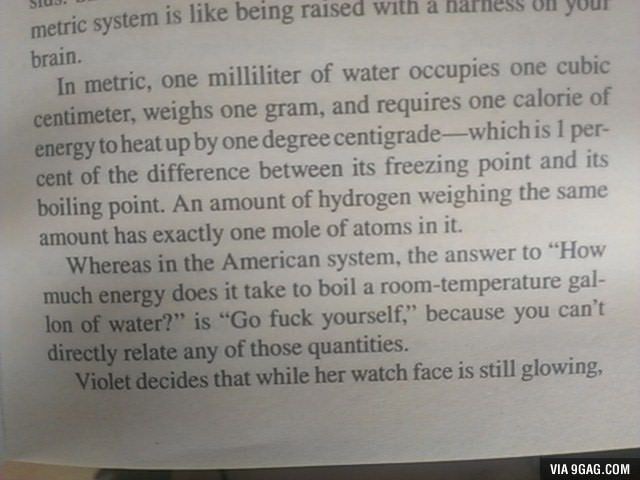
Wait, no, this isn’t really correct.
Metric is the first part, but it is also the second part. The entire point of imperial units is that they ARE humanistically intuitive measurements.
Science = metric, relatable = imperial.
Imperial doesn’t care about how many units of energy it takes to boil x quantity of water at y elevation pressure etc, and that’s the whole point, it’s about how many approximately hands tall is this horse. You look at your hand, look at the horse, and go “about 15”. If you want to know exactly how tall a horse is, relative to human height, you use feet and inches. Everything has its own, weird systems of measurement that got made up over time, organically relative to other human approximation.
Metric if you want standardization and exactness and conversion, but imperial works fine as long as you know of the units, because we make up our own units that make sense. Like, the south park kouric unit is an example. It doesn’t matter what the unit is derived from, you just need to know is it ten or eleven or twelve, because the units are relative to us, not how many units of energy it takes to heat a cubic meter of water to boiling at exactly one atmosphere, because that’s insane. Cool, and converts well and is universal, but the numbers don’t really mean anything.
I really think context matters, and if you work well with metric for everything - fantastic. If you work well with imperial - great. They’re just different systems for different purposes for different situations.
Metric is very relatable if you just, use it, just like imperial.
The only difference is metric is also easy to scale up or down, imperial is pure “fee-fees”
Your implication that metric is not humanistically intuitive is just bonkers when you consider 99.125% of the developed world just uses metric for their every day, always, with no issue.
Germans, Koreans, and Indians aren’t suddenly going “oh no! I can’t measure these shoes and these plates! I only have SCIENCE numbers, not BaldEagleBananaBurgerFreedom™ numbers!”
First off, I want to point out that imperial measurements originated in Europe, not the US. No need to get upset about where the standards are from or who use them, we aren’t talking about that, as I want to eliminate patriotism and tribalism, and isolate the subject to just the differences between the measurements.
Secondly, whether or not something is used commonly or not doesn’t define if something is humanistically intuitive. And I think you misunderstood what I meant by that, anyway, and might be twisting my words away from their original meaning, by using those specific words wrongly in a strawman fallacy, thus making two blind jumps away from my argument and essentially arguing against something that I never really said, which is a waste of both of our time and energy.
I’m saying that the units are human-intuition centric first, not other reference point first.
If you base your 0-100 measurement of temperature around the freezing and boiling points of water, that’s fantastic, but it’s significantly less relevant for what temperature it is outside. Sure, you can divide and multiply it well and it’s a range that’s relevant to water.
But the 0-100 being based around what temperatures span from really cold to really hot to humans (and temperate zones where most humans exist), you’ve created a unit that is significantly more relevant to weather and how it feels and affects us. People who use Fahrenheit basically never, ever use decimals for weather or cooking food, because those are the things that most people REALLY do day to day.
They’re just different philosophies in how to measure stuff, and a lot of people use both at will, because we like to just use the best thing for the job. If people younger than me want to use all metric or all imperial, cool, I don’t give a shit, they’re all available. Whining about units is bizarre. Like, just don’t use them if you can’t be flexible. It’s like language: the person who speaks the most language wins because they understand the differences, pros, and cons. Whereas the person who only understands one language is limited in perspective and understanding, and when that person rages about other standards, they look ridiculous.
Speak your language, if it works, fantastic. But don’t piss over here because you don’t understand the differences. I’m just trying to get through life and I bet you are, too. If you want the truly weird conversions, though, go between imperial and metric ;) those are awesome.
The origins don’t matter, every civilization, region, and town made its own system, I’m referring to the fact the the US and the UK are the only developed nations that still USE imperial, when there’s an easier, widespread, more sensible system available right next to it.
That’s not a strawman fallacy as I didn’t deny your input by miscategorizing your personal value, if anything it approaches a bad reason fallacy or an antecedent denial fallacy, but it’s neither because we both made our points of view on separate foundational assumed beliefs without addressing proofs or evidence. One could also throw an appeal to emotion or an appeal to ridicule fallacy in there with my silly joke about imperial units but we’re not debating a verifiable, objective truth. Neither are we attempting to find some higher level of human understanding of our spaient peoples world, we’re just wasting time on an internet forum, as in “they’re just opinions, man.”
Every unit of measure that humans created to measure the world we live in, like metric and imperial, is human-intuition centric first. Imperial units were created just as formally, and informally, as metric. The imperial system is based on a different system, based on another system, that was based on the science at the time used for pharmaceutical, military, and crafting applications. Just because imperial used hands and feet of SOME guy doesn’t make it less or more arbitrary than the measure of “one liter of water.” A system, based on a system, based on science at the time that is just easier to understand in the base 10 system we live in.
The 0 - 100 hot-cold argument for Fahrenheit is just incorrect. It was made by SOME GUY and 0° was the freezing point of HIS brine in HIS basement. 0 F° isn’t cold, it’s deadly, and 100 F° is not. That seems just as arbitrary as 0 - 40 C°. If the scale was the same people would actually refer to Celcius as -32 - 40 C° instead, and that’s just not the case. Decimals are not scary, they’re equally simple to use by any person who uses the base 10 system, unless the argument is that people who use Fahrenheit also struggle to make change when handling money.
Measurements are not one-to-one comparable to language, but when most people who are familiar with both tell you that one is clearly superior, and most of the world’s educated people agree, and it’s an easier system for children to understand, then it’s fairly safe to call one system better. Maybe some languages are better at one thing than another, but language is interpretive, flowing, changing, adaptable. Measurements are not, they need to be universally, unambiguously understood.
Yeah everyone had their archaic human-derived measures but every city on the Rhine had a different system.
If you were a cologne cabbage trader and had 100 cologne pounds of cabbage, the would be 104 pounds in Düsseldorf, 98 pounds in Mainz, 91 in Karlsruhe and 102 in Frankfurt.
Wonderful human derived measurements.
I get the impression some people think the whole world was English imperial units and then we started to turn metric on a whim.
Metric is wonderful for international and interregional trade and communication. There’s practically only one blank spot on that map.
Only if you’re used to it.
Like, I’m at a shop right now, and outside the window are some scooters.
How many scooters?
I think in units of scooters, not pieces of metal in scooter shape that add up to a volume of mass and energy. Because that’s not what I’m thinking about right now, I just see six scooters, and you instantly know that there are six scooters.
But you don’t measure the number of scooters by the gram either.
since we’re talking hypotheticals, sometimes you order sausages by the unit, sometimes you order them by weight.
honestly idc which really, i am the best sassage eater on the team just give me the damn wurst. give me the damn wurst.
This is true, but that’s because everybody has accepted the unit of scooter as the accepted unit count for scooters…
Okay that’s a bad example, because just counting things is the way to count things. But also, maybe that’s the point - maybe, counting things is just super simple, and why direct or single-level abstract measurements is the difference: metric = relating everything to a single point, and imperial = just counting. Yeah? Maybe?
I’m not really following. What, are we counting feet, then? Mine?
Feet are just really entrenched in the way Americans think about lengths. It may not sound like it’s abstract, but it is. If I said “yeah, it’s about sixteen hands long”, people would have to parse wtf I’m talking about, but then have to grapple with how long a “hand” is exactly and what 16 of them means.
The foot is no less arbitrary than the meter. If you are just unfamiliar with the unit and confused by the fact it’s named after something often close in size to it that’s fine, but keep in mind for a while a meter was defined as the length of a specific metal rod, same as the foot and yard.
Meter was defined as 1/10M of the length from equator to the pole. It’s not exact because the size was established by people literally measuring the distance while traveling. They got really close though. Rest of the units were derived from that length such as 10cm cube of water is 1kg and so on.
Meter is pretty useful though, a large step step is around one meter so you can measure a field by walking after a bit of practice to get the step right. The height of people’s waist is around 1m also.
The point you make about counting is not really an advantage since in metric we count in meters, 10s of centimeters, centimeters, 100s of meters or kilometer which is roughly 10 minutes walking.
The difference is that when you need to do calculation or anything scientific it becomes super easy to convert between units. A cubic meter of water is 1 metric ton (1000kg), 1L of water is 1kg so you can just measure 250ml of milk (~ a cup) by adding 250g of water to a bowl. A tablespoon by adding 15g and a teaspoon by adding 5g.
It makes cooking and baking a lot easier since you don’t need to bring out a whole range of measurement equipment because you can often just use a scale instead.
Then we have Fahrenheit temp scale. Goes from 0 very cold and 100 very hot. Both are intuitive after a while but metric make it very easy to reason about larger ranges and how close to freezing something is outside.
Bottom line is that both are very arbitrary but any time you go outside some regular guesstimates of “this is x long” metric becomes easier.
Oh to be clear, imperial sucks and everyone would be better off just adopting metric, I’m mostly just arguing it doesn’t suck as much or in as many ways as you seem to think.
I was with you until you said the foot is no less arbitrary than the meter. The foot is just a useful size and changed depending on whenever the king decided. The meter was defined by the French using Earth. To say they’re both equally arbitrary is untrue.
Imperial units are nice to work in when accuracy is more important than precision. Want a third of a foot, that’s four inches exactly. A third of a meter is 33.333 cm repeated. It really depends on the situation which is more useful, but metric is more often than not the useful choice.
All the original metric definitions (except seconds I think, but guess what imperial shares exactly) were extremely arbitrary, either relying on assumptions later shown to be false (such as exactly how earth curved) or varied enough to make the units imprecise during sensitive enough measurements (every definition that included water). Those problems have since been corrected, but imperial has also since been defined in terms of metric so the same can equally be said of it.
Nothing stopping you from just saying 1/3rd metre. Fractions still work!
Yeah, they’re both arbitrary. You agree with me.
The “things” being counted in either respect are abstract and are only “known” if they are familiar.
Depends on how into feet the person is
There are four scooters
My heart yearns for the humanity, passion, integrity, competence, and empathy that that show promised me.
I expanded my comment, but, basically, you can get used to any system. Humans are incredibly adaptable.
But for the same reason we’re bad at conceptualizing how rich a trillionaire really is, metric may not be better than imperial. Or, maybe imperial is the reason we’re bad at conceptualizing! I haven’t thought about that before! But it’s an interesting idea!
We have also units in metric, except it’s always the same ones. Horse is around 2m and a small banana is 15cm, a human foot in around 30cm.
You can measure the parts of your body to get to the same point reference pretty fast and it’s very relatable when you live in a non-imperial country.
How much is a kilohorse
Imperial doesn’t use multiplicative prefixes very much.
Instead, they would invent a new random unit, the skyscraper, which is equal to a random number of horses, like 176.
And then everyone goes “Yeah, a skyscraper is 176 horses, everyone knows that.”
3 horsepowers at the curb, 4 horsepowers at the crank
That is 1,000 horses, obviously.
Beat me to it
Where is the world is Fahrenheit relatable?
Temp ranges 0-100 in real life in temperate, North America. This is also about what the human body perceives as “really fucking cold” and “really fucking hot”.
What do they span in Celsius? Probably some easily divisible decimals that are just as easy to understand if you’re used to them. Because Celsius is a scale not relative to weather, but rather to water. Which is sciency, but not weathery.
Lol no
US temps (°F), roughly:
NE / Midwest - winter 15-35, summer 70-85 Northern Plains - winter 0-25, summer 70-85 Southeast - winter 40-65, summer 80-92 Desert SW - winter 45-68, summer 95-110 Pacific coast - winter 40-58, summer 60-78 Alaska (inland) - winter -20 to 0, summer 55-72
Celsius in comparison
OC…water freezes, 100C water boils
You’re right, the Celsius scale doesn’t span across one particular ‘topic’- but either end point is not only relatable, but specific. You’ve got snows/frosts/freezes at one end, and boiling at the other. Both of those will always happen at that temperature (more or less), but different people will feel comfortable or not in a hugely wide range.