RmDebArc_5@piefed.zip to Greentext@sh.itjust.worksEnglish · 8 months agoAnon plays Professor Laytonpiefedimages.s3.eu-central-003.backblazeb2.comimagemessage-square63fedilinkarrow-up1368
arrow-up1368imageAnon plays Professor Laytonpiefedimages.s3.eu-central-003.backblazeb2.comRmDebArc_5@piefed.zip to Greentext@sh.itjust.worksEnglish · 8 months agomessage-square63fedilink
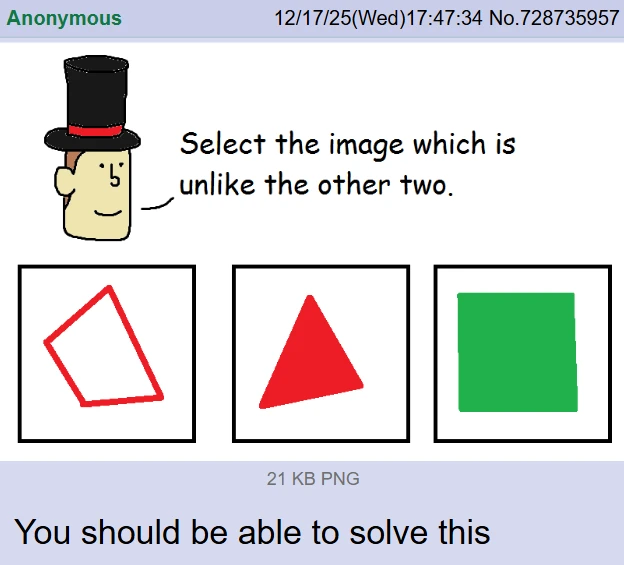
minus-squareKaChilde@sh.itjust.workslinkfedilinkarrow-up28·8 months agoWhat a fool you are! … only one choice is an outline. How is this difficult, other than if you are line blind? The correct choice is A. If you pick B, A is also red, and C is also a filled solid. So B is not unlike either A or C. If you pick C, A is also an irregular 4-gon, and B is also filled solid with color. So C is not unlike either A or B. But if you pick A, while A does have elements in common with B and C… (it shares ‘red’ with B, and ‘4-gon’ with C) … it is also unlike each of them singly, as well as both of them together, in that it is a triangle. A is the only choice where ‘is unlike the other two’… is true, in any sense. It has a distinct property, not found in any member of the remainder set, nor shared by the remainder set as a group.


What a fool you are!
… only one choice is an outline.
How is this difficult, other than if you are line blind?
The correct choice is A.
If you pick B, A is also red, and C is also a filled solid. So B is not unlike either A or C.
If you pick C, A is also an irregular 4-gon, and B is also filled solid with color. So C is not unlike either A or B.
But if you pick A, while A does have elements in common with B and C…
(it shares ‘red’ with B, and ‘4-gon’ with C)
… it is also unlike each of them singly, as well as both of them together, in that it is a triangle.
A is the only choice where ‘is unlike the other two’… is true, in any sense.
It has a distinct property, not found in any member of the remainder set, nor shared by the remainder set as a group.