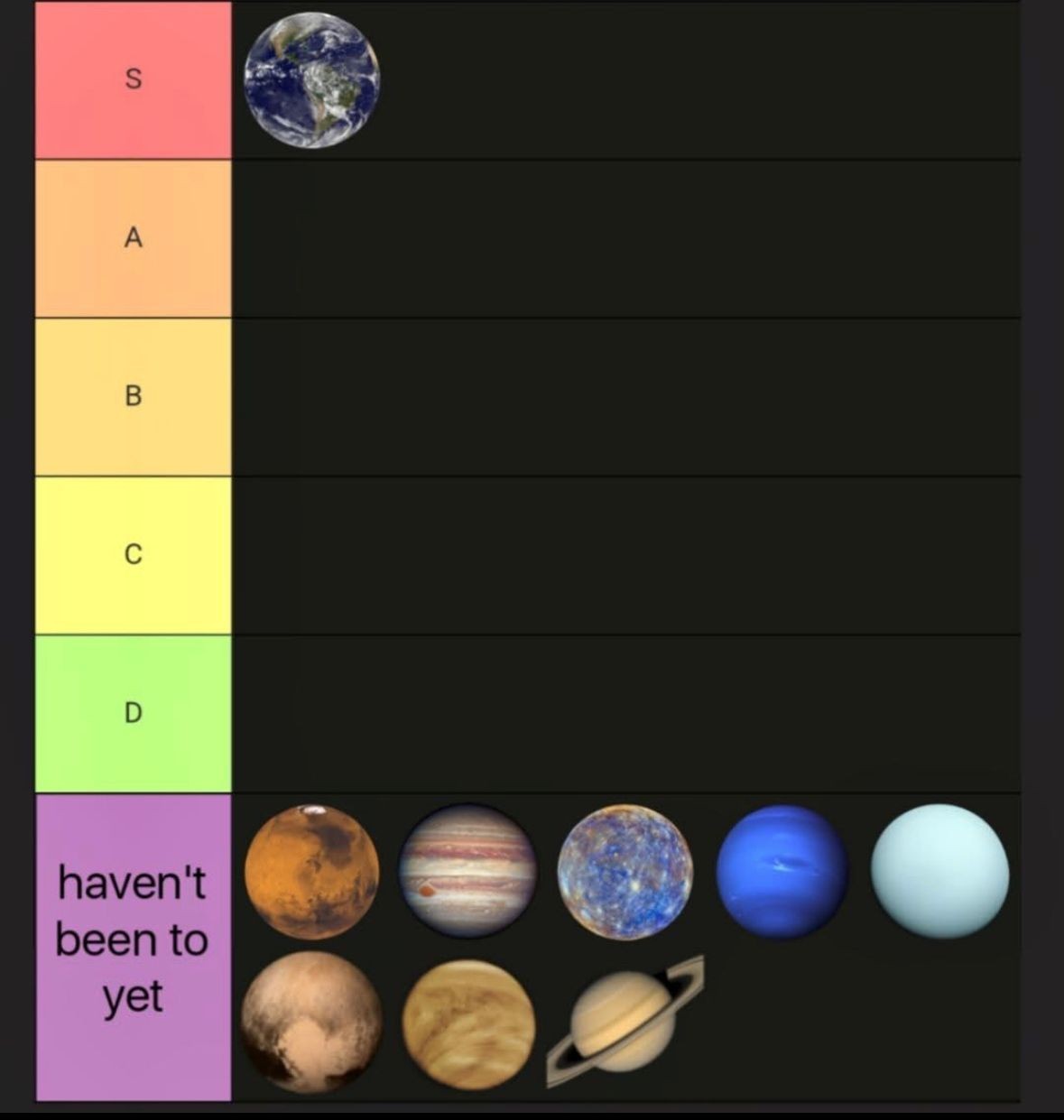

If you’re gonna include Pluto you gotta include like 9 or 10 other dwarf planets too.
Pluto has the distinct advantage of being considered a planet for a while that those one lack. I’m sure after OP visited them all it’ll be docked points for its size.
Damn plutocrats
Dwarf planets should count too. So should most of the moons. Anywhere you could land and walk around should be considered a world. It kind of misrepresents our solar system to think of it as only having 8 or 9 important bodies orbiting the Sun just because some of them are gravitationally entangled with each other.
I think we need a new category that includes dwarf planets and moons, but does not include gas giants and anything too small to have an atmosphere. Basically a “could be terraformed in a sci-fi novel” category.
Anywhere you could land and walk around should be considered a world.
That would disqualify the gas giants. I think the criteria needs workshopping…
I meant it to be taken as sufficient but not required
the thing about an atmosphere is that it protects you from a lot of radiation. like, alpha radiation makes a significant part of the radiation hitting you in outer space, but it’s too weak to go through a sheet of paper so it’s also gonna be stopped by an atmosphere of a planet. and the same goes for beta radiation, which is also easily stopped by an atmosphere. and that’s significant because it protects you from like 99% of all (particle) radiation.
on top of that an atmosphere replenishes volatile chemicals like CO2 and H2O all the time (or at least some volatile molecules) and that’s nice-to-have.
Also important is the heat capacity of the atmosphere. Even if the atmosphere is thin, it makes a lot of difference. I should go about calculating the difference that mars’ atmosphere makes in terms of temperature sometimes. Like, how hot/cold would it be in the day/night if it didn’t have an atmosphere. I guess it would be more extreme, but by how much? I should look into that sometime.
WTF did Pluto ever do to you? We finally get a decent photo and it’s got a big heart on it. Pluto is trying to make things work and you go on about how it’s not special.
I think you’re just racist against dwarf planets.
Yeah, where’s all the love for 120347 Salacia?
Eris ranks higher than Pluto and I will fight anyone who thinks otherwise
I think earth is kinda overrated.
Agreed. I heard it has humans.
Ew humans
humans are a virus and the earth has a fever
now one might be tempted to say that that’s a bad thing, but in my experience you can also catch a fever when you’re really positively excited about something. and virus … well, let’s say, to me it’s not an all-negative term either. knowledge is a virus (i wish i could link to an earlier blog post of mine about this, but unfortunately i never wrote down my ideas about this). basically, knowledge spreads just like a virus, it’s immaterial, consists of information, and has the typical replication patterns of viruses, including being subject to mutation and selection.
Earth is pretty mid tbh
“I concur. It is unremarkable.”

fun fact: in medieval astronomy/astrology (these things were not yet distinct back then), earth was indeed “mid” as it was the middle of the planets; all other planets circled around it.
later in early modern age, earth was “mid” again but in another sense (the planets circling around the sun was accepted by then). uranus and neptune were not yet discovered, so there were only 7 known objects (+ the moon) in the solar system: sun, mercury, venus, earth, mars, jupyter, saturn. again, earth was exactly in the middle of that order.
You’ve described the Aristotelian-Ptolemaic model which dates back to the 2nd century CE. This was part of, but not the extent of the mideval cosmography.
In the cosmography of the middle ages, there existed a realm outside the spheres where God and the angels dwelled. Each of the planets color the divine light of God and pour God’s beneficence upon the Earth. The earth was low and seemingly distant from the heavenly realms. And in the middle of the earth was hell.

A competing mideval theory put God at the center and the Earth at the most distant sphere. It borrowed from another tradition, the Neoplatonists. Here God is a a pure light and the sphere distort the light of God. Humans couldn’t handle the pure light of God, but all the distortions make the universe appear fractured and not unitary. We don’t see God in everything, just the many things.

Thank you. I feel like we need a community for random knowledge like this.
Earth is like c tier max.
Has potential though…
True, get rid of the rich people and it could probably be like an A or B tier
I have been to the other planets, definitely D tier. Except Venus, that’s C tier. Being crushed to death in acid rain is somewhat a nice experience.
What are you on and can I please try some? Very low dose, please 😁
1L Applejuice, 200g banana bread, 1200μg LSD, a cup of coffee and a cigarette. You know, the usual.
I quit smoking a few years ago but the rest sound good 😁
This summer I started again after 12 years not smoking. I’m so stupid.
Stop misinforming people. You’ve never been to other planets. Space travel costs a lot and the best humans have done is land a man on moon. So going to other planets is out of question. That means you’re a blatant lier.
I ask everyone to NOT trust him. Other planets are pretty good.
Eeeeh relax guy!
What are you on about, it was on Facebook so it must be true.
I can even quote a trustworthy news article:
Trustworthy guy on Lemmy went to all planets
Sources: russiantrollarmy.gov, foxnews.com, infowars.com, thewhitehouse.gov
Other planets are pretty good.
It was pretty nice in uranus.
What are you on about, it was on Facebook so it must be true.
Ha! You believe everything you see in Facebook don’t you? What an idiot
None of those websites say anything about anyone visiting any planets. Why’re you lying? Stop putting down other planets to make your planet look good better. You goddamn planetionist
It was pretty nice in uranus.
Are you mocking me sir? That’s very rude of you.
Haven’t you listened to Trump, Musk, Putin, Vance, etc? Facts and logic are sooo 2024.
Today everything people claim immediately is the truth. Everyone knows that.
You can’t fact check me, I claimed first so my claim is always 10x more true than yours.

Settle down, Mercury.
Neptune looking real blue there as well.
Fun fact, Neptune is more of a sea foam green than a blue. https://youtu.be/zKSWcFCMrGU
What about all the moons? They’re part of the solar system too!
like, i remember doing the maths a while ago and figuring out the following:
a planet needs to be in a certain mass range (from minimum mass to maximum mass) to be attractive to long-term human setttlement.
- the minimum mass is given because the planet can only hold an atmosphere if it has a minimum mass of around 10^23 kg because only then the gravitational potential is large enough to prevent the atmosphere from floating away.
- also, the planet has to have less than a maximum mass, sothat a spaceship can still lift off from that planet. that’s because fuel consumption scales exponentially with planet’s mass, and if the planet’s mass is too big, basically you “hit a wall” in the fuel-over-planet-mass diagram where it simply becomes practically impossible to lift off from that planet ever again. that maximum mass is around 10^26 kg.
it is remarkable that earth is in this narrow mass range. there’s only a handful of objects in the solar system who are in this mass range: earth, mars, venus, the 4 biggest moons of jupyter, and the biggest moon of saturn (i hope i didn’t forget anyone). that’s why i think that these objects are especially interesting for long-term human settlement.
Ganymede and Titan are an easy shoe-in for A tier.
Fake and gay. There’s no sun
my favourite has to be Jool or Laythe
Super Earth! Our home!
DEMOCRACY!!!
Can we get Saturn up to B tier, just for it’s badass rings? Possibly higher after the visit.
Just gonna leave the moon out like that?
deleted by creator
stop doing updates then
Keep goin til we do dinosaurs again.
Or we’ve already been to them and ruined them with wars and pollution and doomsday weapons and moved on until we’re on the last habitable one…