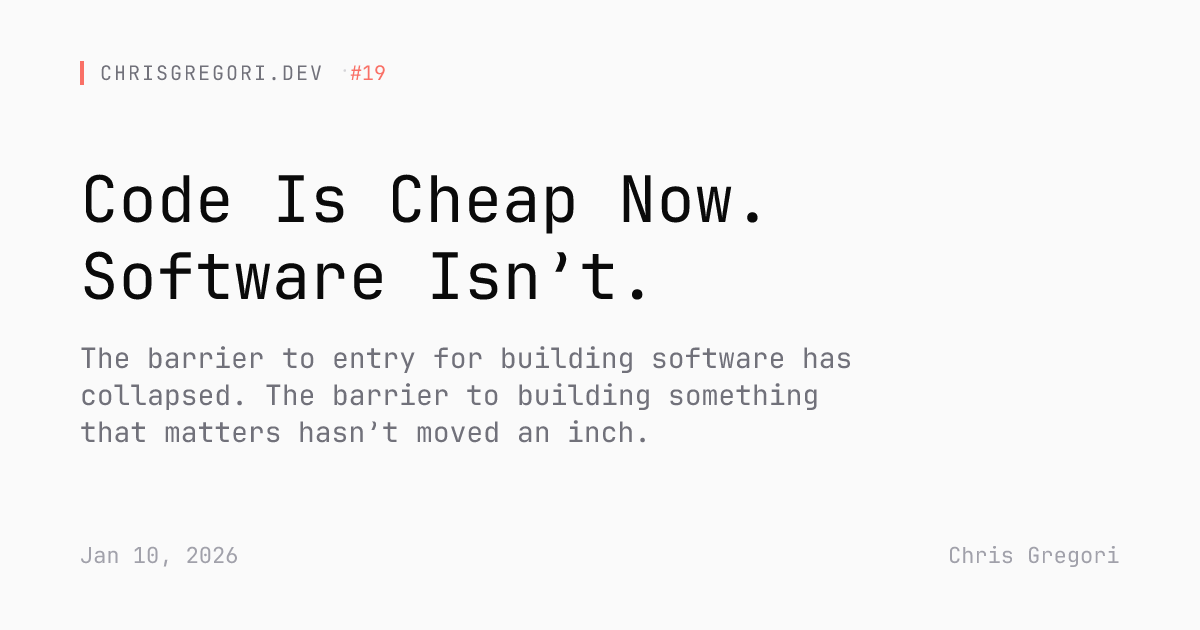
This article is quite interesting! There are a few standout quotes for me:
On one hand, we are witnessing the true democratisation of software creation. The barrier to entry has effectively collapsed. For the first time, non-developers aren’t just consumers of software - they are the architects of their own tools.
The democratisation effect is something I’ve been thinking about myself, as hiring developers or learning to code doesn’t come cheap. However, if it allows non-profits to build ideas that can make our world a better place, then that is a good thing.
We’re entering a new era of software development where the goal isn’t always longevity. For years, the industry has been obsessed with building “platforms” and “ecosystems,” but the tide is shifting toward something more ephemeral. We’re moving from SaaS to scratchpads.
A lot of this new software isn’t meant to live forever. In fact, it’s the opposite. People are increasingly building tools to solve a single, specific problem exactly once—and then discarding them. It is software as a disposable utility, designed for the immediate “now” rather than the distant “later.”
I’ve not thought about it in this way but this is a really good point. When you make code cheap, it makes it easier to create bespoke short-lived solutions.
The real cost of software isn’t the initial write; it’s the maintenance, the edge cases, the mounting UX debt, and the complexities of data ownership. These “fast” solutions are brittle.
Though, as much as these tools might democratise software development, they still require engineering expertise to be sustainable.
The democratisation effect is something I’ve been thinking about myself, as hiring developers or learning to code doesn’t come cheap.
It’s not really “democratizing” anything, since anything made that isn’t like a simple calendar or forum will come with more bugs than working features. Low and no-code development options have been available for ages, so “doesn’t know how to code” was never an actual barrier to making software. Not only that, learning to code could be done effectively for free for well over 15 years now, online resources have only gotten better. It was never about the (lack of) money, it was always about time needed. “I don’t want to/can’t learn this, yet I want the thing done” - that’s why we pay professionals.
However, if it allows non-profits to build ideas that can make our world a better place, then that is a good thing.
At best, they’ll get semi-working prototypes. At worst, they’ll try to sell said prototypes as end products. Besides, anything that is “a disposable utility, designed for the immediate “now” rather than the distant “later.”” is extremely unlikely to make the world a better place.
AI doesn’t “democratise” coding. One still needs to understand the basics of computer science, as well as higher level software design, to make use of AI tools and get actually usable results.
LLMs can write good code but they require constant guidance to do so. This is something that people need to understand. AI in coding is like Photoshop to an “analog” artist - super useful IF you know what you’re doing, but as a complete stranger to the topic, all you’ll do is basic tinkering.
I think you are vastly overestimating the level that statement is pitched at. The overwhelming majority of people dont even know how a for loop works. However they can ask an LLM to write a script to change this list of files with inconsistent numbering conventions and put them in a consistent order. That’s the level of spreading out the ability to program that we are dealing with.
Basic scripting is hardly programming, and it’s been available in various user-friendly forms for quite a while…
Problem is that most people do seem to treat LLMs as if they could replace a well trained engineer. Including middle managers who want to cut costs at all price.
And those people who think LLMs will replace software engineers any time in the near future are wrong. But it can still be the case that LLMs are democratizing coding ability to those who otherwise wouldnt have it while at the same software engineering as a discipline isnt going anywhere.
Its not just basic scripting either, often when people start coding in earnest their programs are just a huge pile of statements connected together with if statements and mutating global variables. and LLM can help show best practices like encapsulating logic into functions and isolating side effects.
The bespoke short-lived solutions angle is an interesting one, to be sure.
I wonder how many orgs will back themselves into a corner thinking their product will be short lived but it ends up hanging out for a while, as you mentioned.
Honestly this feels like an extension of this Agile/Scrum madness we’ve been dealing with since the mid-2000’s. Instead of the next quarter, we’re only building things with a view of the next two weeks.
Now it’s measured in hours, and even then we can give a prompt to an LLM and have a half working thing to throw away after it converts that PDF to a CSV.
I worry about the craftsmanship leaving this field. Engineers used to push back and for good reason.


This article is quite interesting! There are a few standout quotes for me:
The democratisation effect is something I’ve been thinking about myself, as hiring developers or learning to code doesn’t come cheap. However, if it allows non-profits to build ideas that can make our world a better place, then that is a good thing.
I’ve not thought about it in this way but this is a really good point. When you make code cheap, it makes it easier to create bespoke short-lived solutions.
Though, as much as these tools might democratise software development, they still require engineering expertise to be sustainable.
It’s not really “democratizing” anything, since anything made that isn’t like a simple calendar or forum will come with more bugs than working features. Low and no-code development options have been available for ages, so “doesn’t know how to code” was never an actual barrier to making software. Not only that, learning to code could be done effectively for free for well over 15 years now, online resources have only gotten better. It was never about the (lack of) money, it was always about time needed. “I don’t want to/can’t learn this, yet I want the thing done” - that’s why we pay professionals.
At best, they’ll get semi-working prototypes. At worst, they’ll try to sell said prototypes as end products. Besides, anything that is “a disposable utility, designed for the immediate “now” rather than the distant “later.”” is extremely unlikely to make the world a better place.
what a load of bull.
AI doesn’t “democratise” coding. One still needs to understand the basics of computer science, as well as higher level software design, to make use of AI tools and get actually usable results.
LLMs can write good code but they require constant guidance to do so. This is something that people need to understand. AI in coding is like Photoshop to an “analog” artist - super useful IF you know what you’re doing, but as a complete stranger to the topic, all you’ll do is basic tinkering.
I think you are vastly overestimating the level that statement is pitched at. The overwhelming majority of people dont even know how a for loop works. However they can ask an LLM to write a script to change this list of files with inconsistent numbering conventions and put them in a consistent order. That’s the level of spreading out the ability to program that we are dealing with.
Basic scripting is hardly programming, and it’s been available in various user-friendly forms for quite a while…
Problem is that most people do seem to treat LLMs as if they could replace a well trained engineer. Including middle managers who want to cut costs at all price.
And those people who think LLMs will replace software engineers any time in the near future are wrong. But it can still be the case that LLMs are democratizing coding ability to those who otherwise wouldnt have it while at the same software engineering as a discipline isnt going anywhere.
Its not just basic scripting either, often when people start coding in earnest their programs are just a huge pile of statements connected together with if statements and mutating global variables. and LLM can help show best practices like encapsulating logic into functions and isolating side effects.
The bespoke short-lived solutions angle is an interesting one, to be sure.
I wonder how many orgs will back themselves into a corner thinking their product will be short lived but it ends up hanging out for a while, as you mentioned.
Honestly this feels like an extension of this Agile/Scrum madness we’ve been dealing with since the mid-2000’s. Instead of the next quarter, we’re only building things with a view of the next two weeks.
Now it’s measured in hours, and even then we can give a prompt to an LLM and have a half working thing to throw away after it converts that PDF to a CSV.
I worry about the craftsmanship leaving this field. Engineers used to push back and for good reason.