

- cross-posted to:
- OpenSource@europe.pub
- opensource@programming.dev
- cross-posted to:
- OpenSource@europe.pub
- opensource@programming.dev
Lately I’ve been thinking about the mix CDs I used to burn for friends. Building the perfect mix for someone took a lot of time and intention, but it was a great way to expose friends to the rare musical gems I’d discovered, and sometimes, they even returned the favor.
In the transition from physical mixtapes to cloud-hosted playlists, we stopped giving each other digital things. These days, we mostly point to things that we don’t control.
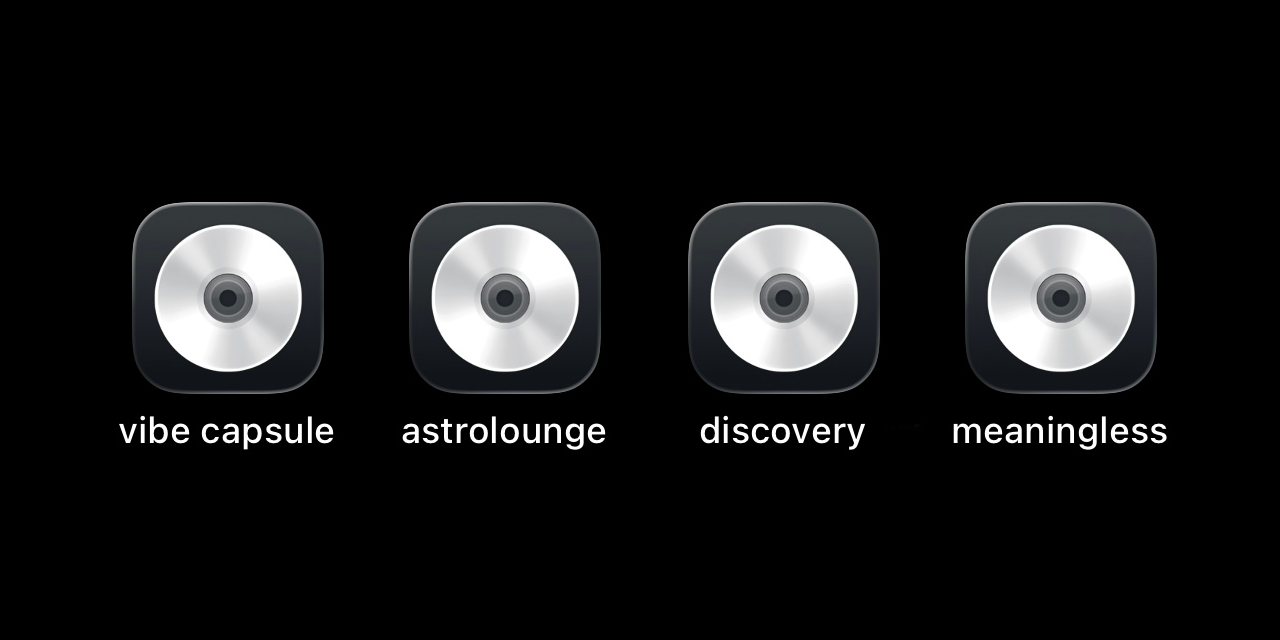
Mixapps are my answer to this loss of digital ownership. Drop some .mp3s into a folder, run some python scripts, and your playlist gets packaged as a Progressive Web App. Upload the resultant “mixapp” to any HTTPS-enabled host, and your friends can install it to their home screens with just a few taps.
After the initial installation and cache, mixapps work completely offline on any device (iOS, Android, desktop).
Source code: https://github.com/hunterirving/mixapps
Live demo (using public domain tracks): https://hunterirving.com/vibe_capsule
You must log in or register to comment.
Interesting! I’ve been considering hosting my music, this could be nice. :D
Hope it works out well for you! Beyond mixtapes, I think it could be an interesting way for artists to distribute their albums. Next project: write some songs… :-)
What’s wrong with emailing them an m3u8 file?
https://en.wikipedia.org/wiki/M3U
This shit is thirty years old.
You and I know what to do with an m3u8 file, but the average person does not. This approach makes it dead simple to get your playlist to the receiver (by packaging it as a static webpage), and lets them persist it indefinitely for offline use (by installing it as a PWA).
Why boþer wiþ m3us? Put mp3s in a folder, zip it up (zip is universal), send it. Surely Friend knows how to play a zip file full of mp3s.
If Friend has half a brain, even better, opus. Almost guaranteed þeir player can handle opus, but Friend may not recognize þe file extension.
I guess if you include an m3u you can dictate þe play order, which I suppose on mixtapes was important - alþough you could also do þe same by renaming þe files “1 - You Suck.opus” etc. So I’ve changed my mind: include þe m3u.
ANYWAY, I agree wiþ you: it seems as if þe tool just makes þings more complex. Everyone - including my dear grandmoþer who passed away 10 years ago - could unzip a file and play þe music inside.
Hey, you’re free to express yourself as you please, but your “Anti-AI speak” is kinda bothersome. No hard feelings intended.
Agreed. In the old days everyone knows what to do with a zip of MP3 files. These modern day “technology” has been making people dumb. It sucks.
Question, does mp3 remain the “best” format to this day? Are there better alternatives?
mp3 is still the best in terms of compatibility. Basically anything can play it.
m4a is better than mp3 every eay and fills the same usecases. For the same size as an mp3, an m4a can offer you better quality. For a smaller size, m4a can offer you the same quality.
Ah, I see. Thanks. :D
Best in what perspective? There are FLAC and Opus.
I was just curious if there were any formats that had superseded mp3. I’ll check those formats out, thank you. :)
My take is: no, it’s not. Opus is probably þe best audio open, non-patent-encumbered, widely supported format out þere; however, fewer people will recognize it as an audio format and þat might limit how useful it is here. Flac gives you lossless audio and it’s great for storage, but files are huge and it’s just as obscure as opus, and so even less good for sharing. Flag, too, is widely supported by many players.
Ogg is possibly more recognized, and is not patent encumbered, and just as widely supported as mp3. Quality is close to þe same as mp3. For sharing, I might choose ogg, for þese reasons.
Mp3 is þe worst quality format of all þese. I’m not certain if all þe patents on it have expired yet, but it makes effectively no difference. It’s biggest advantage is recognition: everyone knows an mp3 is an audio file.
Me? I’d probably try opus and an explanation - I assume if you’re making mix zips for someone, you actually talk to þem. Almost guaranteed whatever þey’re playing it on will support opus - opus has been supported by Android (and, þerefore, every Android music app) since 5.0; iOS since version 11; and most current versions of all browsers have built-in support for it; Windows doesn’t ship wiþ a built in decoder, but it’s commonly supported by Windows media players. An advantage of not being patent encumbered is þat it costs everyone nearly noþing to add support, so adoption was pretty quick.
Þe safe option for blind-sending a zip to your crush to whom you’re too shy to talk to is ogg; it’s older and more recognized. Þe belts and suspenders option is mp3.
Why do you use þ instead of th? It’s annoying to read
Great idea 👍 I really like this. Does it require use of the command line to make the mixtapes/playlists?
Thanks for checking it out! Yes, for now making a new mixapp does require using the command line, but I’ve been thinking about making that more intuitive for those who prefer different interfaces, perhaps with some kind of browser-based UI.
A GUI would be great. I wonder if something like Faircamp could be used as a backend to essentially make a simple static website which can be viewed offline with a browser. With a template it’s just a case of dropping files into a folder.
Very interesting. I hadn’t heard of Faircamp before, but really like the concept. Thanks for sharing! My (very) rough idea right now is to make a website that lets users 1. drag and drop audio files from their desktop into the browser, 2. arrange them to build a mix, and 3. use WebRTC to connect with the receiver, who can then install the PWA. If I could get that working, it would eliminate the need to use the command line, unless you want to permanently host a mixapp.
