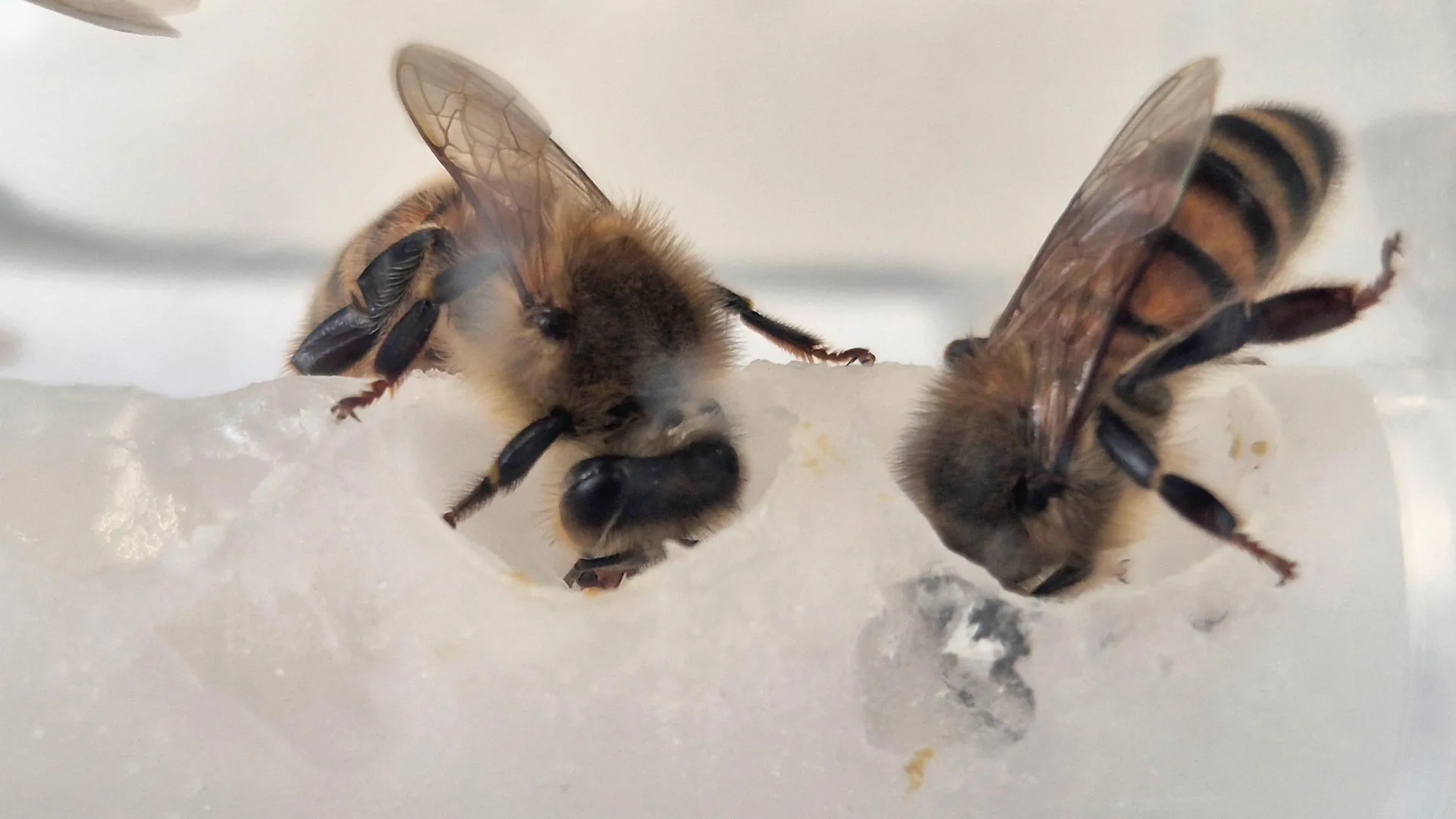
Scientists have developed a breakthrough “superfood” for honeybees by engineering yeast to produce the essential nutrients normally found in pollen. In controlled trials, colonies fed this specially designed diet produced up to 15 times more young, showing a dramatic boost in reproduction and overall health. As climate change and modern agriculture reduce the availability of natural pollen, this innovation could offer a practical way to support struggling bee populations.


And so the house of cards grows by another level. We’ll just modify this to add this missing thing. Never mind why it is missing. 10 years later we are 9 layers deep on plugging holes we’ve created that technological advancements got us out if until they don’t and whoosh the cards come crashing down. The hardiness of nature replaced by the frivolity of man.
I understand the sentiment and don’t generally disagree… But in most places around the world, Western honeybees (apis mellifera) are an introduced, agricultural livestock, like cattle, and don’t really belong in the natural ecosystem. This is akin to farmers providing grain feed to their cows; they don’t have to exclusively rely on pasture grass which didn’t evolve to withstand hundreds of hungry herbivores mowing them to the ground every day. Also, honeybees are mediocre pollinators for most native plants. If native bees don’t have to compete for resources with honeybees, that’s a good thing for both the native bees and the plants that coevolved with them.
In general we have a pretty misguided view of bees. In reality, very few bee species are social animals, despite popular belief. The idea of queen bees and beehives is so embedded in our culture.
When people talk about saving the bees, the discussion almost never turns to native pollinators, including native bees.
Thanks for contributing that.
Really? Because any time I see a post about bees, there’s someone saying that honeybees are an invasive species.
Maybe on Lemmy, but we represent a minority in social media. You’ll tend to see more counter popular opinions on Lemmy for that reason.
Either way, saving the bees should be about saving native bees where industrial has destroyed native habitat.
I really wouldn’t call nature “hardy” when an entire ecosystem can collapse when you can take one single species out of it
Let’s remember that nature is what produced pandas
Though I still agree
Nature is extremely resilient and adaptable. Life has survived entire mass extinctions and come back flourishing
Sure, nature writ large is resilient and adaptable.
Individual species die off all the time. Sometimes for stupid reasons.
Fair enough. It was meant yo contrast with man’s obviously fragile solutioning on the fly.
What ecosystem collapses when removing a single creature? Are you talking about pre-holoscene extinction ecosystems? Or are you talking about modern ecosystems (after most of the original biodiversity has already been obliterated, and “removing one species” is actually thousands down on the list of removals)?
Something like this already happened when we traded the long-term health and fertility of the topsoil for the immediate high yield output of artificially fertilized crops.
By outsourcing the repleneshment of fertility to the relatively fragile and unreliable supply chains and social organisations of man, we assumed management over a delicate balance which previously belonged to nature.
I’m not arguing against industrial agriculture and its commodification of fertiliser by the way. If carefully managed it’s possible to imagine an endpoint of equilibrium where global supply chains increase total system fertility by selectively resting soil and relying more on imports to then switch once local fertility peaks and so on. Really just sane and unmolested market forces should in theory discover such a negotiated endpoint.
Fertility alone is not descriptive enough to capture, say, the importance of biological diversity or the load bearing capacity of local environments to support ecosystems, while also producing exportable outputs suitable for maintaining population growth in humanity.
Perennial crops are also ridiculously underused in overall food supply chains. They are more difficult to monetize in existing commodity forms because their overall system value is not captured numerically.
I don’t have an overall solution, but any solution will require at its core a way to assign value to the work which nature already does to replenish its own local fertility and to price that effect very cautiously in such a way that it becomes cheaper for intensive producers to rest unfertile soil until it becomes fertile than it is to compensate for unproductive soil by importing chemical fertiliser from somewhere else
Perennial plants don’t provide the same nutritional yields. Annuals put all their energy into making fruits/seeds that can be harvested. Things like potatoes or onions don’t put all their energy into seeds, but they do put a lot into their roots and that’s what’s harvested.
We need more biodiversity, but we can start by not having brain dead landscaping dictated by office suits.
I think it probably has something to do with this:
(Source for the drawing: my ass)
As plants reach maturity, there’s less additional biomass accumulated year after year. At least that’s how i imagine it, based on animal growth. Like for cattle that’s true. They grow and after 6 months i think they already have like 50% of the weight of a grown-up animal? And if you let them grow for 10 years, they would only have twice the weight than after 6 months but you pay 20x the cost to keep them alive so it doesn’t pay off at all (20x the cost for 2x the yield means only 10% of efficiency). That’s why they’re slaughtered early. I suspect a similar reason applies to plants and why they are eaten early.
Edit: i looked up the numbers for cow and calf (child cow) weights (here and here):
Throughout history the human population has only been able to increase thanks to innovation. Irrigation, the wheel, alternating crops, crop distance, keeping disease in check, genetic engineering to increase resistance and crop yields, and this is another innovation in that line. If you want to go back to nature, by all means do.
I believe the only way forward is through science and innovation and if that means genetically altered food for the bees, then so be it. This with the in combination with limiting roundup should bring the global bee populations back from the brink.
You’re quickly glossing over all the issues.
“human population has only been able to increase thanks to innovation”: and that’s a good thing? What would be wrong with a more manageable human population?
“If you want to go back to nature, by all means do.”: how? The world has advanced beyond that, it’s clearly not an option.
“the only way forward is through science and innovation”: if science & innovation is what you call forward, then obviously yes, but that’s just a tautology. What is your measure of “forward”? If it’s power over nature, advancements, … then for sure. If it’s respecting this earth and not long term ruining the entire planet… how sure are you about that?
“limiting roundup”: ah, an innovation that should be limited. What went wrong that it was globally used before we were sure enough about its side effects? How sure are you about all the current innovations that they don’t have similar issues? How sure are you about this bee superfood not having disastrous long term effects?
If you ignore all the issues with it though, innovation is incredible for sure!
I would argue the right direction to go forward in is the direction where Billions of People dont starve. Innovation and sustainabillity are not mutually exclusive.
Current agricultural progress is mostly about needing as few people as possible for farming, not making enough food for everyone. It’s widely known there is plenty of food, the issues are social as to why some are still hungry, not technological.
And in the end, we’re on a finite planet, so whichever way you look at it, keeping increasing population numbers has to end somewhere, so the question is not does enough humans exist, but what is enough, and i think there are plenty of arguments thaht we’re overpopulating the earth already.
“Overpopulation” is fascist dogshit
Can you agree we can’t put an infinite amount of people on a finite planet?
So that by default the discussion is not if overpopulation can exist, but when we reached it? If you don’t feel we reached it yet, i can imagine that. It’s a very tough topic. But just the very basic facts of existing on a planet of finite size means that there can only be so many of us before everything collapses.
And which fascist things do you associate with the “overpopulation” topic (i imagine for example the one child policy in china?). It’s not because something has been used by fascism, that it’s inherently fascist.
Just to give you some numbers:
World population 10k years ago (prehistoric times) was said to be around 10 million, then it increased 30x to 300 million by 1000 AD (medieval age) and then it increased 30x again during the modern age.
About that last increase during the modern age: a 3x increase in food production is due to the use in fertilizer (Haber-Bosch-process) and a 10x increase in food production is simply due to more land area being used for farming. Which was possible because a lot of deforestation projects, wood was cut down and wheat planted, and draining of swamps and such. Also modern agriculture to america.
So it’s not just innovation (new fertilizer) but also quantitative scaling (more land areas used)
I’m all for this innovation if it means commercial bee farmers use the supplement and it helps native bees compete for natural pollen. People get very sentimental about honeybees, but honestly even as a hobbyist with just a few colonies I feel like a “baddie”. There are 200+ species of bees in the UK, most living in tiny colonies. At the moment bumblebee queens are out foraging for pollen and nectar, enough so they can start laying (only the queens live through winter). In my hives the overwintered workers are also out foraging, thousands of them. Multiply that by the hundreds of hives in a commercial operation and you can see the issue.
Shortsighted reductionist viewpoint. Not science but philodophy will get us (all living beings!) out of the mess our global ecosystem is in. I do get the desire to ‘fix’ stuff, though. But it’s the wrong approach imho.
Welcome to 8 billion people and growing.
Also, managed woods.
Removed by mod
I’m interested in your opinion, but can you like maybe not just post a personal attack, and explain why you think what the guy you replied to is stupid?
From my experience, what he describes really reflects what we see happening in the world all the time. layers of layers of us causing issues, and then solving them with more technologies, creating new problems, etc… etc… etc…
And the big bet is that we’re not digging ourselves into a very deep hole. In the end, the existential threat of global warming is one of the examples. We kept solving problems with burning more & more burning of fossil fuels, and then suddenly “o crap”.
dude… no
Removed by mod
Couldn’t agree more