

- cross-posted to:
- linux@programming.dev
- cross-posted to:
- linux@programming.dev
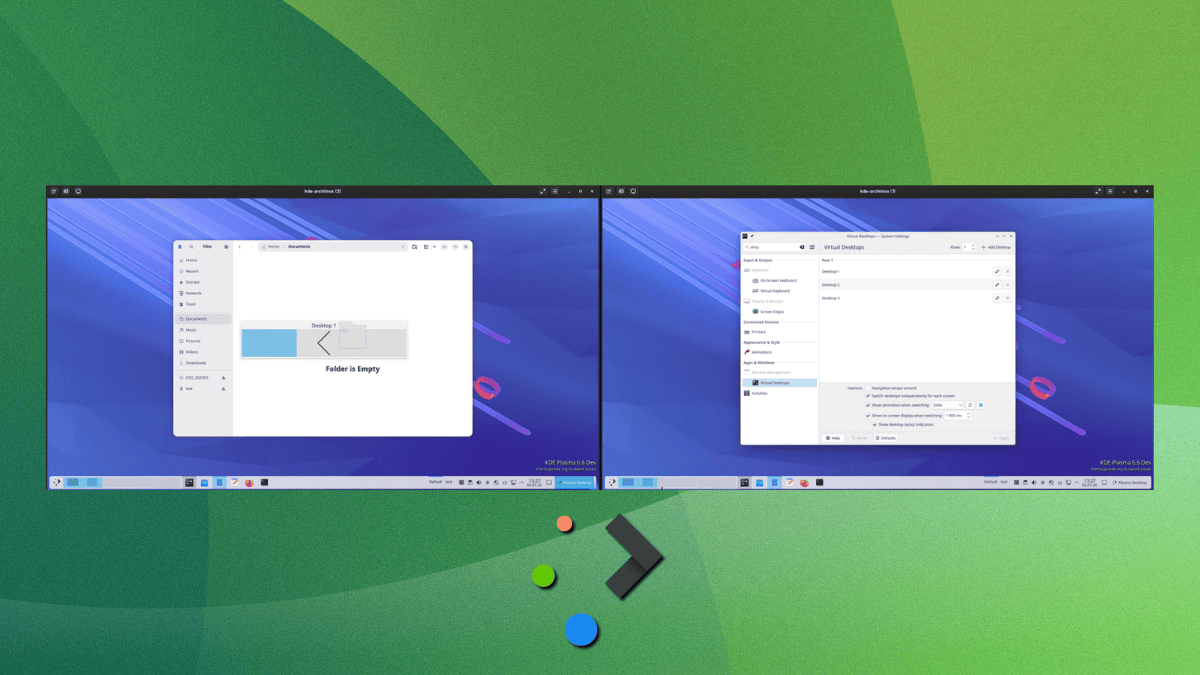
Back in 2005, a bug report was filed by Kjetil Kjernsmo, then running KDE 3.3.2 on Debian Stable. He wanted the ability to have each connected screen show a different virtual desktop independently, rather than having all displays switch as one unit.
Over the years, over 15 duplicate reports piled onto the original as more people ran into the same wall. And that’s not a surprise, because multi-monitor setups have become increasingly common.
The technical reason why this issue stayed open this long comes down to X11. Implementing it there would have required violating the EWMH specification, which has no concept of multiple virtual desktops being active at the same time.
The KWin maintainer Martin Flöser had said as much in 2013, effectively ruling it out for the entire KDE 4.x series. The only realistic path was through Wayland, and that path needed someone willing to actually walk it.
Someone finally did. The feature has now landed in KWin’s master branch and is set for a Plasma 6.7 introduction.
If you look further into the thread, he said he spent 200 hours coding this himself with the assistance of “AI” … look, I’m not really a coder, but give me 200 hours, and I can certainly pull off some shit. If you’re consulting an LLM like a book, I’m not really sure where the problem lies.
Yeah, I also put more faith in those 200 work hours than in the original, generated code which the guy completely rewrote before submission.
Saw a news item the other day, reporting that a significant number of university students now use “AI” bots instead of course literature. One student replied, “Nah, I opened a book like once. Anyway, the literature can be just as flawed as AI because there’s new research being made all the time”…
There is a significant overestimation of the factuality of “AI” responses at play there. And a lack of understanding of the entire chain of fact checking, verification, and review that goes into making a book, particularly for education.
I know that is slightly OT, but I think the comparison is fair.