
Title text:
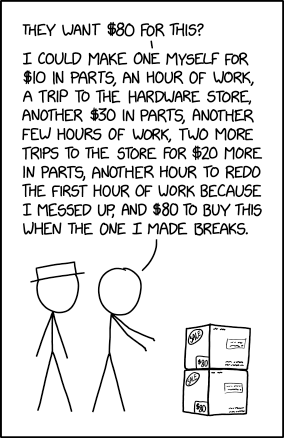
It’s not as big a loss as it looks, because now I have have leftover supplies, which will help me talk myself into doing this all over again with a new project!
Transcript:
Transcript will show once it’s been added to explainxkcd.com
Source: https://xkcd.com/3233/
I’m a Generalist (mainly because I’m challenge-driven) - even in my own professional area (Software Engineering) I’ve worked in all sorts of domains over the years, and I’ve also really went down deep in other very different directions (Embedded Systems in Electronics, Acting, 3D modelling, plus countless “just playing around” areas into which I did not spend years of my life).
In my experience, the “problem” of starting to do something that you don’t really know well is that it takes at least a year of constantly doing that kind of thing, more often two to even start doing it properly.
Oh, yeah, in the meanwhile after the initial “zero to hero” stage you’re quickly in the phase were you ride the peak of the Dunning-Krugger curve on that subject, thinking you’re really DOING IT. If you do persists doing that kind of thing you eventually figure out that you actually know very little of it - this cartoon is exactly somebody at that later stage: done it long enough that they have figured out how amateurish they still are and can now genuinelly judge their playing around for what really is and how much it really costs (the level of awareness of that cartoon character is of somebody entering or in the domain expert stage).
Even knowing how it goes and being very aware of the different speed of growth of the “confidence in one’s knowledge” and “actual knowledge” curves (which together yield the Dunning-Krugger curve), this still happens to me EVERY TIME I go down a new knowledge domain.
So why do it?
Well, if you like challenge and learning, the first couple of years of doing something are a lot of fun: lots of challenges, smaller and simpler projects quickly yielding the rewards of achieving something, a strong felling of progression because you’re learning a ton of things (which later will seem small, but when you do learn them, they feel like big improvements) all the while you feel you’re achiving a lot (the upside of the Dunning-Krugger effect is that results which are basic and amateurish for domain experts, feel like great things to somebody ridding that overconfidence part of the curve).
All this to say that, IMHO, you don’t really derive any monetary value earlier on (it might feel like it’s returning something but if you do the Maths versus other options, you’re lucky to break even on it even if you count your own time as being worth nothing) and you’re not actually learning all that much early on (you’re going to be wasting lots of time and resources doing the wrong things and going back to redo what you did and at best your work yields something slightly flawed and you kinda just accept it and live with the problems) but it certainly FEELs like you are learning a lot.
Personally I recomend it for the fun of it if you have the kind of personality that enjoys learning and the challenge of doing new things, not so much for saving money when doing it yourself vs paying others for it.
I love the self-awareness in this comment.
One thing though:
That is learning!
Yes! I resonate so hard with your comment.
Sometimes my friends ask me what my secret is to learning the absurd number of skills I’ve acquired over the years, and my genuine response is “hubris”; I often start out with an overambitious goal which inevitably leads to a poorly executed result — however, one that I am always very satisfied with.
The key to it is that when I buy tools or materials for a new skill, I think of it as my learning being the end product, rather than whatever item the project aims to produce. Once I’ve immersed myself in a hobby a little, it gets easier to find a balance of pragmatic ambition that results in usable items, but for that first stage, I’ve found it’s better to assume I’ll almost certainly fuck it up. I’ve been able to have a lot more fun since properly understanding that
Those are a lot of words just to say, enjoy a hobby.