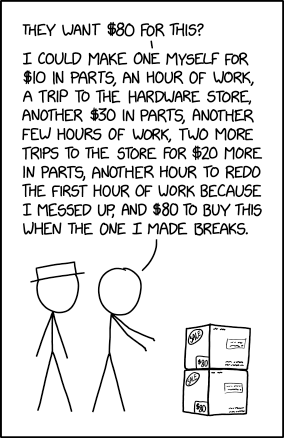
Title text:
It’s not as big a loss as it looks, because now I have have leftover supplies, which will help me talk myself into doing this all over again with a new project!
Transcript:
Transcript will show once it’s been added to explainxkcd.com
Source: https://xkcd.com/3233/
You must log in or register to comment.
I find that it really depends. Some contracted work mostly take specialised equipment, where the necessary skill is something you can pick up. The cost of the equipment is often (at entry level, but more than good enough for the task at hand) less than the show + a couple of hours.
You spent the whole weekend maybe. But you learned something new. Got some nice tools. And more often than not, did a better job because you didn’t rush anything.
I do this at home and work. My running joke is “its about the journey, not the destination.” I’ve gotten my coworkers to believe in that approach too, so now everyone says that about a failed project. At the end of the day you probably learned something failing and that’s a win in my book.
I think you are right to do it like that. Learning skills is invaluable in and of itself, because it enriches our mind and life.
That’s great, but daily people at work talking shit about how they can do everything build anything themselves, and im like yeah that’s why you make $15 hr in a warehouse, because you’re so good at doing everything yourself.
“we didn’t do this because it was easy. we did it because we thought it was easy.”
I built a Bluetooth receiver for my car for $12. It worked great for like 3 months til the janky electrical connector I made vibrated apart. I’ve been meaning to fix it but I need to find out how to identify the type of connector I need to plug into the aux connector on my car so it will actually hold up. It was a fun project though.
This vastly depends on the field you are talking about.
There are absolutely things that are worth doing yourself, so that when they inevitably break you can fix them.
And there are also other things that are absolutely better bought or contracted…
In the end imo it gets down to time, money, and how many times are you going to need to maintain or replace the thing in your lifetime.
I’m in this picture and I don’t like it.
The journey is more important than the destination.
I didn’t want to spend $10 to buy a 3d model my nephew wanted me to 3d print, I’ve spent 2 weekends so far modelling my own version.
I bet you’ve learned a lot though!
There are also a bunch of sites that turn an image into 3d print files if that helps
Things really can be harder than they look! Especially when you don’t have a optimized build process and bulk buying power.
But maybe you got some value out of the time and money you “wasted”. Learned something, appreciate things more, and maybe the next project will go a bit better.
I’m a Generalist (mainly because I’m challenge-driven) - even in my own professional area (Software Engineering) I’ve worked in all sorts of domains over the years, and I’ve also really went down deep in other very different directions (Embedded Systems in Electronics, Acting, 3D modelling, plus countless “just playing around” areas into which I did not spend years of my life).
In my experience, the “problem” of starting to do something that you don’t really know well is that it takes at least a year of constantly doing that kind of thing, more often two to even start doing it properly.
Oh, yeah, in the meanwhile after the initial “zero to hero” stage you’re quickly in the phase were you ride the peak of the Dunning-Krugger curve on that subject, thinking you’re really DOING IT. If you do persists doing that kind of thing you eventually figure out that you actually know very little of it - this cartoon is exactly somebody at that later stage: done it long enough that they have figured out how amateurish they still are and can now genuinelly judge their playing around for what really is and how much it really costs (the level of awareness of that cartoon character is of somebody entering or in the domain expert stage).
Even knowing how it goes and being very aware of the different speed of growth of the “confidence in one’s knowledge” and “actual knowledge” curves (which together yield the Dunning-Krugger curve), this still happens to me EVERY TIME I go down a new knowledge domain.
So why do it?
Well, if you like challenge and learning, the first couple of years of doing something are a lot of fun: lots of challenges, smaller and simpler projects quickly yielding the rewards of achieving something, a strong felling of progression because you’re learning a ton of things (which later will seem small, but when you do learn them, they feel like big improvements) all the while you feel you’re achiving a lot (the upside of the Dunning-Krugger effect is that results which are basic and amateurish for domain experts, feel like great things to somebody ridding that overconfidence part of the curve).
All this to say that, IMHO, you don’t really derive any monetary value earlier on (it might feel like it’s returning something but if you do the Maths versus other options, you’re lucky to break even on it even if you count your own time as being worth nothing) and you’re not actually learning all that much early on (you’re going to be wasting lots of time and resources doing the wrong things and going back to redo what you did and at best your work yields something slightly flawed and you kinda just accept it and live with the problems) but it certainly FEELs like you are learning a lot.
Personally I recomend it for the fun of it if you have the kind of personality that enjoys learning and the challenge of doing new things, not so much for saving money when doing it yourself vs paying others for it.
I love the self-awareness in this comment.
One thing though:
and you’re not actually learning all that much early on (you’re going to be wasting lots of time and resources doing the wrong things and going back to redo what you did […])
That is learning!
Yes! I resonate so hard with your comment.
Sometimes my friends ask me what my secret is to learning the absurd number of skills I’ve acquired over the years, and my genuine response is “hubris”; I often start out with an overambitious goal which inevitably leads to a poorly executed result — however, one that I am always very satisfied with.
The key to it is that when I buy tools or materials for a new skill, I think of it as my learning being the end product, rather than whatever item the project aims to produce. Once I’ve immersed myself in a hobby a little, it gets easier to find a balance of pragmatic ambition that results in usable items, but for that first stage, I’ve found it’s better to assume I’ll almost certainly fuck it up. I’ve been able to have a lot more fun since properly understanding that
Those are a lot of words just to say, enjoy a hobby.
My hardest (self-imposed) projects that I’ve worked on, have always led to my easier projects becoming even easier. I like to build upon the things I learn, it’s half the fun
The question isn’t usually about saving money, it’s about whether it’s worth it to me to save personal time (vs learning something new). I like it
Oof ouch owwie my entire existence.
My partner has gotten into car detailing and Luke’s to clean our hats and shoes. He’s happy with his hobbies.
My entire existence is fighting entropy to help save people money when everything breaks, and my hobbies are camping, repairing old Coleman Lanterns and riding/maintaining a 41 year old motorcycle.
Take a guess who feels fulfilled and accomplished with his hobbies more often?
I enjoy my hobbies, honestly, but there’s basically never a “done” state for this stuff, just “I can’t afford the cost/time to do this lower priority thing right now, I’ll revisit it when it starts making strange noises on the highway/actively combining fuel and fire”.
I recently took up sewing so I could repair my clothes. That’s been really satisfying and it’s nice because I can pick it up and put it down at will and it isn’t difficult so I can just kind of zone out and do it when I’m stressed out from other shit.
Personally, I found myself a lot more fulfilled in my hobbies when I learned to stop holding myself to the standards of people who don’t work the way that I do. In my case, that meant embracing the fact that I’ll always be a generalist, because I’m in it for the love of learning, and thus chasing novelty is a part of the fun. I need to be mindful that I do try to actually finish some projects, but I found that much easier to do once I stopped holding myself to competency standards that don’t map well onto why I engage with my hobbies.
It sounds like my experience is going to be quite different to your own, but I wonder whether part of your problem might be a similar thing of trying to chase after a model of hobby fulfillment that’s incompatible with why you do this stuff. I’d wager that fulfillment and accomplishment may still be possible for you, but they may come from a different source than your partner’s
I’ll rebuff your entire argument with one question: how freaking satisfying is it to get an old lantern running though?
My entire existence is fighting entropy to help save people money when everything breaks
Take a guess who feels fulfilled and accomplished with his hobbies more often?
Are you Emiya Shirou?
It’s the same principle that anchors the idea that you can fix any plumbing problems at home yourself.
I feel personally attacked
No no, you should feel valued! You played, you learned, you moved on.
Absolutely.
FAFO isn’t always a negative thing.
Fuck about, figure out.
It almost always is though.
Yes, but then you can fix it and keep it going for your life! That’s at least $80 or $160 saved direct, plus life lesson and future fixes… (Fuck MC) priceless!
I really like being able to help fix my friend’s stuff, or show them how to fix things. It makes me feel like I’m some sort of techy martyr for my community — I suffer, so other people don’t have to.
I hate this because I’m halfway through it. At least now I have instructions for the other half.
Bought a used car recently. Rear door latch was seized inside the door. surely that’ll be an easy fix, I thought when I gave the seller my offer. after all, it’s over a decade old and an economy car, those cars aren’t too complicated yet.
one $12 handle to replace the one I cut off the door (and also the second half of it was broken anyways, so that was always going to be an expense), one pair of $30 long nose vise grips that didn’t even help me get a seized half of a screw out of the inner latch assembly (screw sheared immediately when I tried to remove it to take the assembly off the door), two broken drill bits trying to drill out that seized screw that the vise grips didn’t help with, $1.83 at the fastener store to replace the captured nut that the seized screw was stuck in after I just smashed it out with a hammer, 2c of dollar store epoxy to secure the replacement nut that was just slightly smaller but enough that it wasn’t held properly in the part, a die to chase the threads on the incredibly rusted screw holding the window actuator to the window (I actually already had that, but still, had to buy the set for a previous project like this), a lot of penetrant and scouring for the original problem part that was causing the door latch to seize, $180 for an ultrasonic cleaner to help clean that seized spring and the shaft joint (okay again I bought this for other reasons too in the past), 2c of lube I’ve had sitting around for ages, and then a few broken trim retaining clips and a slightly broken inner door panel and the door is good as new! y’know, but without paint matched door handles.
the replacement platch assembly part was quoted as $100 from the dealership, so I’ll take the $2 + cost of driving 15km that it was to fix the one I have. I wish it hadn’t taken me 8 hours to complete, though, once you account for all the figuring out how to open the door when neither inside nor outside handle worked, and take it apart, and get the broken part out, and clean the tape off the door paint that was stuck to it after I put it on to prevent rain entering the door from the open holes where the handle used to be, and then put it all back together. at least putting it back together was as easy as expected and took less than an hour going slow. all the other expenses, to be fair, were either inevitable or something I’d already bought for various reasons or will be able to use elsewhere (after all, he who dies with the most tools, wins)
the odds that my repair fails where getting a shop to do it, however, are not zero. also, the shop would likely have replaced the broken trim clips. I didn’t, because I don’t have them. so the door panel is also probably going to rattle a bit now.
Trim clips are cheap, check for all the broken ones you can find and replace them. Double sided tape and some packaging materials like foam helps with rattles if stuff just doesn’t fit perfectly, if stuff is already off it doesn’t take much extra time to stick a few pads.
(If the manufacturer charges too much for clips, you can probably find them on AliExpress using the part numbers, they’re often a bit annoying to substitute so if you’re only saving a few dollars by trying your luck with a mix of generic ones, I’d say don’t bother. If you don’t have any, plastic levers for trim are also very useful and cost very little, the metal ones tend to scuff things and covering the ends in tape makes them too bulky)
1: Angle grinder the previous latch until it opens.
2: Screw on a simple gate latch from the hardware store ($5)
3: If you want to be really fancy, add a decent padlock to that latch ($10)
Done.
no need for the noise of the angle grinder, the handle is all plastic and came off easily with a hacksaw with a metal blade
I suppose there’s already body rust on the car, so some screws into the panel won’t hurt it too much
although the whole point of this exercise was to be able to open the door from the inside and pass safety inspection
If you took it to a shop the apprentice will be doing the work and breaking more shit than they fixed. If you don’t pick it up soon enough and can’t prove it was them then your paying to fix their fuckups as well.
Oh good it’s not just me