Locating radar emissions is a passive process, it doesn’t reveal your own location. That’s why i said the radar array would have to have very strong defenses extending out 30 km in all 360 degree directions from each individual radar station. And if a group has that strong a level of military equipment already then i don’t see why they would need this huge redundant array of radar stations all concentrated in a small area.
And locating radar emissions is a passive process, it doesn’t reveal your own location
That depends very much so on the radar system. In practical terms, almost all the radar systems we’re discussing here are going to be both transmitter and receiver in one design. You can’t simply rely on passive radio energy to detect moving objects in a complex environment. You would want both passive and active beam forming in one instrument; not having both is just leaving some of the most valuable developments in modern radar on the table.
And the specific radar we’re discussing, is an active, pulsed LFM phased-array radar. It does both, because, obviously it needs to do both. Its wouldn’t be useful for its intended use if it cant do both.
Your information about passive radar detection is not up to date. There are tons of passive detection of radar systems that by design do zero emission. The radar array stations will need to emit in order to function, but the enemy can find those radar emitters without emitting any energy of their own
Okay so I was overly general with my first statement.
No one is saying passive radar systems don’t exist. We’ve been using them for decades and there have been massive improvements. But the actual radar system we’re discussing here isn’t. You simply aren’t going to get the same capabilities from a purely passive system than you will from an active + passive system where you can tightly control the frequencies and directions you are transmitting on, and have the information about what frequencies you transmitted on, when you transmitted them, and how (what array configuration) you transmitted them. The point is that the transmission itself is structured to reveal certain information. So when you get a response back (also, coming back to a phased system), you can learn far more about your target than you could in a purely passive system because you that prior information about what you transmitted.
Your confused about what I’m saying. The ARRAY OF RADAR STATIONS is emitters. I’m saying THE ATTACKERS AGAINST the array of radar stations only need to be passive detectors.
No, I’m not confused whatsoever. You can not get the same kind of information using radar using the system you are describing. Period. You are confusing broad, beacon like radar systems (like a flashlight or a paint brush) with phased systems, which are fundamentally different.
Phased systems depend on nano-pico second scale precision in timing; you aren’t accomplishing that across a distributed system. And the exact structure of the beam that is going to be formed is dependent on what the receiver has detected, whatever scan pattern is being used. They are a coupled system.
Basically you deny enemy armor and other infantry support into the area you are working in, which means the infantry can’t operate effectively in that area.
I’m not understanding. Let’s say army A has a radar array of 500 relatively cheap radar stations. They clump them all into a 1 square km area. So now army Z drives some howitzers nearby (which aren’t detectable by ground based radar), waits till a radar station turns on, the passively locates the radar base station, and shoots a cheap shell at it which destroys it.
But if you say army A has the level of military equipment that can locate and destroy howitzers up to 30 km away in all directions, then what benefit does an array of concentrated radar stations provide?
I don’t know where you are getting this 1km cluster idea from.
The point of cheaper radar systems is that you don’t need to defend them as much, because destroying them requires equipment that’s more expensive than the radar station. They overlap, and the locating that they provide can both protect the stations themselves and other targets in their coverage area.
How are those tanks going to maneuver undetected without air support?
Radars are already deployed like that. Most radars sit many kilometers from each other because of interference and not needing the extra coverage. Radar coverage is absolutely enormous for modern systems.


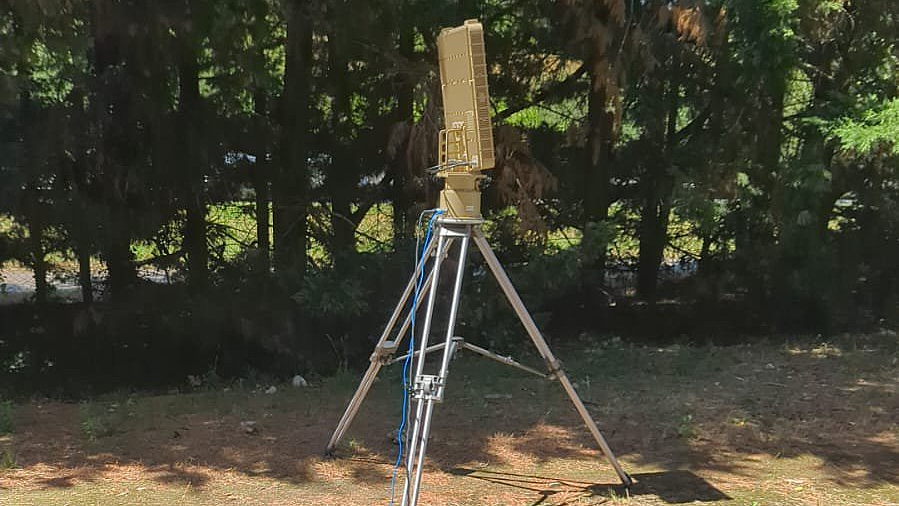
Locating radar emissions is a passive process, it doesn’t reveal your own location. That’s why i said the radar array would have to have very strong defenses extending out 30 km in all 360 degree directions from each individual radar station. And if a group has that strong a level of military equipment already then i don’t see why they would need this huge redundant array of radar stations all concentrated in a small area.
That depends very much so on the radar system. In practical terms, almost all the radar systems we’re discussing here are going to be both transmitter and receiver in one design. You can’t simply rely on passive radio energy to detect moving objects in a complex environment. You would want both passive and active beam forming in one instrument; not having both is just leaving some of the most valuable developments in modern radar on the table.
And the specific radar we’re discussing, is an active, pulsed LFM phased-array radar. It does both, because, obviously it needs to do both. Its wouldn’t be useful for its intended use if it cant do both.
Your information about passive radar detection is not up to date. There are tons of passive detection of radar systems that by design do zero emission. The radar array stations will need to emit in order to function, but the enemy can find those radar emitters without emitting any energy of their own
https://daronmont.com.au/products/passive-radar
Okay so I was overly general with my first statement.
No one is saying passive radar systems don’t exist. We’ve been using them for decades and there have been massive improvements. But the actual radar system we’re discussing here isn’t. You simply aren’t going to get the same capabilities from a purely passive system than you will from an active + passive system where you can tightly control the frequencies and directions you are transmitting on, and have the information about what frequencies you transmitted on, when you transmitted them, and how (what array configuration) you transmitted them. The point is that the transmission itself is structured to reveal certain information. So when you get a response back (also, coming back to a phased system), you can learn far more about your target than you could in a purely passive system because you that prior information about what you transmitted.
Your confused about what I’m saying. The ARRAY OF RADAR STATIONS is emitters. I’m saying THE ATTACKERS AGAINST the array of radar stations only need to be passive detectors.
No, I’m not confused whatsoever. You can not get the same kind of information using radar using the system you are describing. Period. You are confusing broad, beacon like radar systems (like a flashlight or a paint brush) with phased systems, which are fundamentally different.
Phased systems depend on nano-pico second scale precision in timing; you aren’t accomplishing that across a distributed system. And the exact structure of the beam that is going to be formed is dependent on what the receiver has detected, whatever scan pattern is being used. They are a coupled system.
Basically you deny enemy armor and other infantry support into the area you are working in, which means the infantry can’t operate effectively in that area.
I’m not understanding. Let’s say army A has a radar array of 500 relatively cheap radar stations. They clump them all into a 1 square km area. So now army Z drives some howitzers nearby (which aren’t detectable by ground based radar), waits till a radar station turns on, the passively locates the radar base station, and shoots a cheap shell at it which destroys it.
But if you say army A has the level of military equipment that can locate and destroy howitzers up to 30 km away in all directions, then what benefit does an array of concentrated radar stations provide?
I don’t know where you are getting this 1km cluster idea from.
The point of cheaper radar systems is that you don’t need to defend them as much, because destroying them requires equipment that’s more expensive than the radar station. They overlap, and the locating that they provide can both protect the stations themselves and other targets in their coverage area.
How are those tanks going to maneuver undetected without air support?
That’s the topic of the thread your replying in. Quote:
Yeah… A few
Radars are already deployed like that. Most radars sit many kilometers from each other because of interference and not needing the extra coverage. Radar coverage is absolutely enormous for modern systems.