Not necessarily, it seems you can work with screw-based foundations even with higher setups. I found a german source with good pictures for what looks like a raspberry farm
Oh that’s great, thanks!
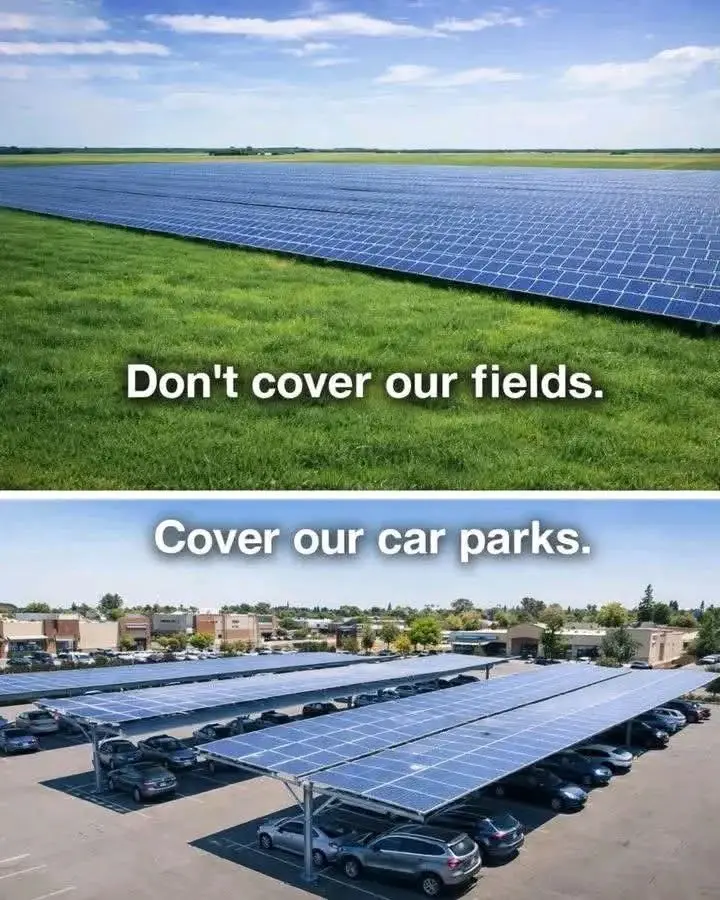
It’s s bit disheartening to see how many fields are covered in PV without doing agri-pv, effectively competing with farming, at least in my area. It seems like agri pv is a purely academic thing for now, at least I haven’t ever read about productive usage. My best guess, aside from steep investment costs, would be that the laws are different for farming and pv (I’m in Germany).
How many places outside of Europe regularly use green houses for agriculture?
For Europe, integrating solar voltaics into the existing greenhouse covers seems like a decent idea. Most of the infrastructure is already there and there are various breeds of plants designed to be grown there.
North America, in contrast, doesn’t use greenhouses outside of niche crops. There is no infrastructure set up, crops are grown where natural temperatures are adequate, and breeds are selected to take full use of the sun.
Agri-pv may work in Europe because of how agriculture works there, but it may not scale to other parts of the world.
It’s not that the scale of greenhouse farming is enormous in Europe. To my knowledge, it’s mostly the Netherlands, and also “niche” crops (compared to the big ones like wheat and corn). Also my guess would be that the structures are more complicated to integrate with PV since greenhouse covers can be switched open/shut.
Europe also mostly has open farming and also usually grows crops that used to be fine with being in the sun all day. The issue is that the summers getting hotter and hotter with the climate change and they are struggling and need a lot of additional watering - or some kind of shade they didn’t need before. I’d assume that’s the same in NA.
The main difference I see between Europe and NA is how densely packed Europe is. Every square cm of land is already used for something, what’s left of natural habitats has to be protected. There’s real competition for space. Land is way more available in NA if I’m not mistaken.
Spain has a similar region filled with greenhouses. The test case used for solar voltaics is for a crop that is sensitive to temperature, so a minor loss in exposed radiance may be preferable to a consistent growing temperatures.
I feel like it also depends on where the land is regarding growing. France is an agricultural giant and would probably compare to California in regards to land values. Yet, both places have an enormous agricultural output.
It is also getting back to my statement as to what kind of farming would benefit from having plants compete with silicon for solar radiance. The best trade off is greenhouses, where is already an attempt to trade some weather exposure for climate control. I don’t see this technology being used for open fields because of how it will affect open farming. And in cases where European farmers use greenhouses to grow vegetables for longer parts of the year, American farmers trade off growing seasons based on latitude.
I know and feel you, that’s wh I have looked into. It seems the biggest issues are bureaucratic (you can either produce power or food, if you want both, it gets murky and you need exceptions) and our bad grid. People can not transport the created energy without the grid straining.
Both can be solved, not sure if Frau Reiche wants to…


Not necessarily, it seems you can work with screw-based foundations even with higher setups. I found a german source with good pictures for what looks like a raspberry farm
Oh, and a comparison when to use what (looks like ai, but, you know…)
Oh that’s great, thanks! It’s s bit disheartening to see how many fields are covered in PV without doing agri-pv, effectively competing with farming, at least in my area. It seems like agri pv is a purely academic thing for now, at least I haven’t ever read about productive usage. My best guess, aside from steep investment costs, would be that the laws are different for farming and pv (I’m in Germany).
How many places outside of Europe regularly use green houses for agriculture?
For Europe, integrating solar voltaics into the existing greenhouse covers seems like a decent idea. Most of the infrastructure is already there and there are various breeds of plants designed to be grown there.
North America, in contrast, doesn’t use greenhouses outside of niche crops. There is no infrastructure set up, crops are grown where natural temperatures are adequate, and breeds are selected to take full use of the sun.
Agri-pv may work in Europe because of how agriculture works there, but it may not scale to other parts of the world.
It’s not that the scale of greenhouse farming is enormous in Europe. To my knowledge, it’s mostly the Netherlands, and also “niche” crops (compared to the big ones like wheat and corn). Also my guess would be that the structures are more complicated to integrate with PV since greenhouse covers can be switched open/shut.
Europe also mostly has open farming and also usually grows crops that used to be fine with being in the sun all day. The issue is that the summers getting hotter and hotter with the climate change and they are struggling and need a lot of additional watering - or some kind of shade they didn’t need before. I’d assume that’s the same in NA.
The main difference I see between Europe and NA is how densely packed Europe is. Every square cm of land is already used for something, what’s left of natural habitats has to be protected. There’s real competition for space. Land is way more available in NA if I’m not mistaken.
Just one word: Almería.
It’s called the “sea of plastic” because of the greenhouse extension.
Spain has a similar region filled with greenhouses. The test case used for solar voltaics is for a crop that is sensitive to temperature, so a minor loss in exposed radiance may be preferable to a consistent growing temperatures.
I feel like it also depends on where the land is regarding growing. France is an agricultural giant and would probably compare to California in regards to land values. Yet, both places have an enormous agricultural output.
It is also getting back to my statement as to what kind of farming would benefit from having plants compete with silicon for solar radiance. The best trade off is greenhouses, where is already an attempt to trade some weather exposure for climate control. I don’t see this technology being used for open fields because of how it will affect open farming. And in cases where European farmers use greenhouses to grow vegetables for longer parts of the year, American farmers trade off growing seasons based on latitude.
I know and feel you, that’s wh I have looked into. It seems the biggest issues are bureaucratic (you can either produce power or food, if you want both, it gets murky and you need exceptions) and our bad grid. People can not transport the created energy without the grid straining.
Both can be solved, not sure if Frau Reiche wants to…
But, my favorite German example is the Hop farmer in the Hollertau who built a commercial system himself and is pretty happy (if the grid was stable)