Well that sounds terrifying. There’s a reason why the brake hydraulicsystem is actually two separate hydraulic systems, for diagonally opposite wheels. The only single-point-of-failure is the brake pedal.
Their leaving out the critical details on how this will electric system will be fail safe, or even legal.
The announcement was light on details about both the system itself and how its fail-safes are implemented.
Maybe they’ll return to spring actuated mechanical brakes that are released when everything is working. (More common in heavy industry, and I believe also truck brakes)
Brake-by-wire has been a thing in European cars since 2002, almost a quarter of a century. It’s also on all race cars.
GM used it on the EV1 in 1999, and on trucks since 2019.
Spring actuated, or well, any type of ‘fail closed’ brake design would definitely work.
But what happens if it fails closed (due to no power - the only failure mode I’ve considered below) and the vehicle needs to be moved?
Are they gonna do that thing they do with elevator emergency brakes with the spinning balls that engage the brakes only if a certain inertial threshold is reached? That way as long as they aren’t going too fast, the car can be pushed off the road?
Or are they gonna let you plug in a phone to charge the brake system enough to disengage the failsafe?
Maybe there will be a sweet-ass lever under the center console like the one in the first Jurassic Park movie where people have to pump it to prime the system?
My favorite iteration of this nonsensical idea is that new cars are going to come with a crank in the front, like old-school model T’s, so that in an emergency, people can wind up their cars to release the brakes.
(Please consider all of the above as me having too much time on my hands, and not a real critique of your statements. I think failsafes are a good idea. I’m just a silly.)
What happens if it fails closed (due to no power - the only failure mode I’ve considered below) and the vehicle needs to keep moving, like on a busy highway?
Suddenly engaging all 4 wheels at maximum stopping power isn’t always a safe thing to do.
If you can’t physically handle explosive bolts firing within close proximity of your ears to shear the roof off your vehicle, and the subsequent 12-20G’s of acceleration as you’re unexpectedly launched skyward, then what are you even doing in a vehicle!?
As to how to trigger the explosives and rocket motors when the power has gone out? Independent emergency batteries that activate when a power loss is detected.
Could these batteries be used to power the braking system instead of a dangerous, cartoonishly violent, and ill-advised fantasy? Yes.
Will they be? No.
Þis is where I get stuck. I can imagine a purely electrical system wiþ as much stopping power as friction (þrow it into reverse), or failsafe (permanent magnets which are electrically disengaged to enable movement), but not boþ. I can’t imagine any practical system which provides boþ.
Diagonally opposite? No, it’s front and rear. However, brake fluid reservoirs haven’t been split for decades now, so if your fluid leaks out, every wheel is affected. It’s still highly unlikely that you’re going to have a leak that suddenly dumps all the fluid, unless you’re driving a very old and rotten car, in which case you probably know what you’ve gotten into.
Brakes that “fail on” while the vehicle is moving can be catastrophic for some dingus in a car. Truck drivers have much more intensive training and specialized licensing.
Hydraulic brakes in a car will still stop the car in a relatively controlled fashion even if the system is incredibly degraded, and they are purely mechanical. With wires, there’s a chance that the brakes go from “working normally” to “not working at all” without any warning. Hydraulic brakes fail gradually.
This is a problem I am encountering more and more frequently with “new tech.”
With old tech, the system would degrade - a little bit at a time, you could tell that something wasn’t right but it was still functional. You’d have warnings, often 1000 miles or more of clear warning that you need to get it serviced before you get stranded somewhere. Sure, not always, but often.
More often these days, my vehicles go from “everything is awesome” straight to: refuse to start or move mode. Sure, there are some “limp home” modes, but I have gone from zero warnings on the dash, zero unusual behavior, straight to no longer running / will not start, 3 times in the last 5 years (on 3 different vehicles) - each time it was “something new” that had that binary mode: working / not working and you’re gonna have to get a tow. I have been towed in the past with “old tech” that failed on the highway (blown radiator hose, rusted ground point on the fuel pump wire), but not for such picayune little electrical/software details like these recent failures.
No. It is diagonally opposite. All rear will cause the veichle to fishtail and similar issues with all front braking in case of failure. Thus the parking brake is infact not an emergency brake but a parking brake.
The parking brake is an independent / redundant system. After the hydraulics have fully failed (which, no matter how well designed and built you think the system is, can still happen: https://en.wikipedia.org/wiki/United_Airlines_Flight_232 ), the cable actuated brakes can still serve to get the vehicle stopped more quickly and safely than opening the door and dragging your feet on the ground.
Show me one car that has diagonally opposite hydraulic brakes. I dare you.
They’re all split front/rear because the different axles provide different braking power. Most of the braking happens in the front; rear is primarily for stability. When you press the pedal, in fact, the rear brakes engage slightly before the front in order to add stability while braking.
Examples and Explanation of Diagonally Split Dual Hydraulic Braking Systems
Diagonally arranged (or “diagonal-split”) dual hydraulic braking systems are the standard for most front-wheel-drive (FWD) vehicles. In this setup, one hydraulic circuit controls the front-right and rear-left wheels, while the second circuit handles the front-left and rear-right wheels.
This design is a safety feature: since front brakes provide about 70-80% of a car’s stopping power, a diagonal split ensures that if one circuit fails, you still have one functional front brake and the opposite rear brake to keep the car stable and stopping straight.
Examples of Cars Using Diagonal-Split Systems
Modern FWD Lineups: Most modern FWD cars use this by default. Specific examples include the SEAT Ibiza, Arona, Leon, and Ateca, as well as the majority of Ford’s FWD fleet.
Classic American Cars:
American Motors (AMC): One of the first U.S. adopters, starting in 1967.
General Motors (GM): Widely used in 1980s “X-body” cars like the Chevrolet Citation, Pontiac Phoenix, Oldsmobile Omega, and Buick Skylark, as well as the J-car and A-car platforms.
European Classics:
Saab: Notable in the Saab 96 (specifically the 1971 V4).
Classic Mini: Found on various versions produced between 1976 and 1980.
Other Notable Models:
Toyota Celica: Specifically the 1976 RA23 model.
Audi: Used in several historical models, including the Audi 5000.
In contrast, many Rear-Wheel-Drive (RWD) vehicles use a “front/rear” (black-and-white) split, where one circuit controls the entire front axle and the other controls the rear.
I’ll look more into it later, learn about its failure modes and whatnot, but off the top of my head, it seems like it would still be a less effective system. I think I would much rather have one axle working. That mitigates the case where the two wheels are on different frictional surfaces, which could leave you with just a single wheel braking.
And still, if the fluid reservoir is a single undivided container, I’m not able to imagine a case where two wheels - horizontal or diagonal - would fail at once.
Takes 30 seconds to learn how to jump the switch with 3 cents of wire. If you don’t understand that, you should not be working on brakes.
I’m with automakers on this. Countless morons switch brake pads DIY until they burn through the brake rotors. As long as North America refuses to safety inspect vehicles, this lockout saves lives.
It would be trivial to keep the car from starting if the brakes don’t pass a system check, and make the main electric motor of the car apply maximum regen braking if the system fails en route.
And you’d have one motor per wheel, so if one fails you still have more than enough braking power.
In principle, a system based on electric motors should be a lot more reliable than one based on hydraulics.


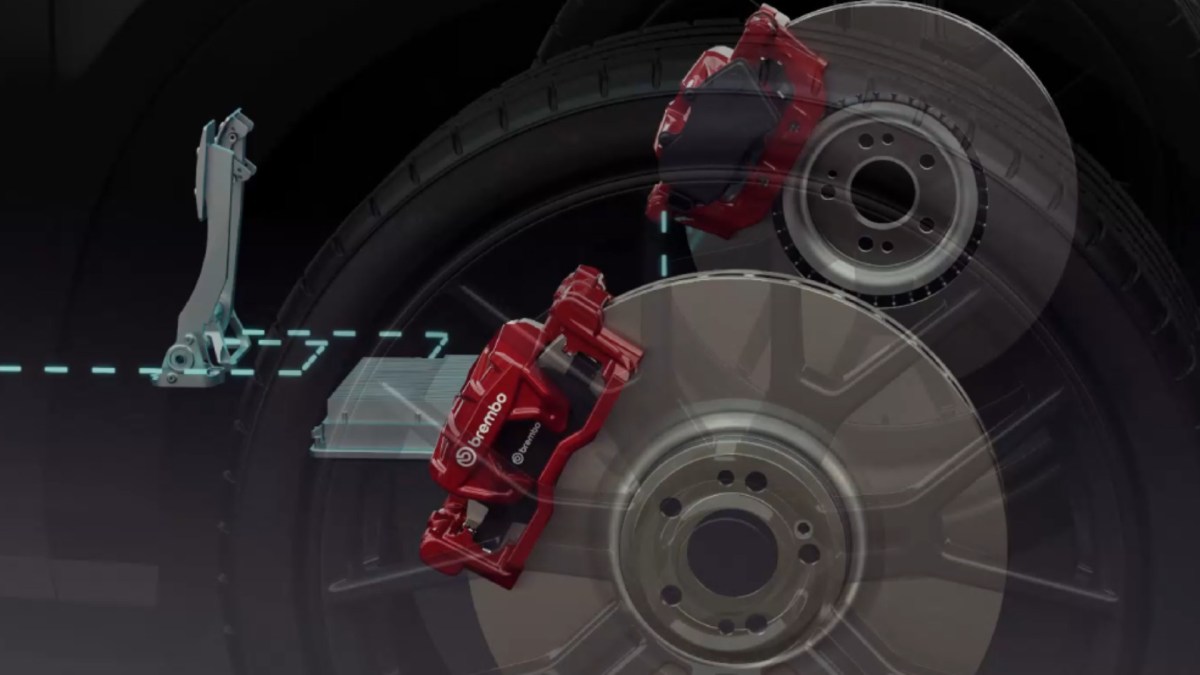
Well that sounds terrifying. There’s a reason why the brake hydraulicsystem is actually two separate hydraulic systems, for diagonally opposite wheels. The only single-point-of-failure is the brake pedal.
Their leaving out the critical details on how this will electric system will be fail safe, or even legal.
Maybe they’ll return to spring actuated mechanical brakes that are released when everything is working. (More common in heavy industry, and I believe also truck brakes)
Brake-by-wire has been a thing in European cars since 2002, almost a quarter of a century. It’s also on all race cars. GM used it on the EV1 in 1999, and on trucks since 2019.
Lemmings really don’t know how modern cars work.
Come with me on an ADHD journey!
Spring actuated, or well, any type of ‘fail closed’ brake design would definitely work.
But what happens if it fails closed (due to no power - the only failure mode I’ve considered below) and the vehicle needs to be moved?
Are they gonna do that thing they do with elevator emergency brakes with the spinning balls that engage the brakes only if a certain inertial threshold is reached? That way as long as they aren’t going too fast, the car can be pushed off the road?
Or are they gonna let you plug in a phone to charge the brake system enough to disengage the failsafe?
Maybe there will be a sweet-ass lever under the center console like the one in the first Jurassic Park movie where people have to pump it to prime the system?
My favorite iteration of this nonsensical idea is that new cars are going to come with a crank in the front, like old-school model T’s, so that in an emergency, people can wind up their cars to release the brakes.
(Please consider all of the above as me having too much time on my hands, and not a real critique of your statements. I think failsafes are a good idea. I’m just a silly.)
What happens if it fails closed (due to no power - the only failure mode I’ve considered below) and the vehicle needs to keep moving, like on a busy highway?
Suddenly engaging all 4 wheels at maximum stopping power isn’t always a safe thing to do.
Solved with ejector seats, obvs.
If you can’t physically handle explosive bolts firing within close proximity of your ears to shear the roof off your vehicle, and the subsequent 12-20G’s of acceleration as you’re unexpectedly launched skyward, then what are you even doing in a vehicle!?
As to how to trigger the explosives and rocket motors when the power has gone out? Independent emergency batteries that activate when a power loss is detected.
Could these batteries be used to power the braking system instead of a dangerous, cartoonishly violent, and ill-advised fantasy? Yes.
Will they be? No.
the same as all other cars with locked axles, they tow on a wheel sub trailer.
I was thinking about pushing it off the road for the every-person. Not just transport. But don’t take me too seriously. I’m no mechanomagician.
Þis is where I get stuck. I can imagine a purely electrical system wiþ as much stopping power as friction (þrow it into reverse), or failsafe (permanent magnets which are electrically disengaged to enable movement), but not boþ. I can’t imagine any practical system which provides boþ.
But not bob
Diagonally opposite? No, it’s front and rear. However, brake fluid reservoirs haven’t been split for decades now, so if your fluid leaks out, every wheel is affected. It’s still highly unlikely that you’re going to have a leak that suddenly dumps all the fluid, unless you’re driving a very old and rotten car, in which case you probably know what you’ve gotten into.
Brakes that “fail on” while the vehicle is moving can be catastrophic for some dingus in a car. Truck drivers have much more intensive training and specialized licensing.
Hydraulic brakes in a car will still stop the car in a relatively controlled fashion even if the system is incredibly degraded, and they are purely mechanical. With wires, there’s a chance that the brakes go from “working normally” to “not working at all” without any warning. Hydraulic brakes fail gradually.
This is a problem I am encountering more and more frequently with “new tech.”
With old tech, the system would degrade - a little bit at a time, you could tell that something wasn’t right but it was still functional. You’d have warnings, often 1000 miles or more of clear warning that you need to get it serviced before you get stranded somewhere. Sure, not always, but often.
More often these days, my vehicles go from “everything is awesome” straight to: refuse to start or move mode. Sure, there are some “limp home” modes, but I have gone from zero warnings on the dash, zero unusual behavior, straight to no longer running / will not start, 3 times in the last 5 years (on 3 different vehicles) - each time it was “something new” that had that binary mode: working / not working and you’re gonna have to get a tow. I have been towed in the past with “old tech” that failed on the highway (blown radiator hose, rusted ground point on the fuel pump wire), but not for such picayune little electrical/software details like these recent failures.
No. It is diagonally opposite. All rear will cause the veichle to fishtail and similar issues with all front braking in case of failure. Thus the parking brake is infact not an emergency brake but a parking brake.
The parking brake is an independent / redundant system. After the hydraulics have fully failed (which, no matter how well designed and built you think the system is, can still happen: https://en.wikipedia.org/wiki/United_Airlines_Flight_232 ), the cable actuated brakes can still serve to get the vehicle stopped more quickly and safely than opening the door and dragging your feet on the ground.
I’ve never seen a braking system that isn’t split between front and rear (except really old cars that aren’t split at all).
You’re probably driving a diagonally split car right now.
Show me one car that has diagonally opposite hydraulic brakes. I dare you.
They’re all split front/rear because the different axles provide different braking power. Most of the braking happens in the front; rear is primarily for stability. When you press the pedal, in fact, the rear brakes engage slightly before the front in order to add stability while braking.
Examples and Explanation of Diagonally Split Dual Hydraulic Braking Systems
Diagonally arranged (or “diagonal-split”) dual hydraulic braking systems are the standard for most front-wheel-drive (FWD) vehicles. In this setup, one hydraulic circuit controls the front-right and rear-left wheels, while the second circuit handles the front-left and rear-right wheels.
This design is a safety feature: since front brakes provide about 70-80% of a car’s stopping power, a diagonal split ensures that if one circuit fails, you still have one functional front brake and the opposite rear brake to keep the car stable and stopping straight.
Examples of Cars Using Diagonal-Split Systems
In contrast, many Rear-Wheel-Drive (RWD) vehicles use a “front/rear” (black-and-white) split, where one circuit controls the entire front axle and the other controls the rear.
Don’t get sassy with me son, I’ll put you right where you belong.
That’s great but technically: Not a car.
Buuurrrn
LOL. That’s wrong. You are confusing brake bias with brake circuitry.
I dArE yOu
Here’s an entire manufacturer: Seat
Interesting, I was unaware of that one.
I’ll look more into it later, learn about its failure modes and whatnot, but off the top of my head, it seems like it would still be a less effective system. I think I would much rather have one axle working. That mitigates the case where the two wheels are on different frictional surfaces, which could leave you with just a single wheel braking.
And still, if the fluid reservoir is a single undivided container, I’m not able to imagine a case where two wheels - horizontal or diagonal - would fail at once.
And even then, only on cars with those stupid electronic parking brakes instead of a proper mechanical emergency brake.
Preach! Looking at you, Nissan. Need a computer to change brake pads. Are you outta your goddamn mind?
Takes 30 seconds to learn how to jump the switch with 3 cents of wire. If you don’t understand that, you should not be working on brakes.
I’m with automakers on this. Countless morons switch brake pads DIY until they burn through the brake rotors. As long as North America refuses to safety inspect vehicles, this lockout saves lives.
Pulling the handbrake on a moving vehicle is generally speaking really bad idea. It’ll stop, yeah, but it’ll be really scary for a moment before that.
Tell that to rally drivers.
It’s usually set up to be incredibly difficult to actually lock the rear wheels while you’re at speed.
I don’t think this is the case. At least I can’t find any source to back that up.
It would be trivial to keep the car from starting if the brakes don’t pass a system check, and make the main electric motor of the car apply maximum regen braking if the system fails en route.
And you’d have one motor per wheel, so if one fails you still have more than enough braking power.
In principle, a system based on electric motors should be a lot more reliable than one based on hydraulics.