
You must log in or register to comment.
Unfortunately they had to shut down the Bermuda Triangle due to austerity.
When I was in 4th grade I thought the Bermuda triangle would be a way bigger problem for me than it actually turned out to be.
Also, being on fire. The way they pushed, “stop, drop, and roll” so hard, I presumed that being on fire was a routine part of life.
That one I think was basically a late response to all the ways folks used to kinda find themselves on fire.
Advent and proliferation of gas stoves, cigarettes, and cool new “space-age” (hyper-flammable) building and textile materials. Probably lotsa extra reasons and compounding factors, too, frankly there was (and is) a lot to figure out lol.
You might even have found yourself on fire back then, too!
So true!
And quicksand.
I for sure thought quicksand would happen! With all those sandboxes and shit?
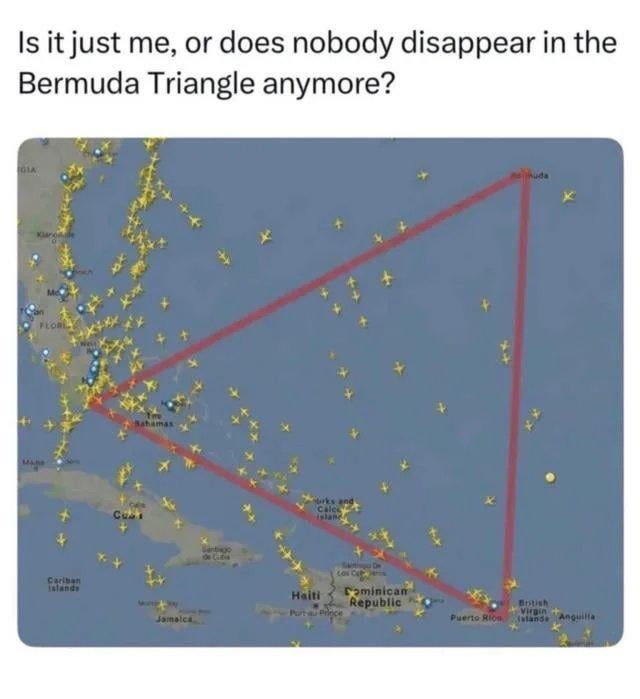
Survivorship bias. The map only shows those that haven’t disappeared, doh.
All the blips you’re not seeing have disappeared.
If I’m not mistaken, the whole myth rose from an incident with a pilot using land navigation, got one cluster of islands confused with another, which caused him to set an incorrect course and ended up getting lost at sea.
Ay least that’s my understanding. Now let’s talk about the real danger: quicksand.
Not to make too fine a point of it, but quicksand is relatively rare in the Bermuda Triangle. Unless it is a very watered down version of course, but that’s outside my comfort zone.
Quicksand is hella rare everywhere. As a kid i feared it hard and knowing how to escape it was absolutely survival-critical knowledge.
I have never once been anywhere even near it.
You can make your own, it’s fun! Dig a big hole on the beach, fill it with water, then put the sand back in. It makes kind of a trap, you can’t necessarily tell there’s a hole there but if you step on it, you’ll sink right in. Don’t worry, you can get out just fine.
New fear unlocked: The Bermuda Quicksand!
Are those called beaches?
Hmm you might be onto something here
I suppose there’s also the really wet sand, on the ocean floor. I don’t think it gets much more wet than that. Not sure how quick it is though. But presumably if you are stuck in that sand, then you have already endured a series of arguably less desirable circumstances.
beaches are huge traps set by government to trap people
As I understand, the number of incidents was no worse than other travel areas. Just that the Bermuda triangle is such a heavily traveled area, meaning more incidents
That, and it’s an area prone to hurricanes.
Or the real danger for kids: you can be abused by the President of the usa but there never will be any repercussions
Scooby doo enforced it for me
As I understand quicksand is only dangerous because people get stuck and can’t get out. People don’t sink in quicksand. You actually can get out all by yourself.
I always felt like sinking mud didn’t get the attention it deserved.
Is it just you? If you’re lost, how are you posting this?
Navigation and tracking have improved since 1970.
The spirits evaporated through the hole in the ozone layer.
The worst part about this is i have absolutely no solid proof that that’s wrong.
Did this mysteriously align with the increasingly prevalent use of gps technology?
Nah, it was never a particularly dangerous place. There were just a couple of accidents there that became famous.
That’s a bit of an understatement. There were books and movies and documentaries on this.
One documentary suggested there could be some kind of gas (like CO2) leaking from the ocean floor, which floated to the surface and affected the buoyancy of ships, causing them to sink. It also rose into the air and made airplanes not fly. So maybe it was also helium or something.
I’m surprised the billionaire pancake Ocean Gate guy didn’t take his fiberglass submersible down in that area to find all these sunken ships and airplanes.
Methane you funky bitch
Wait til you hear about The Great Lakes Triangle. Much nastier than the Bermuda one.
They say if you sail too far you could accidentally find yourself in the USA 🤢
Dude don’t scare people
The legend lives on from the Chippewa on down
Of the big lake they call Gitche Gumee…
The Bermuda Triangle is so 20th Century. That term is considered racist now.
Racist?
They prefer the term three-sided polygon.
Basically.
The bermuda beast was shot by the police in 1976
Think I saw research that shows there was a lot of methane deposits underneath that area and so low flying craft as well as ships would find density of the air as well water changing so much they plummet.
A few years from now I’ll think for a moment, combine a few memories, and tell someone that I heard on pretty good authority that something to do with collected cow farts, arriving right there in the Bermuda Triangle, caused ships and planes to rock around violently.
By which I mean, thank you, for the confused glares from strangers, somewhere in my future.
Doing more research on it and apparently the methane argument may not hold true. Though the information is this year of what they’re finding so it may take a while to manifest into publications.