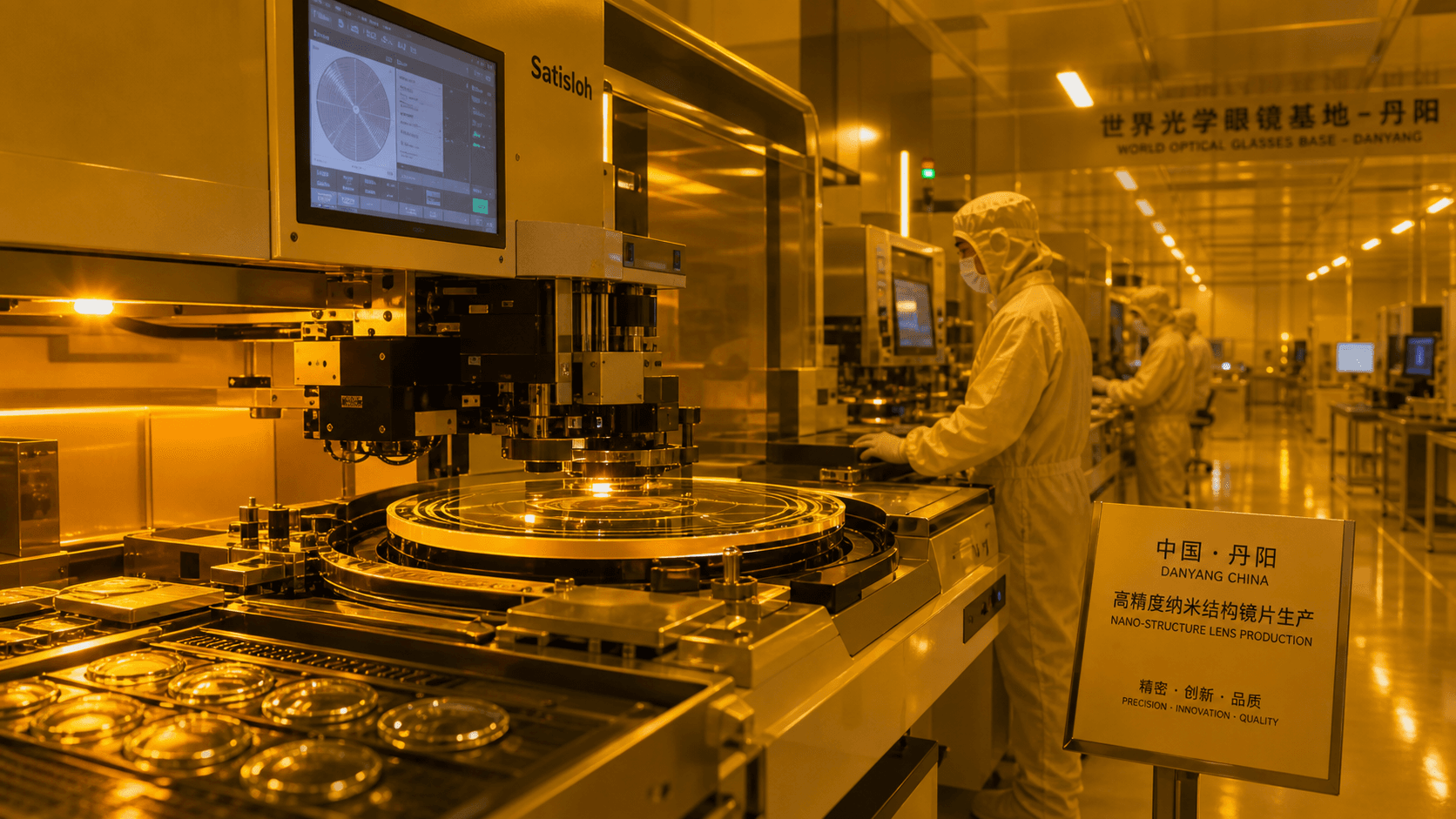
Danyang county, making 50% of global eyeglass lenses, introduces semiconductor lithography to produce nano-structured lenses as thin as 2mm even for 1500-degree prescriptions.
Communists can correctly identify China as socialist because we understand that public ownership is the principal aspect of its economy, and that it has a dictatorship of the proletariat. Inequality exists because China is socialist, not even at an advanced stage of socialism or communism yet.
What do you believe socialism means, and where did this understanding come from, if it leads you to believe a country where public ownership is the principal aspect of the economy and a dictatorship of the proletariat is not socialist?
So, in other words, you only have vibes. You have offered no theoretical basis, no practical basis, you distill socialism to an emotion. You’re getting pushback from people because this vibes-based approach to socialism is unscientific, and used to further imperialist narratives on a developing socialist state.
In China, the backbone of the economy is in the public sector, in huge State Owned Enterprises. The large firms and key industries in China are overwhelmingly publicly owned, while private ownership is relegated to small industry and highly competitive industries. As for working hours, the average is between 40 and 48 hours, usually hovering around 44-46. 996 is illegal, was largely in big tech firms, and is overall rare.
The PRC is a socialist state, not a state capitalist state like the Republic of Korea, US Empire, or Singapore. China being socialist has nothing to do with the name of the party in control, and everything to do with the mode of production and distribution in China. Rather than a neoliberal paradise, it’s closer to a nightmare for neoliberals. This editorial from The Guardian explains it quite well, actually:
But Xi’s support for mixing private and public ownership structures was purely pragmatic. It had value, he said in another forum, because it would “improve the socialist market economic structure.” Xi’s assessment is echoed by Michael Collins, one of the CIA’s most senior officials for Asia. “The fundamental end of the Communist party of China under Xi Jinping is all the more to control that society politically and economically,” Collins argued earlier this year. “The economy is being viewed, affected and controlled to achieve a political end.”
…
The party’s overarching aim, though, has remained consistent: to ensure that the private sector, and individual entrepreneurs, do not become rival players in the political system. The party wants economic growth, but not at the expense of tolerating any organised alternative centres of power.
…
“[Capitalists] act as if they are being chased by a bear,” wrote Zhang Lin, a Beijing political commentator, in response to these comments. “They are powerless to control the bear, so they are competing to outrun each other to escape the animal.”
How then, does China’s economy work? Public ownership is the principal aspect of China’s economy. This means that public ownership governs the large firms and key industries, and is what is rising in China, as private ownership is kept to small and medium non-essential industries. No system is static, meaning identifying the nature of a system depends on identifying what is rising and what is dying away. Cpitalists are held on a tight leash, and are prevented from gaining political power as a class. The reason private ownership is allowed at all is because China has very uneven development due to their rapid industrialization, and private ownership does help with filling in gaps left by the primary aspects of the economy like SOEs.
The form of democracy and the mode of production in China ensures that there is a connection between the people and the state. Policies like the mass line are in place to ensure this direct connection remains. This is why over 90% of the Chinese population supports the government, and why they have such strong perceptions around democracy:
The Chinese political system is based on whole-process people’s democracy, a form of consultative democracy. The local government is directly elected, and then these governments elect people to higher rungs, meaning any candidate at the top level must have worked their way up from the bottom and directly proved themselves. Combining this consultative, ground-up democracy with top-down economic planning is the key to China’s success.
I highly recommend Roland Boer’s Socialism in Power: On the History and Theory of Socialist Governance. Socialist democracy has been imperfect, but has gone through a number of changes and adaptations over the years as we’ve learned more from testing theory to practice. Boer goes over the history behind socialist democracy in this textbook.
China does have billionaires, as you might then protest. China is in the developing stages of socialism. Between capitalism, which is characterized by private ownership being the principal aspect of the economy and the capitalists in control of the state, and communism, characterized by full collectivization of production and distribution devoid of classes and the state, run along the lines of a common plan, is socialism, where public ownership is principle and the working classes in control. China in particular is working its way out of the initial stages of socialism:
The reason China has billionaires is because China has private property, and the reason it has private property is because of 2 major factors: the world economy is still dominated by the US empire, and because you cannot simply abolish private property at the stroke of a pen. China tried that already. The Gang of Four tried to dogmatically force a publicly owned and planned economy when the infrastructure best suited to that hadn’t been laid out by markets, and as a consequence growth was positive but highly unstable.
Why does it matter that the US Empire controls the world economy? Because as capitalism monopolizes, it is compelled to expand outward in order to fight falling rates of profit by raising absolute profits. The merging of bank and industrial capital into finance capital leads to export of capital, ie outsourcing. This process allows super-exploitation for super-profits, and is known as imperialism.
In the People’s Republic of China, under Mao and later the Gang of Four, growth was overall positive but was unstable. The centrally planned economy had brought great benefits in many areas, but because the productive forces themselves were underdeveloped, economic growth wasn’t steady. There began to be discussion and division in the party, until Deng Xiapoing’s faction pushing for Reform and Opening Up won out, and growth was stabilized.
Deng’s plan was to introduce market reforms, localized around Special Economic Zones, while maintaining full control over the principle aspects of the economy. Limited private capital would be introduced, especially by luring in foreign investors, such as the US, pivoting from more isolationist positions into one fully immersed in the global marketplace. As the small and medium firms grow into large firms, the state exerts more control and subsumes them more into the public sector. This was a gamble, but unlike what happened to the USSR, this was done in a controlled manner that ended up not undermining the socialist system overall.
To dogmatically collectivize the entire economy would actually be a move undesirable by Marxist standards. Certain economies like the DPRK and USSR have had to do so in order to develop military deterrence, China managed to negotiate itself into the global economy and take advantage of the utility of markets in socializing the small industries, making them ripe for central planning.
This is why your claims of China “not screaming socialist” to you all fall apart immediately. There’s no materialist analysis, no definition of socialism, no understanding of the dictatorship of the proletariat, no supporting evidence on your part. All of it is just emotions, feelings, and vibes, which are utterly unscientific and are used in a subjectivist manner to downplay a real, existing alternative to capitalist decay.


deleted by creator
Thanks for further clarifying you don’t understand what socialism actually is.
Communists can correctly identify China as socialist because we understand that public ownership is the principal aspect of its economy, and that it has a dictatorship of the proletariat. Inequality exists because China is socialist, not even at an advanced stage of socialism or communism yet.
deleted by creator
No, but it certainly helps. Those who want socialism tend to be the most informed on what it is and how it works.
deleted by creator
What do you believe socialism means, and where did this understanding come from, if it leads you to believe a country where public ownership is the principal aspect of the economy and a dictatorship of the proletariat is not socialist?
deleted by creator
So, in other words, you only have vibes. You have offered no theoretical basis, no practical basis, you distill socialism to an emotion. You’re getting pushback from people because this vibes-based approach to socialism is unscientific, and used to further imperialist narratives on a developing socialist state.
In China, the backbone of the economy is in the public sector, in huge State Owned Enterprises. The large firms and key industries in China are overwhelmingly publicly owned, while private ownership is relegated to small industry and highly competitive industries. As for working hours, the average is between 40 and 48 hours, usually hovering around 44-46. 996 is illegal, was largely in big tech firms, and is overall rare.
The PRC is a socialist state, not a state capitalist state like the Republic of Korea, US Empire, or Singapore. China being socialist has nothing to do with the name of the party in control, and everything to do with the mode of production and distribution in China. Rather than a neoliberal paradise, it’s closer to a nightmare for neoliberals. This editorial from The Guardian explains it quite well, actually:
How then, does China’s economy work? Public ownership is the principal aspect of China’s economy. This means that public ownership governs the large firms and key industries, and is what is rising in China, as private ownership is kept to small and medium non-essential industries. No system is static, meaning identifying the nature of a system depends on identifying what is rising and what is dying away. Cpitalists are held on a tight leash, and are prevented from gaining political power as a class. The reason private ownership is allowed at all is because China has very uneven development due to their rapid industrialization, and private ownership does help with filling in gaps left by the primary aspects of the economy like SOEs.
The form of democracy and the mode of production in China ensures that there is a connection between the people and the state. Policies like the mass line are in place to ensure this direct connection remains. This is why over 90% of the Chinese population supports the government, and why they have such strong perceptions around democracy:
The Chinese political system is based on whole-process people’s democracy, a form of consultative democracy. The local government is directly elected, and then these governments elect people to higher rungs, meaning any candidate at the top level must have worked their way up from the bottom and directly proved themselves. Combining this consultative, ground-up democracy with top-down economic planning is the key to China’s success.
I highly recommend Roland Boer’s Socialism in Power: On the History and Theory of Socialist Governance. Socialist democracy has been imperfect, but has gone through a number of changes and adaptations over the years as we’ve learned more from testing theory to practice. Boer goes over the history behind socialist democracy in this textbook.
China does have billionaires, as you might then protest. China is in the developing stages of socialism. Between capitalism, which is characterized by private ownership being the principal aspect of the economy and the capitalists in control of the state, and communism, characterized by full collectivization of production and distribution devoid of classes and the state, run along the lines of a common plan, is socialism, where public ownership is principle and the working classes in control. China in particular is working its way out of the initial stages of socialism:
The reason China has billionaires is because China has private property, and the reason it has private property is because of 2 major factors: the world economy is still dominated by the US empire, and because you cannot simply abolish private property at the stroke of a pen. China tried that already. The Gang of Four tried to dogmatically force a publicly owned and planned economy when the infrastructure best suited to that hadn’t been laid out by markets, and as a consequence growth was positive but highly unstable.
Why does it matter that the US Empire controls the world economy? Because as capitalism monopolizes, it is compelled to expand outward in order to fight falling rates of profit by raising absolute profits. The merging of bank and industrial capital into finance capital leads to export of capital, ie outsourcing. This process allows super-exploitation for super-profits, and is known as imperialism.
In the People’s Republic of China, under Mao and later the Gang of Four, growth was overall positive but was unstable. The centrally planned economy had brought great benefits in many areas, but because the productive forces themselves were underdeveloped, economic growth wasn’t steady. There began to be discussion and division in the party, until Deng Xiapoing’s faction pushing for Reform and Opening Up won out, and growth was stabilized.
Deng’s plan was to introduce market reforms, localized around Special Economic Zones, while maintaining full control over the principle aspects of the economy. Limited private capital would be introduced, especially by luring in foreign investors, such as the US, pivoting from more isolationist positions into one fully immersed in the global marketplace. As the small and medium firms grow into large firms, the state exerts more control and subsumes them more into the public sector. This was a gamble, but unlike what happened to the USSR, this was done in a controlled manner that ended up not undermining the socialist system overall.
To dogmatically collectivize the entire economy would actually be a move undesirable by Marxist standards. Certain economies like the DPRK and USSR have had to do so in order to develop military deterrence, China managed to negotiate itself into the global economy and take advantage of the utility of markets in socializing the small industries, making them ripe for central planning.
This is why your claims of China “not screaming socialist” to you all fall apart immediately. There’s no materialist analysis, no definition of socialism, no understanding of the dictatorship of the proletariat, no supporting evidence on your part. All of it is just emotions, feelings, and vibes, which are utterly unscientific and are used in a subjectivist manner to downplay a real, existing alternative to capitalist decay.
deleted by creator