No. You get the shed. Put these glasses on.

Damn I’m not stable enough to just get jumpscared by an image like that out of nowhere
Oh, my b. Thought it was just funny.
Christ that’s dark, I love it
Took me a while to see the rope.
TBF, I’ll probably go out in worse style…
Reminds me of commiting to the simulation in superhot VR. I legit had to pull off the headset and make sure it was just a game first.
My back got so prickly in that scene. Every survival instinct was telling me to hold up let’s just think about this for a minute.
Could be remixed with all kinds of fandoms. “Come train with me and Vegeta!”
I’d be lucky to even come close to Mr. Satan’s power level
Something’s fucky.
Removed by mod
Kreigers retirement home.
My cherry blossoms are wilting
We will talk about it in the van!
Exit: Van Left
No shade on folks who live in trailers. Dat poverty trap 😭
I mean, growing up in a trailer at one point, it was bigger than your average NY apartment. Certainly more land. We goats and a whole wooded area.
We goats
Must be difficult to type with hooves
Probably used bleat to text.
I was curious so I tried to find average sizes in NYC. The Internet is full of slop and I hate it. anyway, I found
Average apartment sizes in NYC in 2026:
Studio: 400–550 sq ft (37–51 m²)
1-bedroom: 600–800 sq ft (56–74 m²)
2-bedroom: 850–1,100 sq ft (79–102 m²)
3-bedroom: 1,100–1,500 sq ft (102–139 m²)
But at least in the city you get a walkable living place with mass transit. Very few goats, however.
10 times bigger than a flat in tokyo
I was thinking “it cant be that bad”
An article on tokyo apartment sizes and layouts
Relevant part:
Tokyo’s micro-apartments are famous worldwide. Some studios are under 20 m² (215 sq ft) – indeed, over 1.4 million households in Tokyo live in homes smaller than 19.7 m² (212 sq ft)! These tiny units often feature a single multi-purpose room, a unit bath (compact modular bathroom), and a small kitchen. In extreme cases, a few tens of thousands of Tokyo residents live in spaces around 10 m² (≈107 sq ft) – essentially a single room without much extra space, measuring about 95 sq ft of usable area. Due to the high population density and limited space in large cities like Tokyo, these compact living solutions have become common, especially for many young people and single professionals.
In any case, <20 m² is the lower end of the distribution. The lower end in my country has to build favella like living places.
Ooh. 10 times more cleaning area to ignore…
Frig off Barb-san
Go eat some more cheeseburgers you greasy mustard tiger.
Whatca lookin at my waifu fer?
Does Japan not have any crappy areas?
Well there’s Johnson Town in Saitama.
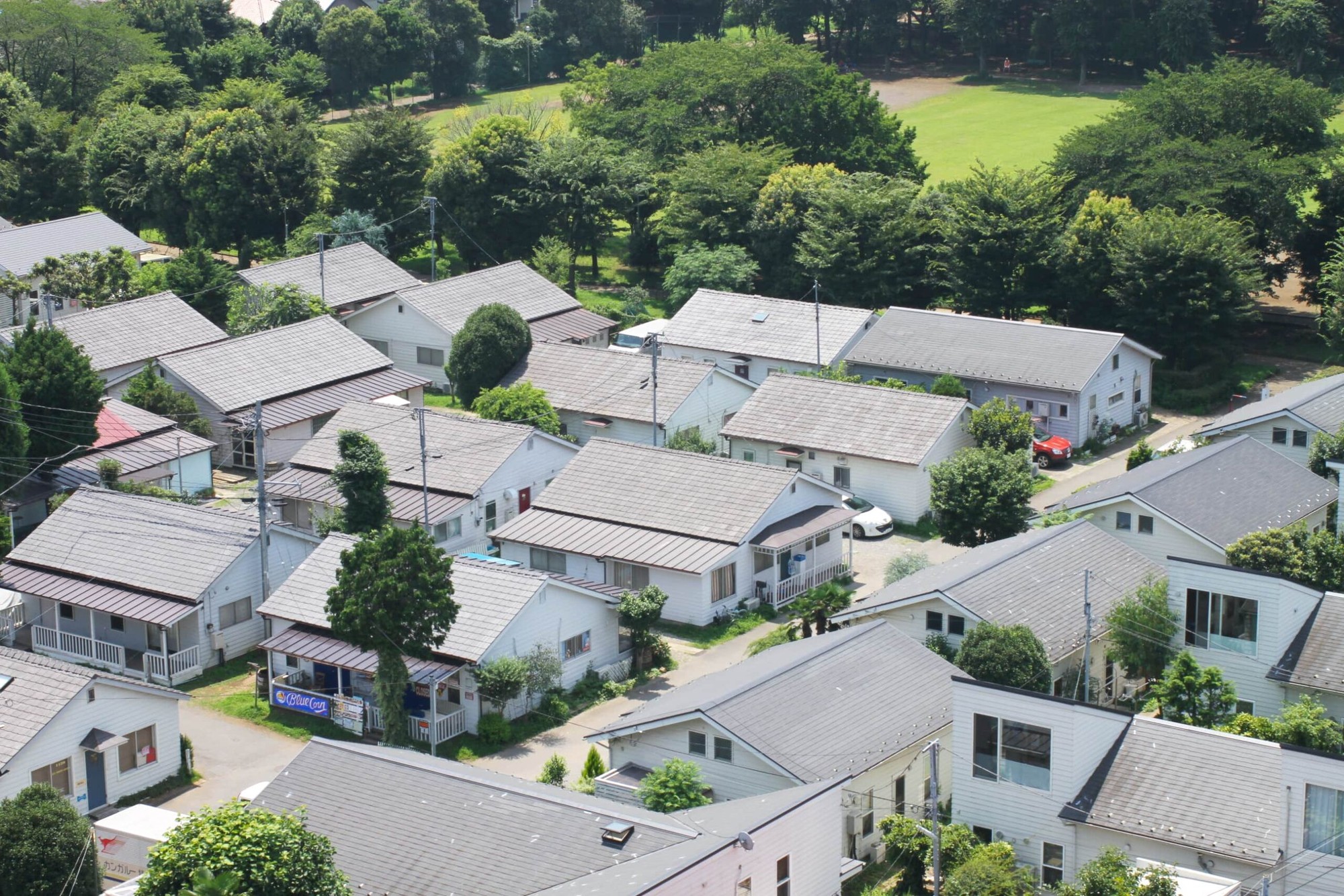
That doesn’t look bad.
It looks like America, so ehhhh
It’s old American military officer housing, rented out as low income housing for several decades, then after it accidentally lasted long enough to appeal to locals, it was refurbed into a kitschy/artsy commercial area to indulge in Americana through a Japanese lens.
Not a single mcmansion in sight! Not even enough yard to have a ride on mower??? Horrors!
Why is there a sign saying “blue corn” in English there? And why is it called “Johnson Town”?
https://www.japan-experience.com/all-about-japan/saitama/attractions-excursions/johnson-town
It was an old US airbase town
Looks like an American suburb but without yard space.
So like a normal suburb from before 1920…
We do, but most of them have something within cycling distance that isn’t on an 70+ kph road with maniacs (and the closer to civilization, they have public transit).
What’s something that most people would be surprised to learn about Japan?
That’s actually rather difficult to give one answer to, even if narrowed to one country/culture as the target audience.
For North America: central heat/air is not a thing here outside of commercial applications. A handful of private individuals do it, but it ends up costing a ton both directly (the unit/maintenance) and indirectly (more materials, ductwork, insulation, etc. that are less common and more expensive here). We just had building laws revised this year to require slightly higher building codes for energy efficiency and insulation, but it’s still well below the standard of other places. It’s somewhat a cost issue (Japanese houses depreciate to nothing after 20 years in most cases and land value only goes up in a handful of areas, so there’s additional pressure not to care a ton), and also a reaction to “sick home syndrome” that came from bad plastics/materials offgassing things like formaldehyde in the '80s in more tightly-closed homes. Here, homes that breathe well are still considered better.
It still boggles my mind people in Japan buy new when it comes to housing. I guess if they are all cheaply built that makes sense.
From what I’ve heard, houses in Japan are torn down after twenty years and rebuilt anew. Absolute craziness from the European standpoint, but I’m sure there must be a reason for it like the propensity to earthquakes and tsunamis (particularly with Japan being rather conservative overall).
It’s probably due to the frequent earthquakes
a lot depends on the climate. you couldn’t do that in germany where you have to have thick walls or you’re gonna freeze to death in the winter.
It’s mostly crappy areas. Outside the urban centers, they refuse to invest in infrastructure. So everyone flees to the city center, which produces slums, and then everything except the high income areas kinda suck.
We have a lot of good infrastructure in my village and I’m pretty rural (depending upon how big ‘urban center’ is in your definition, I’m between 20 and 45 minutes away by train).
A lot of the countryside that is depopulating is quite ugly, but there is no money to invest in that infrastructure when almost the whole population is pensioners. It’s a chicken-and-egg problem to be sure. I think the government needs to do more to get people out of the megalopolises. My area has campaigns that use our tax money to pay people to move here as well as subsidizing preschool and kindergarten.
there is no money to invest in that infrastructure when almost the whole population is pensioners
The national government has plenty of money. And investing in these communities would generate permanent employment, such that more young people would live there.
But the politics of the county resists this kind of investment, because it isn’t immediately profitable.
I think the government needs to do more to get people out of the megalopolises.
i don’t see how that would reduce costs
Re-populating smaller towns would give them more tax income to put money back into infrastructure and other programs. Having people move out of the megalopolises helps reduce demand on things like childcare and lower housing costs as demand cools.
that’s just a really bad take i think. tax laws have to adapt to the people, not the other way around. it’s just a very bad idea to move around people to get more favorable taxation, because tax laws can be changed much faster than people can move around.
on top of that, “demand cools” for housing … is questionable. you know, if we wanted to, we could just build more housing. and i only partially get your childcare take … are you saying that elderly people (who often need care themselves) should take care of the children? i’m not sure about that.
are you saying that elderly people (who often need care themselves) should take care of the children
I have no idea where you’re getting this. I guess because a lot of the population currently in the countryside is elderly? If the people and the jobs move there, that won’t be an issue. The people at the daycare/preschool in my village are middle-aged. EDIT: and more to the point, I meant increased availability in the megalopolises not where I am now.
it’s just a very bad idea to move around people to get more favorable taxation
That’s not the point I’m trying to make. There are people who move to the super-populated areas because they feel it’s their only chance of advancement and job security. I’ve met plenty that would rather be back where they came from or with more space. Without the job security there, without good futures, people are only coming back to visit family and not living even when they want to. If the people feel supported and secure in their opportunities and the opportunities for their children, they will come back which also brings tax revenue and improvements.
tax laws can be changed much faster
I don’t think it makes sense for the central government to directly start shifting large amounts of tax money that no one is going to use. Sure, they could start improving infrastructure and stuff in many rural areas, but if 50 people live there and that number is declining, it’s a waste of money. It only makes sense to help do anything other than basic upkeep if people are coming or it could concretely be shown to increase the chance of people coming. Again, with jobs and future outlook, that’s not happening.
we could just build more housing
This only goes so far. Look at how built out Tokyo is (including into Chiba, Yokohama, Kawasaki, Saitama, etc. I already know people who commute 1.5 hours or more to work. The more affordable housing is further away, and often of very poor quality with paper-thin walls, causing people to lose 3-4 hours of their day in commute. That’s insane. It’s also not like public transit can be increased quickly enough to do anything about this either.
You might argue that the answer is more highrises. The problem is that those tend to go for more and price people, dis-proportionally the elderly and those on fixed income. They also take a long time to build and create new logistics issue with garbage management and other things. Not unsolvable, but I still feel like it’s trying to force many people to live where they ultimately don’t want to.
to live where they ultimately (don’t) want to.
yeah i think that this is the most important issue. we cannot just assume where people want to live. we have to ask them. there needs to be proper data about how many people want to live in which region. then, based on that, construction and infrastructure development should happen, in the countryside / city.
Shit, pay me and I’ll emigrate to Japan in a heartbeat.
Honestly, that’s a pretty nice single wide.
5x the space of the average Japanese household and 1/10th the price
average Japanese household
Only average because of the heavy population density in the top 5 cities. Most places (by area) in Japan are cheap and spacious. You can have a 2 bed for less than a grand in mid-sized towns.
Aren’t those houses usually old and made of very cheap stuff like thin wood and sum? Idk if i’d like to live in a house that isn’t made of bricks…
I don’t know japan very well so i may be wrong tho
i think that the people wouldn’t build it like that if it didn’t work out for them. the climate is different, so you don’t need 1m thick walls for thermal isolation.
It may work in their climate thermal-wise but i don’t want to damage the fucking wall because i accidentally hit it
better spend much time outdoors then ;-)
deleted by creator
Removed by mod
I guess I mistaken. I can’t find the source although I think I have may have confused it with an article from Australia of a homeless shelter inspired from Japanese pods.
idk man. There are antiloitering noisemakers that shrill installed in the urban places.
Is that Barb’s trailer?
You’re a fictional character, you don’t get to complain.
ENNNOOUUGHHHHH!! WITH THE FFFFUCKIN’ JŪSEI!!!
“We’re sorrey, Donnie!”
Mind explaining? I don’t speak weeb
It’s been… how long?! Oh no.
Oh, I took you out of Tokyo to live in the strangest bathroom in Bucharest
Ha I know of a couple where this fits. Asian guy is living in Canada brings over his asian wife from mainland.
Their life consists of take out food and watching crap videos on a phone, with garbage piling up in a single bedroom suite.
I think those were probably her exact words.
Can you explain?